
Four governments, one economy. Comparing macroeconomic performance
Growth, inflation, debt, employment and external performance: Médias24 compares the macroeconomic records of the last four governments through a structured analysis of Morocco’s main economic balances and their evolution over time.

Aziz Akhannouch presented a detailed assessment of his government before both chambers of Parliament on April 15. The head of government outlined a number of macroeconomic indicators.
There are several ways to assess a government’s record. One is to compare its achievements with its pledges. Another is to measure the performance of each term in office. Médias24 is launching today a series of articles on the government’s record, covering all sectors and key indicators. Where relevant, we will point out whether a given promise has been fulfilled.
Médias24 offers here a comparative reading of the records of the last four governments. Our analysis covers the 2008-2025 period.
It should be noted that 2026 data (projections) are not taken into account in a large part of our analysis.
For the purpose of this comparison, each calendar year is assigned to the government in office at that date:
- Abbas El Fassi, heading an executive led by the Istiqlal Party: from 2008 to 2011;
- Abdelilah Benkirane, the first head of government from the PJD: from 2012 to 2016;
- Saad Eddine El Othmani, PJD: from 2017 to 2021;
- Aziz Akhannouch, heading a coalition led by the RNI: from 2022 to 2026.
Economic growth
The El Fassi government recorded the highest average annual growth rate (AAGR) of the entire period under review, at 4.6%. The 2008-2009 subprime crisis certainly slowed global demand, but it affected Morocco only indirectly, without triggering a domestic recession. The growth rates of 2008, at 6%, and 2011, at 5.1%, clearly illustrate this momentum.
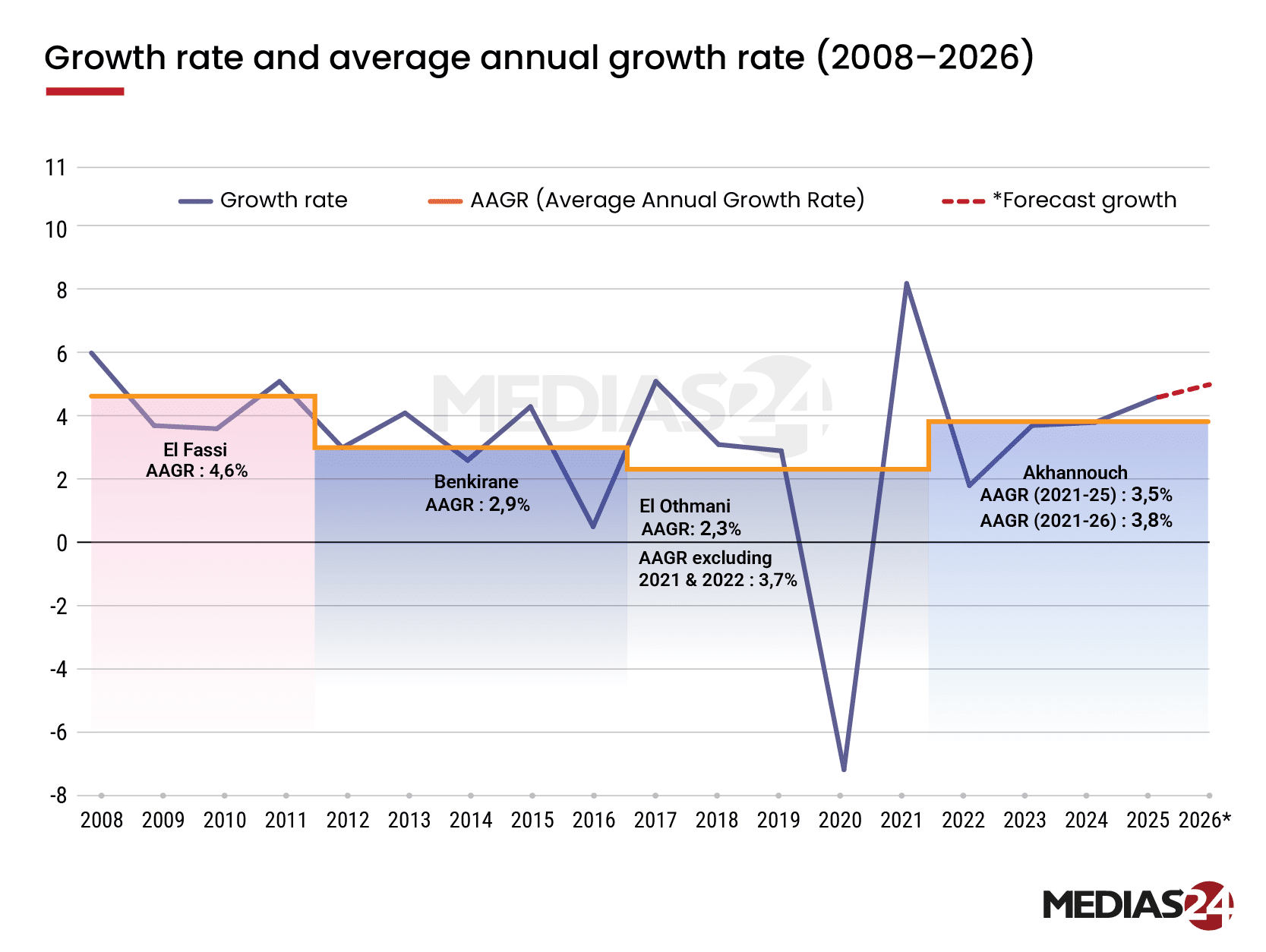
The Benkirane government posted an AAGR of 2.9% over the 2012-2016 period. However, this average masks wide disparities. Years of relatively strong growth, such as 2013 with 4.1% and 2015 with 4.3%, alternated with more difficult years, notably 2016, which marked the low point of the term with growth of just 0.5%.
This downturn was largely the result of a severe agricultural drought. Agriculture accounts for a share of national value added that fluctuates between 9% and 10% depending on rainfall conditions, and these fluctuations have a direct impact on the overall growth rate.
The PJD2 government (El Othmani) recorded the lowest AAGR, at 2.3% over the 2017-2021 period. This result is largely linked to the exceptional shock of 2020 caused by the health crisis. The rebound seen in 2021 mainly reflected a catch-up effect after the sharp contraction of the previous year, rather than a fully restored underlying growth dynamic.
Excluding 2020 and 2021 and considering only the first three years of the term, the AAGR stands at 3.7%.
The Akhannouch government recorded an AAGR of 3.5% over the 2022-2025 period, marking a clear improvement compared with the El Othmani term and the best performance recorded since the Istiqlal-led government.
More specifically, after real growth of 1.8% in 2022, economic activity accelerated significantly, reaching 3.7% in 2023, then 3.8% in 2024, before coming in at 4.6% in 2025. This figure represents the highest growth rate recorded, excluding the post-Covid rebound, since 2017.
Furthermore, if the 2026 growth projection of 5% is included, the Akhannouch government’s AAGR would rise to 3.8%.
That said, this acceleration needs to be viewed in context. While the government has played a role in this momentum, the growth recorded in 2024 and 2025, as well as that expected in 2026, is also partly linked to domestic conditions, particularly to the public investment effort.
The GDP breakdown shows that growth in 2024 and 2025 was largely driven by gross fixed capital formation, itself supported in large part by public investment. The latter posted double-digit growth rates in both years.
Inflation: two years of disruption, followed by a return to calm
Morocco has historically experienced moderate inflation, most often below 2%. Under the Abbas El Fassi government, average annual inflation reached 3.9% in 2008, a high level by Moroccan standards, in a context marked by the global surge in commodity prices and the international financial crisis. It then fell back to much more contained levels, around 1% or less for the remainder of the term.
The two PJD terms followed this same pattern of low inflation. Inflation remained below 2% throughout the period, with limited peaks of 1.6% in 2015 and 2016, then 1.9% in 2018.
The Akhannouch term, however, marked a clear break. Average inflation reached 6.6% in 2022 and then 6.1% in 2023, levels unseen for many years. This inflationary spike then eased rapidly.
Average inflation fell back to 1% in 2024 and then to 0.8% in 2025, with even occasional episodes of year-on-year deflation at the end of 2025 and the beginning of 2026.
Bank Al-Maghrib projects average inflation of 0.8% in 2026. However, given the global environment, the trajectory of inflation in Morocco remains difficult to predict. The war in the Middle East has led to a sharp rise in energy prices, with major implications for an importing country such as Morocco.
It should nevertheless be stressed that inflation cannot be directly attributed solely to government choices. In Morocco’s case, it depends largely on external factors. This sensitivity is reinforced by the country’s heavy reliance on imported energy.
The labor market: a structural fragility
Unemployment is both the most political indicator and one of the hardest to attribute to a single government. It reflects not only growth dynamics, but also inherited sectoral structures, recurrent climate shocks, and demographic transitions whose effects extend far beyond the horizon of a single term.
Under the Abbas El Fassi government, the national unemployment rate remained broadly around 9%. It even declined slightly, from 9.6% to 8.9%.
Under the Benkirane government, which inherited this low rate, unemployment fluctuated but also remained close to 9%, before an upward trend began to emerge at the end of the term and continued thereafter.
Under the El Othmani government, the unemployment rate crossed into double digits in 2019, before jumping to 12.3% in 2021 under the impact of the Covid-19 pandemic.
It was, however, under the Akhannouch government that unemployment reached its highest levels since the early 2000s. The rate stood at 13% in 2023, then 13.3% in 2024, before edging back to 13% in 2025. It should be stressed that the loss of hundreds of thousands of jobs in rural areas significantly worsened unemployment.
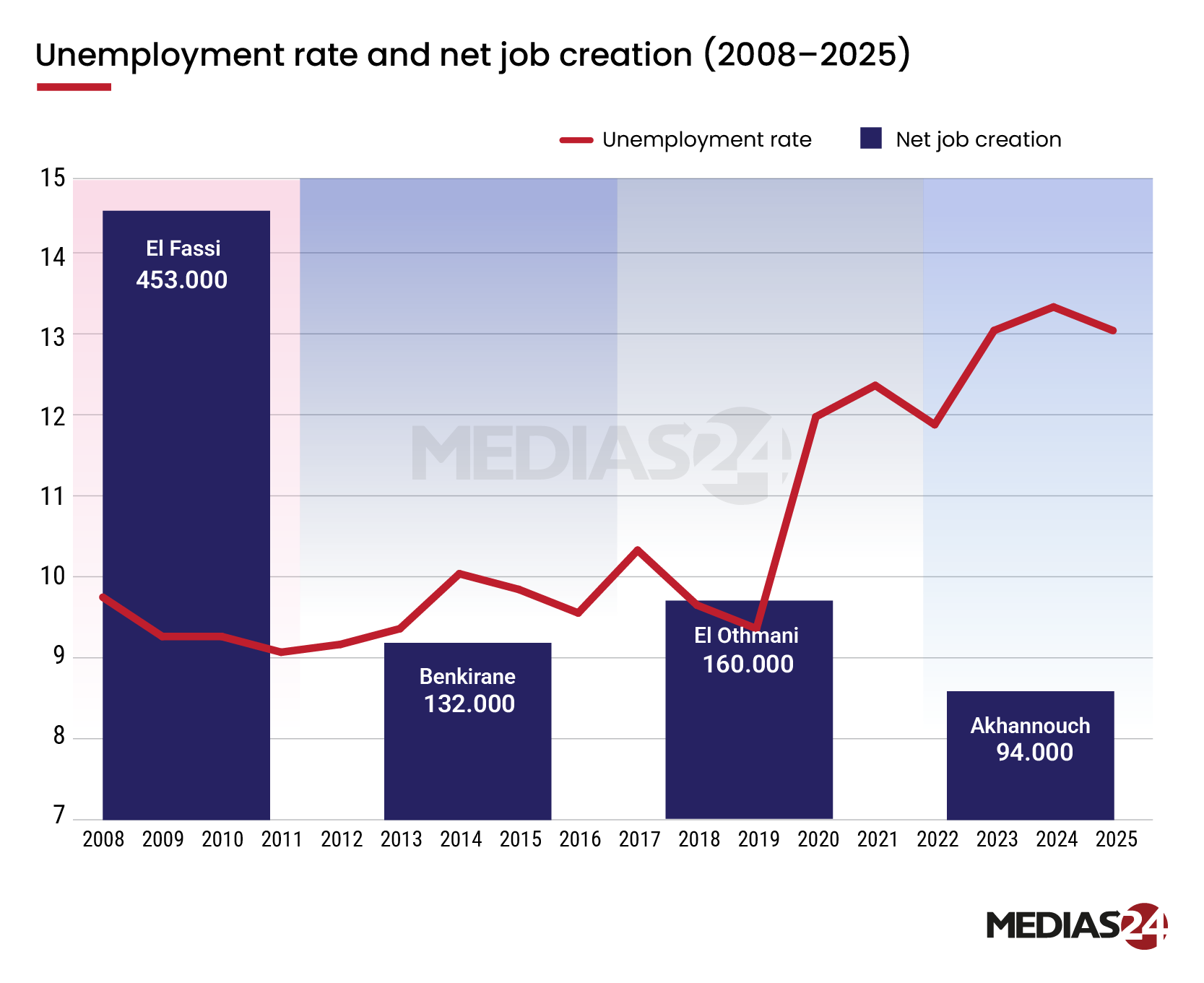
Another way of looking at the issue is through net job creation. On this measure, the Abbas El Fassi government recorded a net gain of 453,000 jobs, compared with 132,000 under Benkirane, 160,000 under El Othmani, and 94,000 under Akhannouch, though only over four years.
It should indeed be specified that the 94,000 net jobs attributed to the Akhannouch government cover only the 2022-2025 period. The assessment therefore remains partial as long as the 2026 figure is not known. It may nevertheless be noted that if the exceptional rainfall recorded this year translates into a rebound in agricultural activity, employment could benefit, as past Moroccan data has often shown.
It should also be emphasized that employment policies do indeed fall within the remit of governments, but a significant share of job destruction in Morocco comes from agriculture, a sector particularly exposed to climatic hazards and therefore difficult to control directly through public policy.
Likewise, employment does not depend solely on short-term measures. It also depends on the level of education, the match between skills and business needs, the structural transformation of the economy, the upgrading of the productive base, and the capacity to create activities that are more intensive in skilled labor. These are long-term developments. They cannot be fully corrected or built within five years.
Treasury deficit and debt
Under El Fassi, the deficit widened gradually, reaching 5.4% of GDP in 2011, under the combined effect of a soaring subsidy bill for basic goods, notably fuel, flour, and sugar, as global prices surged. Debt therefore rose from 41.2% of GDP in 2008 to 48.2% in 2011.
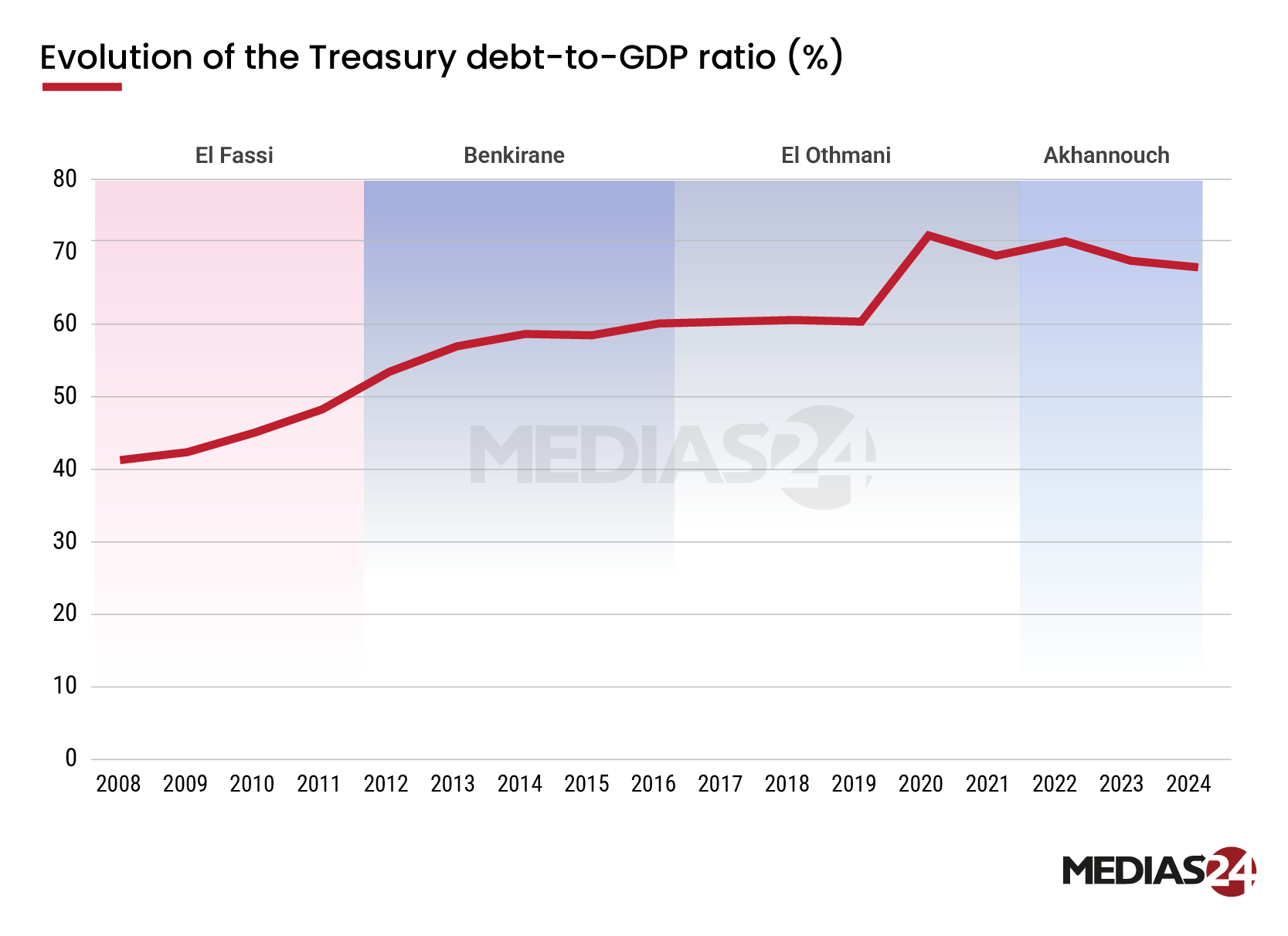
The Benkirane government thus inherited weakened public finances and embarked on a consolidation phase. This mainly involved reforming the Compensation Fund, with the gradual removal of fuel subsidies between 2013 and 2015. The deficit therefore narrowed from 6.2% of GDP in 2012 to 3.8% in 2015, before edging up slightly again in 2016. Debt, however, continued to rise and reached around 60% of GDP by the end of the term.
Under El Othmani, the deficit initially remained relatively contained, at around 3.2% to 3.5% of GDP between 2017 and 2019. The pandemic abruptly broke this trajectory. In 2020, the deficit jumped to 7.1% of GDP, the highest level of the entire period under review, while debt reached 72.2% of GDP. In 2021, despite an improvement in the deficit, the debt level remained high.
Under Akhannouch, the deficit still stood at 5.4% of GDP in 2022. The trajectory then improved markedly, with the deficit reduced to 3.5% of GDP in 2025. Debt also declined gradually, from 71.4% of GDP in 2022 to 67.8% in 2024, marking the first decline in around twenty years.
It should be noted that the 2025 debt figures have not yet been published by the Ministry of Finance, which has so far released only first-half data, insufficient for a comprehensive analysis.
External performance and attractiveness
On the external front, the government-by-government reading is generally favorable to the current administration. The annual average exports-to-GDP ratio rises from 17.7% under Abbas El Fassi to 20% under Benkirane, then to 23.3% under El Othmani, before reaching 29.3% under Akhannouch.
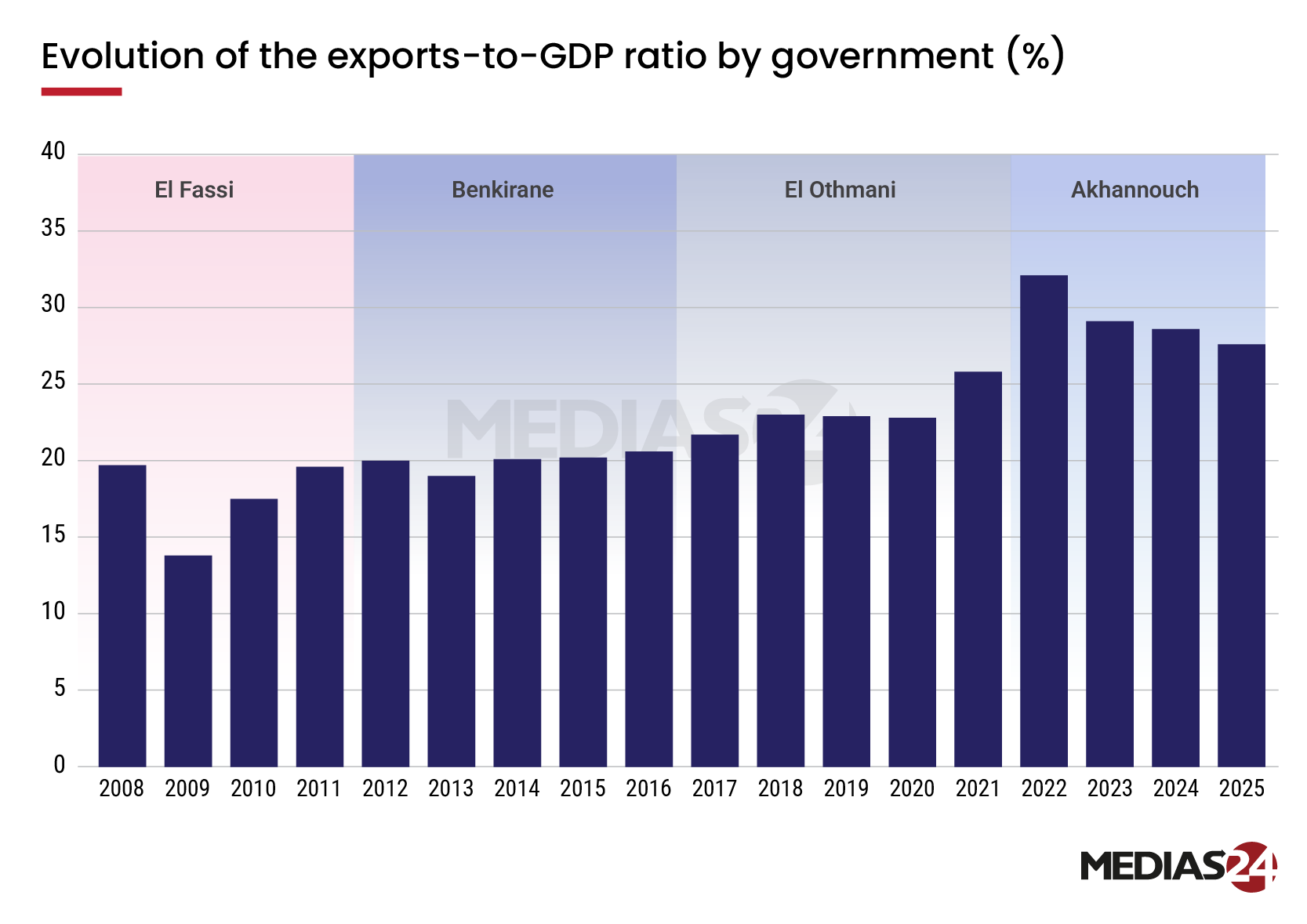
The peak was reached in 2022, with a ratio of 32.1% of GDP, and it then remained at a historically high level between 2023 and 2025. The trend is therefore clearly upward from one term to the next, even if the high point of the series corresponds to the first year of the current term.
This rise reflects the gradual strengthening of Morocco’s export base. It cannot be attributed to a single government team, as it is part of a long-term process involving the country’s industrial transformation and the gradual consolidation of several export sectors.
The Akhannouch term therefore appears less as the starting point of this momentum than as the moment when its effects became particularly visible in the aggregate figures.
Travel receipts follow a more contrasted trajectory. They account on average for 6.7% of GDP under Abbas El Fassi, 6% under Benkirane, and 4.9% under El Othmani.
This decline during the third term is largely explained by the pandemic shock, with a low point of 2.7% of GDP in 2021. In fact, if 2020 and 2021 were excluded, the average under El Othmani would stand at 6.3% of GDP.
Under Akhannouch, by contrast, the rebound is clear. Travel receipts averaged 7.4% of GDP over 2022-2025 and peaked at 8.1% of GDP in 2025, making it the highest level of the entire 2008-2025 period. Arrivals also far exceeded forecasts and continued to set new records.
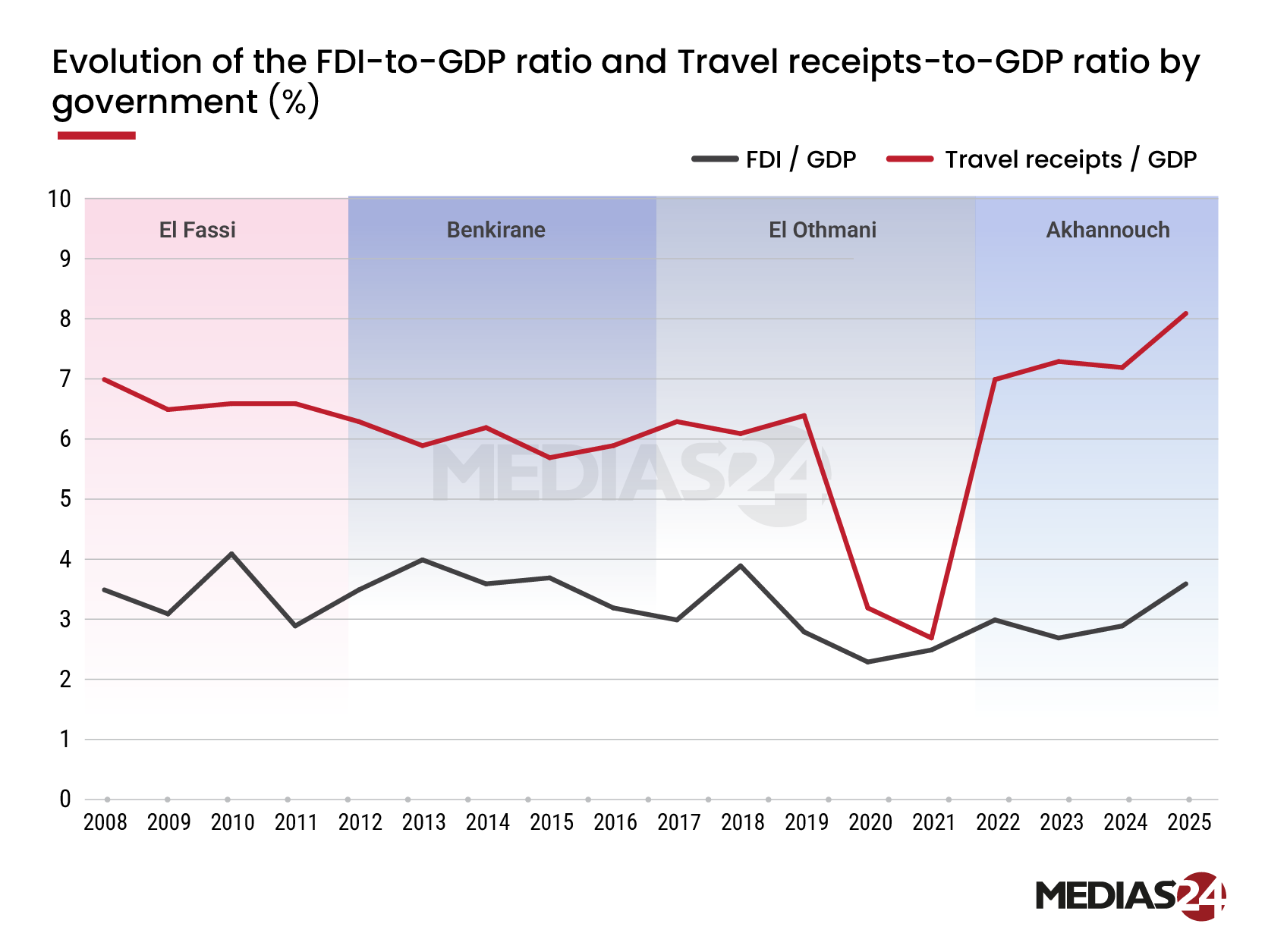
FDI shows a more stable trend. Its ratio to GDP stands at 3.4% under Abbas El Fassi, 3.6% under Benkirane, 2.9% under El Othmani, and 3% under Akhannouch.
FDI is largely subject to international conditions. For the El Othmani period, excluding 2020 and 2021, the average would stand at 3.2% of GDP. Likewise, under the Akhannouch government, the monetary tightening initiated by the Fed and the ECB in 2023 widened the gap with Morocco’s key policy rate. As a result, FDI fell by more than 50% compared with 2022.
-oOo-
Key takeaways:
- The strongest growth performance was recorded under the El Fassi government, while the Akhannouch government has posted a clear rebound in activity in the recent period.
- Inflation remained broadly low under the El Fassi, Benkirane, and El Othmani governments. The real break came under Akhannouch, with the 2022 and 2023 shock, before a rapid easing.
- The labor market remains the weak link of the current government. Unemployment has risen over a long period and reached its highest levels under the current administration.
- As for public finances, balances tend to deteriorate mainly during periods of shock, before improving again. Debt has started to decline under the current government, but it remains high.
- Exports, FDI, and tourism are now at their strongest levels of the period under review. In tourism, these are record highs.
À découvrir




à lire aussi

Article : Coupe du monde 2026. Qualification héroïque du Maroc face aux Pays-Bas (1-1, 3 t.a.b. à 2)
Menés à un quart d’heure du terme, les Lions de l’Atlas ont trouvé les ressources mentales nécessaires pour égaliser grâce à Issa Diop, puis éliminer les Oranjes lors de la séance des tirs au but, dans la nuit du lundi 29 au mardi 30 juin, à Monterrey, au Mexique. Yassine Bounou et Ismaïl Saibari ont propulsé le Maroc en huitièmes de finale face au Canada, samedi 4 juillet à Houston.
Article : Coupe du monde 2026. Centième sélection pour Achraf Hakimi face aux Pays-Bas
Le capitaine des Lions de l’Atlas portera le maillot du Maroc pour la 100e fois de sa carrière, dans la nuit du lundi 29 au mardi 30 juin, face aux Pays-Bas, en seizième de finale de la Coupe du monde 2026. Titularisé par Mohamed Ouahbi, Hakimi n’est plus qu’à 15 sélections d’égaler le record de Noureddine Naybet.

Article : GMT, interdiction du démarchage, IA : la triple peine de l’offshoring marocain
Longtemps porté par les donneurs d’ordre européens et les centres d’appels, le secteur de l’offshoring au Maroc doit désormais composer avec des horaires à réorganiser, des appels commerciaux de plus en plus encadrés en France et des tâches que les logiciels commencent déjà à automatiser. Les grands opérateurs invoquent l’adaptation et la montée en gamme, tandis que les syndicats redoutent moins d’embauches et davantage de postes supprimés.
Article : Maroc-Pays-Bas : les cafés pourront rester ouverts pour diffuser le match
Selon Ahmed Bifergane, coordinateur de la Fédération nationale des propriétaires de cafés et restaurants, aucune interdiction n’a été émise par les autorités pour la nuit du lundi 29 au mardi 30 juin.

Article : Défense : les F-16 marocains concernés par un nouveau contrat américain sur les missiles AMRAAM
Attribuée à Raytheon pour 398,6 millions de dollars, l’enveloppe porte sur des travaux liés au système D4/C9, avec une échéance fixée à décembre 2027. Le Maroc figure parmi les pays partenaires du dispositif FMS, aux côtés notamment des Émirats arabes unis, de l’Arabie saoudite, du Japon, d’Israël et du Royaume-Uni.

Article : My Education lance “MY WAY”, un programme dédié aux compétences du XXIe siècle
Destiné aux jeunes de 9 à 16 ans, le dispositif combine des activités régulières, des bootcamps, des stages immersifs et des interventions en milieu scolaire.