

China Won 2020
BERLIN – In future history books, 2020 will be known as the year of the great COVID-19 pandemic, and rightly so. But it will also be remembered as the year when US President Donald Trump’s vile tenure was brought to an end. Both episodes are closely connected and will leave lasting traces, partly because they unfolded during a broader global transition from the US-dominated twentieth century to a Chinese-dominated twenty-first century.
Against this backdrop, 2020 proved to be a highly successful year for China. To be sure, things didn’t look that way at its start, when a novel coronavirus, SARS-CoV-2, was rampaging through the metropolis of Wuhan. Serious failures by Chinese authorities permitted that outbreak to grow into a pandemic that has now killed almost 1.5 million people and brought the global economy to a standstill. Earlier in the year, it looked as though China’s central leadership was facing a deep crisis of confidence. Coming on the back of a trade war with the United States, COVID-19 momentarily brought the country to its knees.
Since then, Chinese President Xi Jinping’s forceful suppression of the democracy movement in Hong Kong has further increased Western distrust. The administrative clampdown under a draconian new national-security law ends the era of “one country, two systems,” and raises grave questions about the future of Taiwan.
In any case, China’s position looks much improved at the end of 2020. Its failures at the beginning of the pandemic seem to have been largely forgotten, particularly within China. There is no longer any trace of a loss of public confidence in the central leadership. Employing radical measures, China’s authoritarian one-party state quickly contained COVID-19 and put the economy back on track, enabling a near-complete return to normal life.
In the trade war with the US, China has given little ground (mainly a promise to buy $200 billion in US goods). The crackdown in Hong Kong seems to be working precisely as Xi had hoped it would. And in November, China mounted something of a geopolitical coup with the signing of the Regional Comprehensive Economic Partnership, a new trade agreement that will put it at the center of the world’s largest free-trade area. The RCEP will connect China’s huge market to those of the Association of Southeast Asian Nations – from Indonesia and Singapore to Vietnam – and will include important US allies such as Japan, South Korea, Australia, and New Zealand. For the time being, India is not participating, but it might join later. The only regional player to be left out of the RCEP is America.
The creation of a new, China-centered economic bloc illustrates the difference between reality and reality TV. When Trump arrived in the White House in January 2017, one of his first official acts was to withdraw the US from the Trans-Pacific Partnership, an agreement negotiated by President Barack Obama that would have created something like the RCEP, only with America at the center and China left out. Witnessing this US act of self-harm, China’s leaders presumably couldn’t believe their luck, and Xi’s government has been working hard to exploit Trump’s generous gift ever since.
These efforts are now bearing fruit. With a new free-trade zone will come new geopolitical realities. A web of dependencies will arise around China, strengthening its position across the Indo-Pacific region.
While China emerges stronger from this year of crisis, America has come out weaker. Because of Trump, COVID-19 is running riot in the US, and the country remains focused on itself, seeming to others to be floundering in division, chaos, and weakness. This perception has far-reaching geopolitical consequences. Following a contentious election that Trump has tried to discredit, many around the world are wondering if President-elect Joe Biden’s incoming administration will be in any position to lead the US out of its downward spiral. The current post-election phase does not inspire confidence that the two warring political camps will find common ground.
In these turbulent times of pandemic and escalating economic and geopolitical rivalries, America needs its friends more than ever, and America’s friends need it. Without a restoration of US global leadership under Biden, China will be well on its way to becoming the dominant force in the world, and that is not a comforting prospect for US partners and allies in Europe, the Indo-Pacific, and elsewhere.
The world got a glimpse of what Chinese hegemony might look like this month when Xi’s regime issued a 14-point diktat to Australia demanding that it “correct mistakes” it has made in the bilateral relationship. Following Australia’s call for an international investigation of the origins of SARS-CoV-2, its exclusion of two Chinese companies (ZTE and Huawei) from its 5G network, and negative reporting about China in the Australian media, China has unashamedly singled out Australia with new trade barriers.
Europeans, in particular, should take note of this behavior. America’s allies will soon be rid of Trump and his nationalistic foreign policy. But if “America First” is simply replaced with “China First,” little will have been gained. Europeans and others will still be looking down the barrel of endless tributes and kowtowing. Europeans must wake up. This is the last chance to shore up the “benevolent” hegemon and the promise of liberty in the twenty-first century.
à lire aussi
Article : Le Nouvel an de l'hégire (1er Moharram) sera célébré ce mercredi 17 juin au Maroc
Le 1er Moharram de la nouvelle année de l’Hégire 1448 correspondra au mercredi 17 juin 2026, a annoncé le ministère des Habous et des affaires islamiques.

Article : Adouls : la Cour constitutionnelle valide l’essentiel de la réforme, mais écarte plusieurs dispositions
Saisie par 93 députés avant la promulgation du texte, la Cour a déclaré non conformes des articles touchant aux incompatibilités professionnelles, aux personnes en situation de handicap, au témoignage collectif dit “lafif” et à l’organisation des instances représentatives. Le texte devra donc être corrigé sur ces points, sans remettre en cause le cœur de la nouvelle loi 16.22.

Article : En commission, les conseillers votent la nationalisation de la Samir et le plafonnement des hydrocarbures
Deux propositions de loi portant sur les hydrocarbures et la Samir ont été récemment adoptées en commission à la Chambre des conseillers. Un vote "surprise" rendu possible par un rapport de forces numérique défavorable à la majorité, lors d’une séance où l’opposition était majoritaire en nombre. Si ces textes ont franchi l’étape de la commission, leurs promoteurs sont conscients qu’ils ont peu de chances d’être adoptés en plénière.

Article : Retail : la guerre silencieuse pour conquérir le panier des Marocains
Pendant longtemps, les courses du quotidien se sont surtout jouées entre l’épicier du quartier, le grossiste et quelques grandes surfaces. Ce modèle commence à se fissurer. Entre fusion capitalistique, rachats d’enseignes, master-franchises, centrales d’achat, logistique commune et formats de proximité, les grands opérateurs installent peu à peu des réseaux capables d’accompagner le consommateur du café du matin aux achats du week-end. Non sans bousculer les équilibres.

Article : Crédit du Maroc : ce que cache l’augmentation de capital à 699 MDH
Depuis son passage sous le contrôle de Holmarcom, Crédit du Maroc a changé de rythme. La banque affiche des bénéfices en hausse, prépare son plan CDM Boost 2028, et propose désormais à ses actionnaires de suivre le mouvement via une opération ouverte du 26 juin au 16 juillet. Derrière le prix fixé à 938 DH par action, le marché devra surtout juger si cette nouvelle étape confirme une trajectoire ou ouvre un pari plus large. Décryptage.
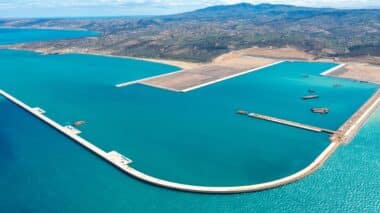
Article : Nador West Med : derrière le port, le pari industriel de l’Oriental
ROUND UP. Prévu pour entrer en service fin 2026, Nador West Med se construit déjà au-delà de ses quais : routes dédoublées, future autoroute vers Guercif, projets chinois dans l’éolien, les pneus et les alliages, ambition énergétique autour du GNL et de l’hydrogène vert. L’enjeu est désormais de transformer cette infrastructure en véritable moteur économique régional.