

Two Systems, One World
BERLIN – With the 30th anniversary of the fall of the Berlin Wall approaching, the issue of freedom has returned to the fore in Moscow and Hong Kong, albeit under very different historical and political circumstances. We are reminded that the modern era was built on freedom, and on the recognition that all people are born equal. This radical Enlightenment idea, when it took hold, constituted a break from all previous history. But times have changed. In the twenty-first century, we are confronted with a fundamental question: Could a modernized form of authoritarianism represent an alternative to liberal democracy and the rule of law?
In 1989, the obvious answer to that question would have been no, not just in the West but around the world. Since then, however, we have witnessed the revival of nationalism in Europe, the failure of the Arab Spring, the election of US President Donald Trump, Russia’s relapse into revanchism, and the emergence of a global China. Now, all bets on liberal democracy are off.
China’s emergence as a second military, economic, and technological superpower suggests that there is now an alternative development model. In modern China, the rule of law and democracy are regarded as a threat to one-party rule. Hence, the ongoing protests for freedom and democratic accountability in Hong Kong expose a division not just between two normative frameworks, but between two systems of political power.
For a while, China appeared to have found a formula for bridging this divide. The principle of “one country, two systems” was supposed to allow for the orderly reintegration of Hong Kong and (more aspirationally) Taiwan. Should this formula now fail in Hong Kong, there will be an immediate escalation of military tensions across the Taiwan Strait, because the island’s continued special status will become impossible for the Chinese government to accept or ignore.
Still, the formula has indeed worked so far. Hong Kong has become extraordinarily important to the Chinese economy, because it provides access to global capital markets and serves as a financial gateway for inward foreign direct investment. And the relationship with Taiwan has, for the most part, remained relatively quiet.
The arrangement with Hong Kong worked because the government in Beijing showed ample consideration for the city’s semiautonomous status. But as China has grown stronger, its perception of itself as a new global superpower has produced a change in behavior. The Chinese authorities are exerting ever more influence in Hong Kong, suggesting that they want to move in the direction of “one country, one system.”
The proposed law (since suspended) to enable the extradition of people arrested in Hong Kong to mainland China was widely seen as a threat to democracy and the rule of law in the former British colony. The authorities in Beijing know perfectly well that this attempt to weaken Hong Kong’s autonomy – not covert operations by foreign intelligence services – is why millions of people have taken to the city’s streets.
Given the current power structures in China (and Russia), the mass protests this summer in Hong Kong (and Moscow) have little to no chance of success in the short term. Yet they are significant nonetheless, because they provide a foil for the democratic malaise that has spread throughout the West.
More broadly, the division of the world into two systems immediately brings back memories of the Cold War. But in that conflict, the main issue was military strength – hence the centrality of the nuclear-arms race. When it came to living standards, the Soviet Bloc never really had a chance (as was obvious in the so-called Kitchen Debate between then-US Vice President Richard Nixon and the Soviet leader, Nikita Khrushchev, in 1959).
The competition with China, however, will be precisely about the question of which system delivers more in terms of technological and material progress. China’s ascent from a poverty-stricken developing country to an economic powerhouse is one of the greatest achievements of the modern era. Millions of people have been lifted out of poverty and into a growing consumption-oriented middle class, and millions more could soon follow them.
At the same time, although China has been building up its military, it has not exerted force beyond its immediate neighborhood, unlike the Soviet Union. When China pursues its strategic interests in Africa and Eastern Europe, it does so through economic and financial means. It owes its growing global influence not to its military, but to its economy and its growing capacity for rapid technological innovation. For the West, the “Chinese Challenge,” then, is to show that its model of democracy is still better suited than Eastern-style authoritarianism for the majority of humankind.
In this larger contest, US President Donald Trump is something of a Chinese Trojan Horse. Although he is waging an aggressive trade and technology war against China, he is also doing everything he can to undermine the credibility of the Western model. In historical terms, his attacks on democracy will prove far more consequential than his tariffs. Making matters worse, Europe, with its obvious economic weaknesses and geopolitical naiveté, is also failing to marshal a defense of the Western model.
At this stage, China’s ascent cannot be prevented. The country is simply too large and too strong to be boycotted or contained; at any rate, the Chinese people’s desire to share in global prosperity is entirely legitimate. The West has little choice but to maintain good relations with the new superpower, while at the same time defending its values. The rise of China – and of the Chinese system – will inevitably create more competition, and these new rivalries must be handled peacefully at all costs. A world with eight billion people cannot afford a global conflict.
Whether China’s model of authoritarian modernization can succeed in the long term is a question for future generations of Chinese. Those with no memories of past horrors such as the Cultural Revolution may simply regard the Chinese model as a matter of course. But the modern age was built on liberty. As we have seen in this summer in Hong Kong and Moscow, that lesson will not be forgotten anytime soon.
à lire aussi

Article : Censure de la loi 16.22 : ce qu'en pense l'ordre des adouls
Saisie par 93 députés avant la promulgation du texte, la Cour constitutionnelle a écarté plusieurs dispositions portant sur les incompatibilités professionnelles, les actes impliquant des personnes en situation de handicap, le témoignage collectif “lafif” et l’organisation des instances représentatives. Pour Maître Driss Trali, membre du bureau exécutif de l’ordre national, cette décision confirme les alertes formulées depuis des mois par la profession, tout en laissant encore ouverts plusieurs dossiers jugés essentiels, dont le dépôt des fonds, l’officialité pleine de l’acte et l’indépendance réelle de l’instance professionnelle.
Article : Bourse de Casablanca : le MASI termine encore dans le vert
Au lendemain de sa progression de 4,63%, l'une des plus fortes hausses de son histoire récente, le MASI poursuit son redressement le mardi 16 juin. L'indice a gagné 0,15% à 18.782,58 points, porté notamment par les valeurs immobilières et minières, dans un marché qui conserve une partie de l'élan né du regain d'optimisme sur le front géopolitique.
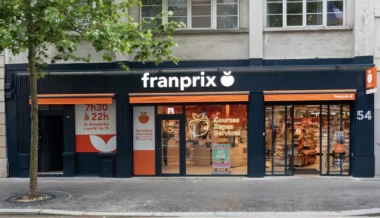
Article : Un premier magasin Franprix en test à Casablanca dès le 3 juillet
Le groupe H&S Invest Holding de Moncef Belkhayat concrétise son accord avec le groupe Casino avec l’ouverture, en test, d’un premier magasin Franprix à Casablanca.
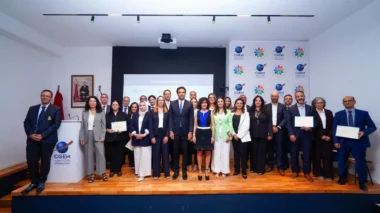
Article : 20 ans de la Charte RSE : la CGEM distingue 21 entreprises et porte à 152 le nombre de sociétés labellisées
Lancé en 2006, le dispositif patronal a récompensé cette année dix nouvelles entreprises, dont Crédit Agricole du Maroc, Pharma 5 et Rabat Région Mobilité. Onze autres ont vu leur distinction renouvelée.
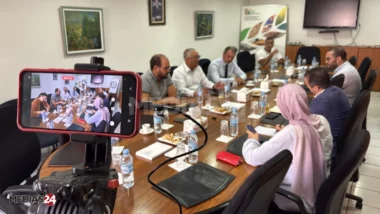
Article : Céréales : les minotiers s’engagent à collecter 15 à 20 millions de quintaux de blé marocain
D’ici au 15 juillet 2026, les minotiers se sont engagés à collecter entre 15 et 20 millions de quintaux de blé tendre issu de la production nationale. Un volume proche du record historique au Maroc et dont dépendra, selon eux, la réouverture des importations. Détails.
Article : Santé : la FM6SS et ABA Life s’allient pour développer des infrastructures médicales intelligentes
Dès octobre 2026, les premières solutions devront être déployées au Maroc, avec des objectifs chiffrés à l’horizon 2030 : 100.000 professionnels formés à l’IA, 25 millions de téléconsultations et plus de 100 start-up HealthTech accompagnées.