
“Green Basin”: A Strategic Project to Transform the Port of Jorf Lasfar into a Hub for Green Batteries and Fuels
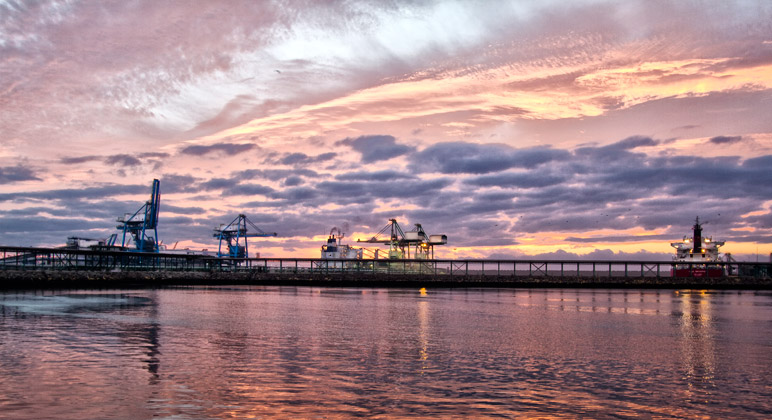
Jorf Lasfar is no longer just a port for phosphates, coal, and heavy industrial bulk cargo. As the National Ports Agency (ANP) prepares its next expansion—adding more than 3,500 meters of new docks—the site is taking on a new dimension. Around phosphoric acid, several projects linked to batteries, electrolytes, graphite, and green-hydrogen derivatives are already taking shape in its hinterland. With the "Green Basin," this growing industrial ecosystem is now finding its maritime outlet. Details.
The Essentials
- The ANP recently issued two calls for tenders to carry out geotechnical studies related to the extension of the port of Jorf Lasfar.
- The extension project, known as “Green Basin,” anticipates the port’s future logistical and energy flows, integrating clean‑energy sectors such as green hydrogen.
- Backed by the world's largest phosphoric acid production platform, a unique industrial ecosystem is taking shape, dedicated to electric-battery components and the green fuels of the future.
-oOo-
The Details
Technical studies for the extension of the port of Jorf Lasfar are now entering an operational phase. The National Ports Agency (ANP) has recently reached a new milestone in the project by launching two separate calls for tenders: the first focuses on geotechnical investigations through drilling, while the second covers parallel geotechnical modeling to guide the technical design choices for the structure.
In the long run, this project, named "Green Basin," will anticipate the logistical and energy flows of tomorrow, integrating clean‑energy sectors—most notably green hydrogen.
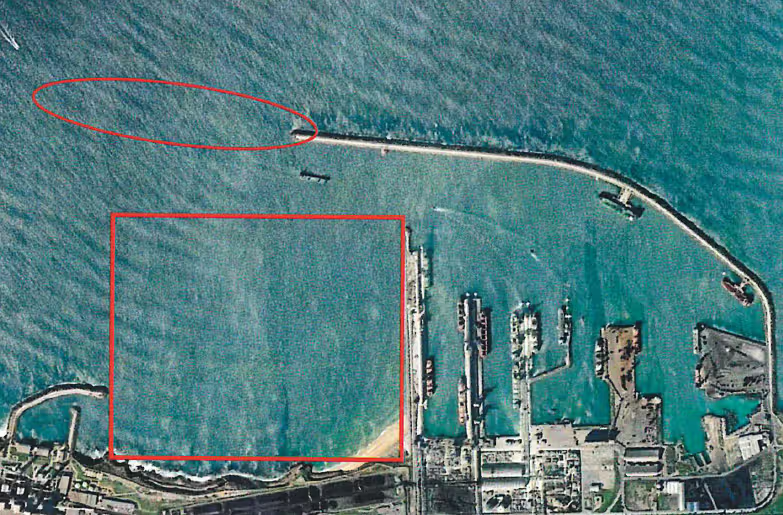
Jorf Lasfar, a mineral port undergoing industrial transformation
Concretely, the extension plans include the construction of over 3,500 linear meters of new docks and more than 1,000 linear meters of breakwaters, as well as the deepening of 1,000 linear meters of existing docks.
Beyond this extension, the historical vocation of Jorf Lasfar—the country’s main mineral port—is set to strengthen with the emergence of an industrial ecosystem in full transformation. In addition to current activities tied to the phosphate industry and energy imports, new high‑value‑added investments have chosen to establish themselves in the hinterland of this strategic port.
Concretely, an ecosystem dedicated to battery materials is taking shape, driven by four structuring projects located around the Jorf Lasfar chemical complex — the world’s largest platform for the production of phosphate fertilizers and derivatives.
These projects are set to be established in two areas: the Jorf Lasfar Industrial Acceleration Zone and Park X, a subsidiary of InnovX, located near the Jorf Lasfar complex. This choice is also driven by the presence of a strategic raw material for the battery sector — phosphoric acid.
Cobco, marking the battery sector’s first industrial milestone
In the battery sector, the first industrial output comes from Cobco, a joint venture between Al Mada and China’s battery‑materials giant CNGR. Dedicated to the production of cathode precursors for electric batteries, the plant began production in June 2025, with an initial capacity of 40,000 tons of NMC (nickel‑manganese‑cobalt) precursors.
The plant began operations in June 2025. Its initial output is being distributed under Cobco's existing contracts, notably with the multinational Umicore, for the American and Asian markets.
Production is expected to ramp up gradually to 120,000 tons of NMC. The site also plans to produce 60,000 tons of LFP cathodes, which require phosphate inputs, and to develop a black‑mass recycling unit to recover material derived from the grinding of end‑of‑life batteries.
Fluoralpha, bridging phosphates and fine chemistry
Fluoralpha, a subsidiary of InnovX, aims to strengthen the phosphate industry by turning fluorinated by‑products from phosphate processing into valuable resources.
Initially, the company will focus on two key products: anhydrous hydrofluoric acid (AHF) for fine chemistry and electronic components, and aluminum fluoride (AlF₃) for aluminum production.
The planned complex will include a 20,000‑ton‑per‑year AHF unit and a 28,000‑ton‑per‑year AlF₃ unit.
In practice, Fluoralpha will initially supply two new investments located nearby: Falcon Energy Materials, which uses hydrofluoric acid to purify graphite, and Tinci Materials, dedicated to the production of battery electrolytes.
On the other hand, Falcon Energy Materials, based in Dubai, is preparing to launch a pilot plant with a daily capacity of 100 kg of purified and coated spherical graphite (CSPG), a material used in lithium‑ion battery anodes.
This pilot plant will qualify, certify, and commercialize the valorized graphite in Morocco. Scheduled between late 2027 and early 2028, Falcon’s large‑scale plant is expected to produce approximately 25,000 tons of purified and coated spherical graphite (CSPG) per year.
Another structuring investment in Morocco’s battery sector, the Chinese group Tinci has chosen Jorf Lasfar for the same reasons as its neighbors. Its activity relies on locally available inputs: phosphorus and fluorine.
From these resources, the company will produce lithium hexafluorophosphate (LiPF₆), a salt used in the composition of nearly all commercial lithium‑ion batteries.
The project targets an initial output of 150,000 tons per year of electrolytic products and their main raw materials. This positioning is significant, as the electrolyte accounts for about 10 to 15 percent of the total cost of battery cell materials.
Jorf Lasfar, future hub for green fuels?
Jorf Lasfar, an international fertilizer production hub, is naturally expected to attract investments related to green hydrogen. The OCP Group is already developing projects there, further strengthening its international competitiveness.
The Jorf Lasfar region has already attracted projects for the production of green hydrogen derivatives. As part of the Moroccan Offer, the consortium formed by the Emirati Taqa and the Spanish Moeve aims to replicate in Jorf Lasfar the mega e‑methanol project they are developing in Huelva, at the heart of the Andalusian Green Hydrogen Valley.
The roles are clearly defined between the two partners. Taqa will develop renewable energy capacity in Dakhla, while Moeve will handle the production and commercialization of e-methanol at the port of Jorf Lasfar. The project has entered its development phase following an initial milestone in February 2026, marked by the signing of a land reservation agreement with the Moroccan government.
The potential of Jorf Lasfar extends beyond methanol. The port has also been identified by the International Civil Aviation Organization's ACT-SAF program as Morocco's most promising site for the development of sustainable synthetic aviation fuel (e-SAF) production capacity. These developments further reinforce the position of the country's leading mineral port.

à lire aussi
Article : Rahhou veut miser sur l'IA pour renforcer la transparence des marchés
Monographies sectorielles actualisées chaque année et nouvelles règles sur les échanges d'informations. Le Conseil de la concurrence entend mettre les mêmes données à la disposition des opérateurs en place et des nouveaux entrants.
Article : Maroc-Banque mondiale : 15 milliards, mais pour quels emplois ?
Prévu jusqu’en 2035, le nouveau partenariat entre le Royaume et l'institution de Bretton Woods doit orienter les interventions de la BIRD, d’IFC et de la MIGA vers la compétitivité des entreprises, les territoires et le capital humain. Mais les financements restent indicatifs et leur impact difficile à isoler.
Article : Drâa-Tafilalet peut-elle réussir son virage minier ?
Riche d’un sous-sol exceptionnel et d’un savoir-faire ancestral, la région de Drâa-Tafilalet, qui assure plus de 40 % de la production minière nationale hors phosphates, se positionne aujourd'hui comme la nouvelle frontière de l'investissement minier au Maroc. Entre la modernisation du modèle artisanal de la CADETAF et l'arrivée de grands opérateurs internationaux, le défi est désormais de structurer une chaîne de valeur durable et de lever les obstacles logistiques pour hisser ce territoire au rang de géant minier national.
Article : Sawti, la plateforme qui veut réconcilier jeunes et MRE avec la politique
Disponible en neuf langues, dont la darija, l’outil permet de vérifier son inscription électorale, de comparer les partis et leurs positions, puis d’accéder à des quiz fondés sur des sources vérifiables.
Article : Feu vert à l'entrée d'Ayrad et de la CIMR dans le capital de CMT
Le Conseil de la concurrence a autorisé la prise de contrôle conjointe du groupe minier, dont 37,04% seront détenus indirectement par Ayrad, aux côtés des 16,12% conservés par la Caisse interprofessionnelle marocaine de retraite. L’opération doit désormais déboucher sur une offre publique d’achat obligatoire.
Article : Taroudant : à Ouneine, les Canadair freinent un incendie de plus de 100 ha
Environ 150 intervenants restent mobilisés face aux fumerolles et aux foyers résiduels, attisés par la chaleur et le vent. Aucune victime n’est à déplorer et les douars voisins ne sont pas menacés.