
Exclusive. OCP resumes full production pace, turning the crisis into an opportunity.
For weeks, the OCP group has been under close scrutiny amid a tense backdrop: the Strait of Hormuz crisis, soaring sulfur prices, billions in debt, and announced production cuts. All signs seemed to point to an unprecedented crisis. Yet the reality is more nuanced. At the end of May, the group made a decision it confirmed exclusively to us: a return to full fertilizer production capacity by the end of June. A move that challenges prevailing interpretations and raises new questions. Revelations.
→ It all started in Ormuz
Sulfur. That's where it all begins. Without sulfur, there is no sulfuric acid. Without sulfuric acid, there are no phosphate fertilizers. And globally, around 50% of sulfur trade passes through the Strait of Hormuz.
When tensions between Iran and the United States escalated in the region, this maritime corridor was effectively cut off from the global market. Not physically closed. But uncertain enough for flows to halt. The result: sulfur went from $500 per ton to $1,400. In a matter of weeks. Tripled.
"From one day to the next, half of the world’s sulfur flows were disrupted," observes Iliass El Fali. "Yet sulfur is a critical raw material, not only for the phosphate industry but also for the value chains of copper, nickel, and many other strategic metals."
Two factors made it worse. China, the world's leading exporter of sulfuric acid, a by-product of its metallurgy, banned its exports until the end of August. And in Russia, Ukrainian strikes damaged some production and transportation facilities. Russia was exporting 3 million tons of sulfur per year. Kazakhstan, whose exports passed through Russian territory, also found itself blocked.
In agricultural markets, conditions also weakened on the other side of the chain. Wheat, corn and soybean prices remained low. The 2025–2026 season was near-record worldwide. In this context, farmers — particularly in Brazil, where agricultural credit is under pressure — simply delayed their fertilizer purchases.
→ Crisis management, stepping back to leap forward
By the end of February, OCP chose to navigate with utmost caution. The group brought forward its maintenance windows, usually scheduled for the second half of the year, and reduced fertilizer production by about 30%. No more buying sulfur at any price. Nor storing it at $1,400 per ton, if Hormuz were to reopen tomorrow and prices were to plummet.
By the end of May, OCP changed gears. Decision made: a return to 100% capacity by the end of June. Why now? Because several signals have aligned.
Brazil and India are entering their main fertilizer application seasons. Stocks in importing countries are low. And something unprecedented is unfolding: nations — especially in Europe — are planning strategic fertilizer reserves, just as they do for oil or gas.
"People have realized they can’t afford to be exposed to a food security risk," says one of our contacts. "Countries are turning to OCP. Morocco is now seen as a guarantor of global food security through its fertilizers."
→ The last one standing
While OCP managed the crisis, its competitors were shutting down. In the United States, Mosaic reduced its capacities by 50% in several sites. Brazilian producers completely stopped their production because they could no longer operate without losing money. Sulfur at $1,400 kills their margins.
Which is not the case for OCP. This is where the Moroccan group plays in a different league.
"We can afford to buy expensive sulfur and continue to make margins, where others cannot," one of the leaders simply states. "It's thanks to Cost Leadership, which has always been a pillar of our strategy."
OCP’s competitive advantage is the rock. Not gas, not oil. Moroccan rock, its extraction cost, its unique chemical properties. Everything else is built on this foundation.
To reduce exposure, the group is also exploring alternatives: Canadian and Iraqi sulfur blocks, and pyrite — already used by OCP back in the 1960s.
→ TSP, the game-changing product
Furthermore, the sulfur crisis accelerated a project that OCP had been preparing for several years. The rise of TSP (Triple Superphosphate). A simple product in its definition as it contains pure phosphorus, without added nitrogen or potassium, but revolutionary in its logic.
Conventional agricultural fertilization mixes everything, phosphorus, nitrogen, potassium, in standard formulas that are spread on fields. Half of the nitrogen applied in the world does not end up in the plant. It goes into the atmosphere or groundwater. Pure waste economically and ecologically. TSP allows for the phosphorus to be applied at the right time of the vegetative cycle, and lets the farmer manage nitrogen separately, when the plant really needs it.
With urea prices rising from $300 to $900 per ton, farmers have understood the benefits. And OCP benefits doubly. TSP consumes 30% to 50% less sulfur per unit produced.
This reality is reflected in the numbers. Before the crisis, TSP and TSP+ accounted for 30% of OCP's sales portfolio. Currently, they are at 65%. The annual target is set at 50%. Even India, historically a DAP market, has for the first time issued a public tender for TSP.
→ A century of transformations: the S-curve that explains everything
To understand why OCP is not backing down, one must look at its origins.
Over the past century, the group has faced three major disruptions — what its leaders call the S‑curves.
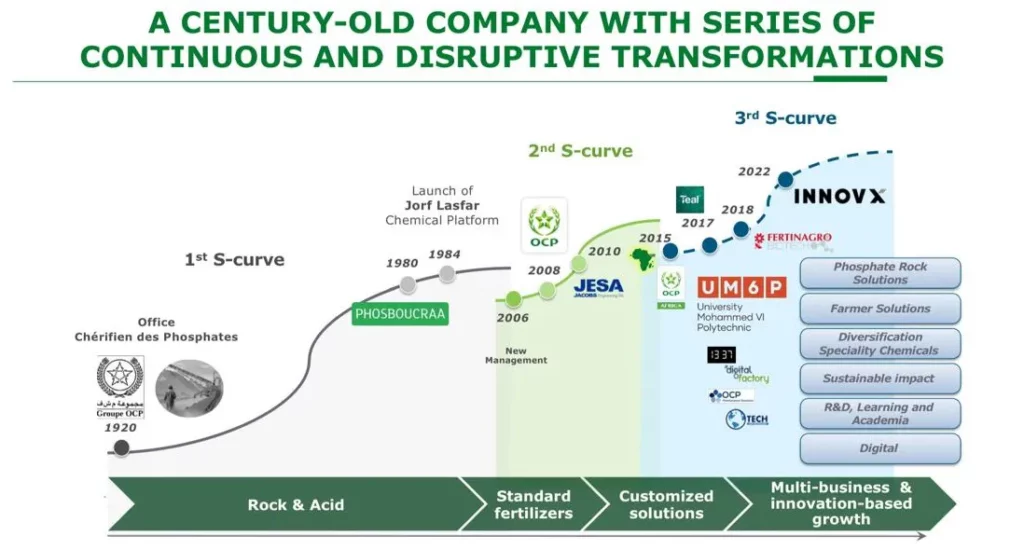
First curve, 1920–2006: the rock and the acid. OCP extracted and exported. The Maroc Phosphore units in Safi and the Jorf Lasfar platform, launched in 1984, marked the first leap — transforming the rock into phosphoric acid instead of exporting it raw.
Second curve, from 2006 to 2017: standard fertilizers. With a new management team, OCP increased from 2.5 million to 10 million tons. It established an engineering company, JESA, because no global industrial ambition is sustainable without mastering projects end-to-end. It created OCP Africa to irrigate the continent. It founded UM6P because without research and innovation, the rest is fragile.
Third curve, since 2017: customized solutions and multi-business growth. OCP no longer sells just fertilizers. It offers tailor-made fertilization solutions. It ventures into specialty chemicals, the "phosphate hacking" as its leaders call it. Uranium, fluorine, rare earths, technical acids for batteries, and perhaps pharmaceutical applications in the future.
The sulfur crisis of 2025-2026 does not alter this trajectory. It tests it, and the group passes the test.
→ Innovation, uranium, rare earths, fluorine, UM6P
UM6P changes the game on the innovation front. In its laboratories, one idea has prevailed: what if what we discard is worth more than what we keep?
Moroccan phosphate is extraordinarily rich — uranium, fluorine, vanadium, rare earths. Precious elements scattered in the rock, long ignored by traditional industry. UM6P took a closer look.
Uranium and fluorine, for instance, migrate into the phosphoric acid during transformation. Pilot extraction units are already operational, using technology developed in Morocco. The volumes are staggering: at current production rates, recoverable uranium could power fifteen one‑gigawatt nuclear reactors each year. Fifteen. Far beyond fertilizers.
Phosphogypsum tells another story. This solid residue — about five tons for every ton of phosphoric acid — concentrates nearly all the sulfur. For decades, it was piled up, endured, dismissed as waste. Today, researchers are recovering sulfur to reintroduce into the production cycle. And more: phosphogypsum also contains clinker, a key material for cement. Mining in waste, again.
When sulfur is trading at $1,400 per ton in global markets, every kilogram recovered internally is no longer a small saving. It's industrial strategy. Behind all this, a university that has transformed. UM6P is now ranked as the fourth African university in terms of scientific publications in leading journals. It is no longer the in-house school of a mining group. It is the brain of an industry that has decided to think differently.
→ Cadmium: controversy and the real response
There was something else in recent months. A controversy from Europe, that of cadmium. A heavy metal naturally found in soils, and consequently in fertilizers. Some actors tried to turn it into a weapon, in a context of sensitive negotiations between Morocco and the European Union. One of our contacts does not hide that well-identified interests were behind it.
OCP's response is factual, in two steps.
First: Moroccan phosphates already meet current European cadmium standards. This is not a future perspective, it is the current situation. OCP admits it has not communicated this enough.
Second: thanks to processes developed at UM6P, OCP plans to reduce the cadmium content of all its fertilizers to below 20 mg/kilogram (the current European regulatory level is 60 mg/kg) within approximately 18 months. A program already underway, operationally monitored.
Turning constraints into a competitive advantage. It's the same logic, once again.
→ What the numbers say
At the last board meeting of Nutricrops, OCP’s commercial arm, executives reviewed the 2026 forecasts The executives did not disclose figures. But one of them mentioned: the 2026 revenue is expected to exceed that of 2025.
The goal by 2035 remains 35 million tons of fertilizer production capacity. Compared to the expected 19 million in 2028 and, let's remember, less than 3 million in 2006. The crisis has not erased any of the group's ambitions.
“We even see it as an opportunity to accelerate our strategy.” In a global market reshaping its rules around food security, OCP is not just aiming to be the world’s leading phosphate producer. It wants to be the last resort.

à lire aussi

Article : Coupe du monde 2026. Le Maroc bouscule le Brésil mais doit se contenter du nul (1-1)
Après une entame énergique et l’ouverture du score par Ismaïl Saibari, l’équipe nationale a concédé l’égalisation face au Brésil, ce samedi 13 juin dans le New Jersey. Les Lions de l’Atlas sont toujours dans la course à la qualification. Ils pourront valider leur billet contre l’Écosse lors de la deuxième journée, vendredi 19 juin.

Article : Mondial 2026 : des fan zones à Casablanca et Rabat pour vivre les matchs
À l’occasion de la Coupe du monde 2026, un réseau de fan zones sera déployé dans plusieurs villes marocaines afin d’accompagner les Lions de l’Atlas et permettre aux supporters de vivre pleinement la compétition.
Article : Le Festival Gnaoua, d’un pari culturel à un modèle de rayonnement pour le Maroc
Trente ans après sa création, le Festival Gnaoua et Musiques du Monde d’Essaouira s’est imposé comme bien plus qu’un événement musical. Invitée de Médias24, sa fondatrice Neila Tazi revient sur les origines de cette aventure née à la fin des années 1990 et devenue, au fil des éditions, un levier de transformation pour la ville d’Essaouira et un outil de rayonnement pour le Maroc.
Article : Numérique et résilience climatique : la Banque mondiale approuve deux programmes de 6 MMDH pour le Maroc
D’un montant total de 650 millions de dollars (plus de 6 milliards de DH), les deux nouveaux programmes sont destinés à accélérer la réalisation des objectifs du Maroc en matière de transformation numérique, tout en renforçant la résilience financière du Royaume face aux risques liés au climat, aux catastrophes et aux cyber-risques.

Article : Air Transat lance sa première liaison aérienne directe entre Montréal et Agadir
Le premier vol direct de la compagnie canadienne "Air Transat" reliant Montréal à Agadir a atterri samedi 13 juin, à l’aéroport Al Massira avec 194 passagers à bord.
Article : Crimes de masse, mémoire sélective : le procès impossible de l’Occident
De la traite transatlantique aux guerres contemporaines, des génocides coloniaux aux famines organisées, cette contribution de Fatiha Charrat, docteur en sociologie, interroge une contradiction majeure : les puissances qui ont façonné le droit international et se présentent comme gardiennes des droits de l’Homme sont aussi au cœur des crimes les plus structurants de l’histoire moderne. Une réflexion sur l’impunité, la mémoire sélective et l’exigence d’une justice réellement universelle.