
Morocco behind schedule on the New Development Model: current trajectory remains insufficient (World Bank)
Five years after the launch of the New Development Model (NMD), Morocco is moving forward, but not yet at the required pace. The reforms undertaken are improving the trajectory, but remain insufficient to meet the targets set for 2035. To stay on course for that deadline, the country must combine more efficient markets, more dynamic businesses and better-targeted public investment. It must also do more to integrate women and young people into the labor market.

Key takeaways:
- Five years after the launch of the NMD, the reforms undertaken have given the economy fresh momentum, but they are still not enough to put the country on the planned trajectory.
- The gaps are visible in employment, female labor force participation and growth, all of which remain below the NMD’s targets.
- According to the World Bank, at the current pace, Morocco would double per capita income only around 2044, nine years after the NMD’s 2035 horizon.
- To meet the 2035 target, Morocco needs to accelerate reforms in markets, business dynamics, public investment and the integration of women and young people into the labor market.
- If implemented coherently, these reforms could, according to the World Bank, lift real GDP in 2035 by 17% above a scenario in which Morocco continues at the current pace, while generating the equivalent of 1.7 million more or better jobs.
-oOo-
Details:
The New Development Model (NMD), launched in May 2021, is a national transformation framework for the 2035 horizon. Its ambition is to move Morocco to a new stage of development, one that is more productive, more inclusive and, above all, more job-creating.
Its main objectives include doubling GDP per capita by 2035, raising the female labor force participation rate to 45% and formalizing 80% of employment.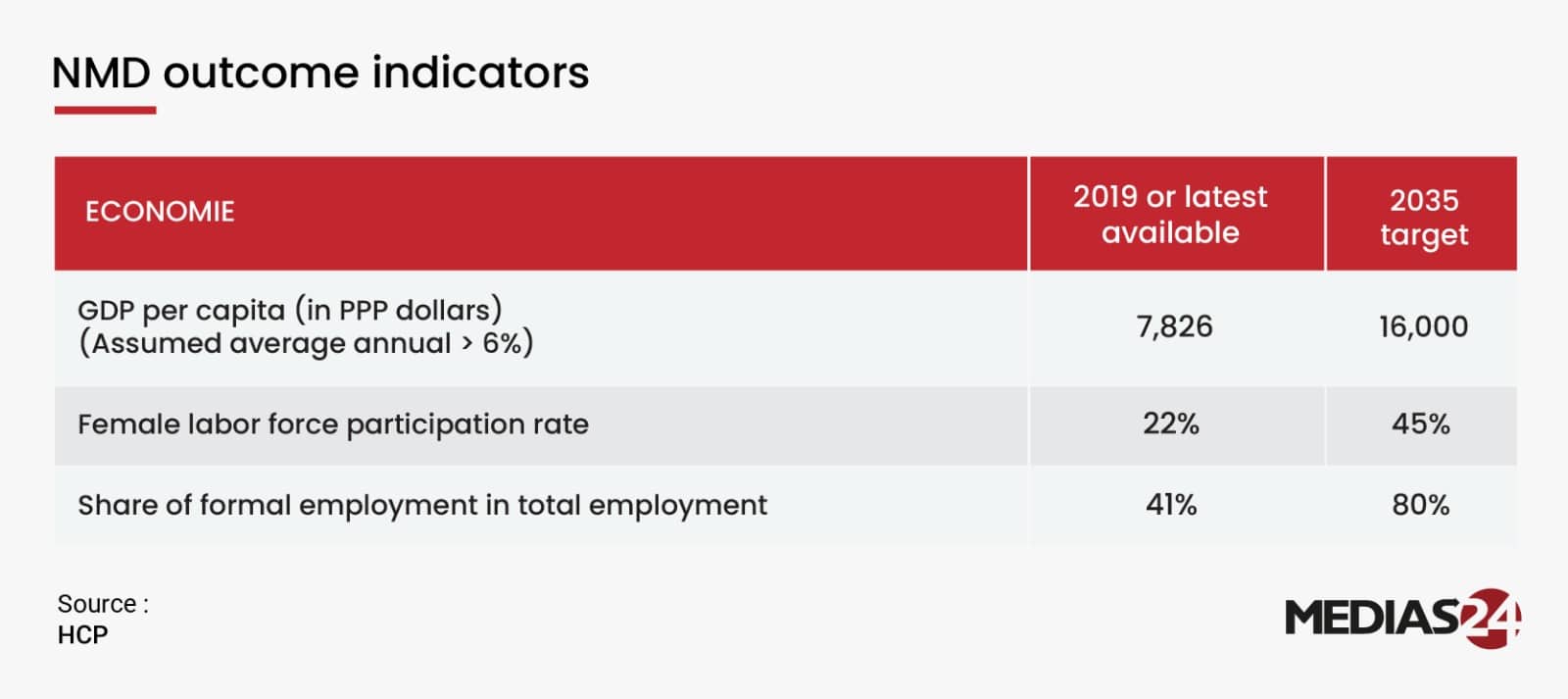
The government was formed a few months after the launch of the NMD. This close timing fueled the idea that it was meant to be, in a way, the first government tasked with translating this new framework into public policy.
The Head of Government stated before both Houses of Parliament his commitment to implementing the content of the NMD, confirming that government action was expected to follow this direction.
In its 2021-2026 program (p. 21), the government retained several quantified commitments. It pledged to create at least one million net jobs over five years, raise the female labor force participation rate to more than 30%, compared with around 20% at the time the program was presented, and bring the growth rate to 4% over the government’s term.
These commitments did not exactly replicate the NMD’s objectives, which is normal. The NMD sets a course for 2035, while a government acts over a five-year mandate. But the two trajectories were expected to move in the same direction. If government action alone could not achieve the national ambition, it was supposed to bring the country closer to the required pace.
Is Morocco moving fast enough to meet the NMD’s objectives?
First, development is a long-term matter. It requires institutional reforms, the transformation of the productive base, an upgrade of the education system, better quality and greater efficiency in public investment, but also, and above all, a more dynamic private sector and a labor market capable of absorbing young people and women.
The context also has to be taken into account. The government has operated in a difficult period, marked by the aftermath of Covid, inflation in 2022 and 2023, droughts, budgetary pressures and the cost of expanding social protection. These shocks reduced its room for maneuver.
Even so, important projects have moved forward, notably in social protection, direct cash transfers, taxation, investment, parts of the social welfare agenda and measures to support purchasing power.
But the question remains the same. Is this enough to put the country on the NMD trajectory? For now, the answer is no.
Morocco is now roughly one-third of the way through the period set for achieving the NMD’s objectives. If we focus only on employment and growth targets, the picture is fairly clear. The data show a significant gap between what has been achieved and the targets that were set.
Employment illustrates this gap clearly. Over the 2022-2025 period, net job creation amounted to only 95,000 positions. The labor force participation rate for women did not improve. It even fell, from 20.9% in 2021 to 19% in 2025. Unemployment also rose over the period.
The same observation applies to economic growth. The average annual growth rate stands at 3.5% over the period. This remains below the 4% projected in the government program and far from the pace of more than 6% needed to meet the NMD’s objectives. It could possibly be reached with a very strong performance in 2026.
Recent investments have admittedly helped deliver relatively strong growth in 2024 and 2025. But more growth is not enough. Morocco needs growth that actually transforms economic life. Growth capable of creating jobs, especially formal ones. Growth that enables young graduates to find their place. Growth that gives women real opportunities to enter the labor market, and also to remain there sustainably.
The government can therefore defend part of its record. There have been reforms, shocks and constraints. But the results achieved over the first four years remain insufficient to reach the pace required by the NMD.
How can Morocco still meet the 2035 target?
The recent World Bank report provides an answer to this question. Its projections do not show that the NMD is unrealistic, but rather that the current trajectory remains insufficient, even when ongoing reforms are taken into account.
It should nevertheless be stressed that Morocco is not starting from scratch. According to the simulations, ongoing reforms would raise medium-term growth potential by about 0.6 percentage points per year, bringing it to an average of 4.2%.
But this pace remains below the 6.9% needed to meet the NMD’s objectives by 2035, notably the doubling of GDP per capita. Under this scenario, according to the World Bank simulation, Morocco would double its 2023 per capita income only around 2044, nine years later than the NMD’s target date.
Current reforms are therefore improving the trajectory. Major investments are providing momentum. But taken together, they are still not enough to reach the 2035 target.
What Morocco needs to change now is the quality of its growth. Investments need to be better directed. The country also needs to go beyond supporting activity through major projects and build a fabric of firms capable of growing, innovating, exporting and hiring. In other words, Morocco needs growth that creates productive jobs, above all formal and better-paid ones.
The World Bank also quantifies the possible gains from accelerating reforms. A coherent package focused on market efficiency, business dynamism, the quality of public investment and the participation of women and young people could lift real GDP by 17% above the baseline scenario in 2035.
It should be noted that this 17% does not refer to total GDP growth. It is an additional gain compared with the current trajectory if it is maintained.
The same package of reforms could generate the equivalent of 1.7 million more or better jobs by 2035, according to the "more and better jobs" indicator used by the World Bank.
This transformation requires reforms to be linked together. If Morocco only increases the number of people looking for work without creating enough productive jobs, it risks ending up with more unemployment or greater discouragement. If Morocco improves productivity alone without integrating more women and young people, it will leave part of its human capital unused.
The solution therefore lies in the combination. More open markets. More dynamic firms. More effective public investment. Greater participation of women and young people. And, above all, growth that is not only stronger, but more useful.
The NMD remains achievable. But it will not be achieved by simply extending current trends. Reforms will have to be deepened, and the pace will have to change.
Secteur privé. Le grand manque à gagner pour l’économie marocaine (Banque mondiale)
Chatbot Médias24. La Banque mondiale publie son diagnostic du secteur privé au Maroc

à lire aussi

Article : Coupe du monde 2026. Qualification héroïque du Maroc face aux Pays-Bas (1-1, 3 t.a.b. à 2)
Menés à un quart d’heure du terme, les Lions de l’Atlas ont trouvé les ressources mentales nécessaires pour égaliser grâce à Issa Diop, puis éliminer les Oranjes lors de la séance des tirs au but, dans la nuit du lundi 29 au mardi 30 juin, à Monterrey, au Mexique. Yassine Bounou et Ismaïl Saibari ont propulsé le Maroc en huitièmes de finale face au Canada, samedi 4 juillet à Houston.

Article : Coupe du monde 2026. Centième sélection pour Achraf Hakimi face aux Pays-Bas
Le capitaine des Lions de l’Atlas portera le maillot du Maroc pour la 100e fois de sa carrière, dans la nuit du lundi 29 au mardi 30 juin, face aux Pays-Bas, en seizième de finale de la Coupe du monde 2026. Titularisé par Mohamed Ouahbi, Hakimi n’est plus qu’à 15 sélections d’égaler le record de Noureddine Naybet.

Article : GMT, interdiction du démarchage, IA : la triple peine de l’offshoring marocain
Longtemps porté par les donneurs d’ordre européens et les centres d’appels, le secteur de l’offshoring au Maroc doit désormais composer avec des horaires à réorganiser, des appels commerciaux de plus en plus encadrés en France et des tâches que les logiciels commencent déjà à automatiser. Les grands opérateurs invoquent l’adaptation et la montée en gamme, tandis que les syndicats redoutent moins d’embauches et davantage de postes supprimés.
Article : Maroc-Pays-Bas : les cafés pourront rester ouverts pour diffuser le match
Selon Ahmed Bifergane, coordinateur de la Fédération nationale des propriétaires de cafés et restaurants, aucune interdiction n’a été émise par les autorités pour la nuit du lundi 29 au mardi 30 juin.

Article : Défense : les F-16 marocains concernés par un nouveau contrat américain sur les missiles AMRAAM
Attribuée à Raytheon pour 398,6 millions de dollars, l’enveloppe porte sur des travaux liés au système D4/C9, avec une échéance fixée à décembre 2027. Le Maroc figure parmi les pays partenaires du dispositif FMS, aux côtés notamment des Émirats arabes unis, de l’Arabie saoudite, du Japon, d’Israël et du Royaume-Uni.

Article : My Education lance “MY WAY”, un programme dédié aux compétences du XXIe siècle
Destiné aux jeunes de 9 à 16 ans, le dispositif combine des activités régulières, des bootcamps, des stages immersifs et des interventions en milieu scolaire.