
Canary Islands absent from Morocco-Spain high-level talks
The Canary Islands, along with Ceuta and Melilla, were not part of the agenda at the 13th Morocco-Spain high-level meeting held in Madrid on Thursday, December 4.
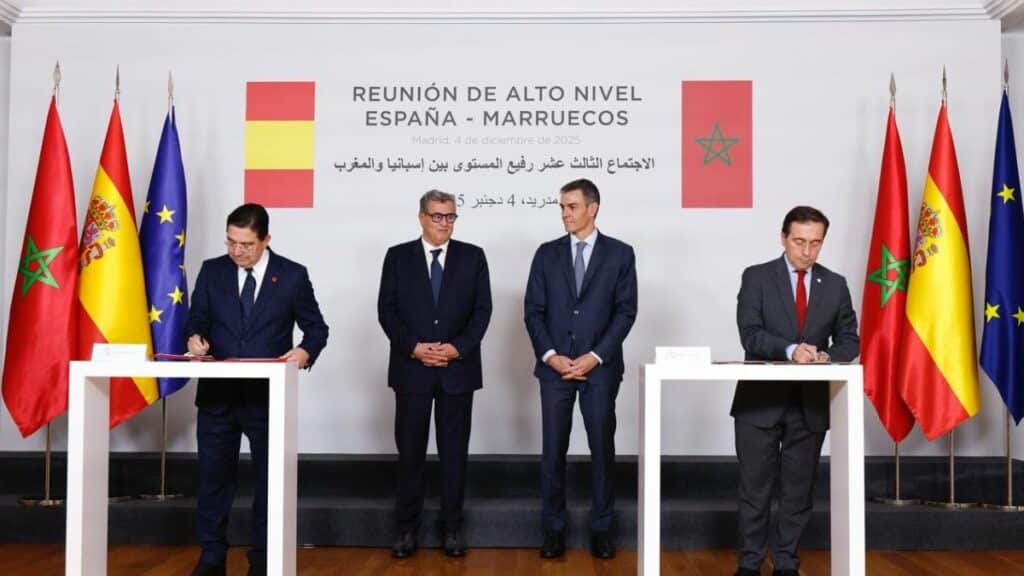
Morocco and Spain signed 14 agreements across strategic sectors during their 13th high-level meeting in Madrid on Thursday, December 4, marking a new step in bilateral ties.
The 13th Morocco-Spain high-level meeting ended without any explicit mention of Ceuta and Melilla, the two cities occupied by Madrid. They were referenced only indirectly in point 62 of the final declaration, in the context of customs cooperation.
The Canary Islands were left out of the official discussions. The omission reflected a mutual effort to avoid friction, as both sides highlighted strengthened cooperation and a partnership described as historic, with the joint hosting of the 2030 World Cup on the horizon.
The delimitation of maritime borders remains one of the most sensitive issues. Rabat asserts its right to establish its maritime boundaries and challenges Spain’s reading of the UN Convention on the Law of the Sea. The contested area lies west of the Canary Islands, stretching nearly 350 nautical miles, including a 200-mile zone where Moroccan and Canarian waters overlap.
The area’s subsoil is rich in tellurium, cobalt, and other rare minerals vital to the global economy. These strategic resources have fueled a silent rivalry between Rabat and Madrid, as the technological revolution and the rise of the fifth industrial generation increase the geopolitical importance of critical metals.
Control of these resources is expected to shape states’ economic influence in the years ahead, raising the prospect of outside involvement in this sensitive issue. The United States, the world’s largest economy and a strategic ally of Morocco, is closely monitoring developments linked to critical minerals.
In Washington, the resources are seen as vital to U.S. economic security, particularly as commercial and technological rivalry with China intensifies. Beijing holds a dominant position in the extraction and refining of rare minerals, prompting the United States to seek new supply sources, notably in strategic areas such as the Atlantic and the Mediterranean.
In this context, Morocco could gain a strategic edge in future negotiations. The Kingdom’s role as a reliable U.S. ally contrasts with Washington’s sometimes strained ties with the government of Pedro Sánchez, particularly during the Trump administration.
The geopolitical configuration strengthens Rabat’s room for maneuver on an issue where economic, technological and security stakes are rising.
The only reference to the maritime issue was made outside the joint statement, in a declaration by Foreign Minister Nasser Bourita. In an interview with EFE agency, he called for "imaginative solutions" to key points of disagreement between Madrid and Rabat, including Morocco’s request to manage Sahara airspace and ongoing talks over the maritime border southwest of the Canary Islands and west of the Sahara.
Sahara, Mont Tropic, FIR : les nouveaux rapports de force entre Rabat et Madrid
Reprise du dialogue entre le Maroc et l'Espagne sur les frontières maritimes atlantiques

à lire aussi
Article : Énergie verte : les futurs câbles Maroc-France et le gazoduc H2 prennent place dans les plans européens
Les projets énergétiques reliant le Maroc au continent européen se multiplient dans le Plan décennal de développement du réseau européen, version 2026. Portés par Xlinks, Fortescue ou encore Enagás, ils confirment le positionnement du Royaume comme futur fournisseur d'énergie verte de l'Europe.

Article : Une fusion-absorption de l'Université internationale privée Averroès par LCI Africa Holding en projet
Le Conseil de la concurrence a été saisi le 2 juillet de l’opération, qui rapprocherait l’établissement casablancais du groupe LCI Education, déjà présent au Maroc à travers HEM, Collège LaSalle International Maroc et Foncière L’AGORA pour l’Éducation.
Article : À Tétouan, les juges constitutionnels veulent rendre l’État de droit plus visible
Organisé avec la Commission de Venise, le colloque a réuni pendant deux jours des intervenants marocains et étrangers autour d’un enjeu central : l’indépendance des cours et leur capacité à dialoguer au-delà des frontières. Les travaux ont aussi été marqués par la présentation de la version révisée de la Liste des critères de l’État de droit.

Article : Rabat : pour faire revivre son patrimoine, Balima mise sur des appartements-galeries
La marque a inauguré, le 2 juillet, la Senior Suite Balima Harcourt 31, conçue avec le photographe Julien Guyard et consacrée aux paysages du Sud marocain, dans le cadre d’un programme associant hébergement, création artistique et vente d’œuvres.

Article : Achats par IA : Oliver Jenkyn, président de Visa, esquisse les ruptures du paiement et du commerce du futur
Le président du groupe Visa a ouvert la journée médias du Payments Forum 2026, à Paris. Lors de son intervention, il a dessiné les contours de ce que sera, selon lui, le commerce des prochaines années : des agents qui achètent à notre place, des stablecoins encore balbutiants, et une confiance qui devient la seule monnaie qui compte vraiment.

Article : Coupe du monde 2026. Physiquement, le Maroc est au point
Courses à haute intensité, sprints, distances parcourues… Signes d’une préparation physique réussie, les Lions de l’Atlas ont été énormes dans la générosité tout au long de la compétition. Ismael Saibari, Neil El Aynaoui et Achraf Hakimi sont les porte-étendards d’une équipe au rendez-vous sur le plan athlétique.