
Despite a challenging environment, Lekjaâ forecasts 5.3% growth and a deficit cut to 3%
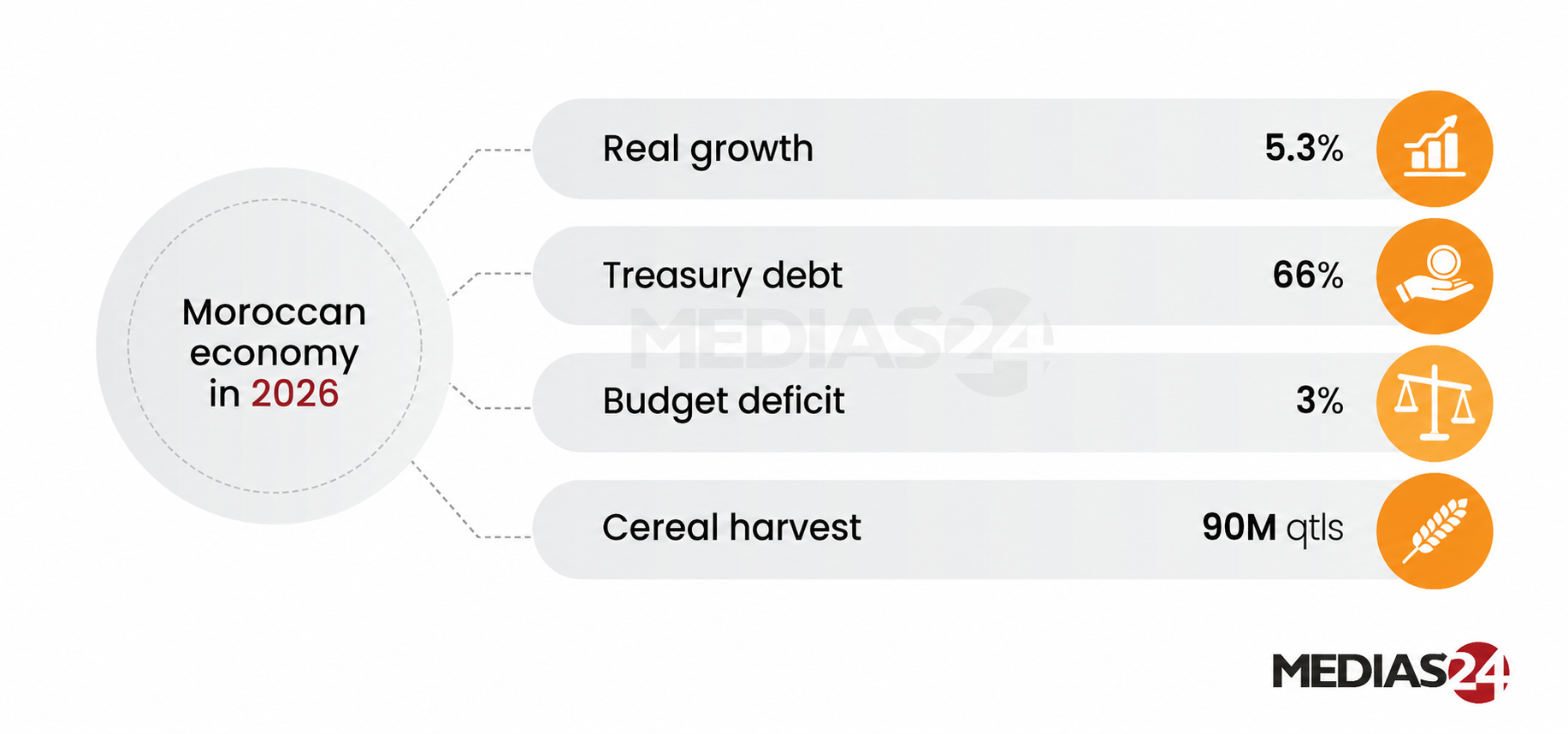
Fouzi Lekjaâ expects growth of around 5.3%, partly driven by the agricultural rebound. According to him, this momentum should help bring the budget deficit down to 3% of GDP and stabilize Treasury debt at around 66%.
Growth, budget deficit, Treasury debt, the agricultural season, inflation, etc. Fouzi Lekjaâ presented, on May 12, 2026, before the House of Councillors, a favorable outlook for Morocco’s economy in 2026.
Robust growth despite a difficult environment
Growth comes first. It is the key indicator, the one that best captures the pace of economic activity. "The Moroccan economy is expected to record a growth rate of around 5.3% in 2026, despite the current environment and constraints," Lekjaâ said.
If this figure is confirmed, the Moroccan economy would record its strongest growth rate, excluding the post-Covid rebound, since 2008, when growth reached 6%.
At first glance, this level may seem counterintuitive. The international context remains tense, geopolitical uncertainties persist, particularly in the Middle East, and the external environment remains unfavorable. But a closer look at Morocco’s growth record, and especially at its main drivers, shows that a rate above 5% is not unrealistic.
Indeed, this year, two major drivers of Moroccan growth are coming together: agricultural value added and public investment, two engines that are expected to support activity in 2026.
The agricultural season looks promising and should contribute significantly to growth. Its share in overall value added generally ranges between 9% and 10%. On this point, Lekjaâ said the 90 million quintals expected from the cereal harvest should make a significant contribution to projected growth.
"This year has been marked by significant rainfall and an improvement in the country’s hydrological situation after six consecutive years of drought, pointing to good prospects for the 2025-2026 agricultural season. Cereal production is expected at around 90 million quintals, paving the way for a reassessment of growth prospects. According to macroeconomic forecasts, each additional 20 million quintals of cereals is likely to generate between 0.2 and 0.3 percentage points of growth".
Following this logic, a harvest of 90 million quintals in 2026 would represent an increase of 46 million quintals compared with the 44 million estimated for 2025. The direct gain from the cereal harvest would therefore be around 0.7 percentage points of growth*.
It is also worth noting that, for several years, the forecasts of the Ministry of Economy and Finance on economic growth have generally remained very close to the final figures later published by the High Commission for Planning (HCP).
The trajectory of the deficit and debt
When growth accelerates, fiscal ratios become easier to stabilize. In the same vein, Lekjaâ expects a continued improvement in the Treasury’s deficit and debt ratios. The deficit is expected to be reduced to 3% of GDP in 2026, while Treasury debt is expected to stabilize at around 66% of GDP.
"This controlled financial situation, made possible by the fiscal space created by stronger revenues and spending control, will allow us to reduce the budget deficit to 3% of GDP by end-2026, an improvement of around 0.5 percentage points compared with 2025. As a result, the level of Treasury debt, relative to GDP, will continue its downward trajectory and stabilize at around 66% in 2026," the minister said.
With a real growth assumption of 5.3% and inflation that Lekjaâ expects to rise slightly in 2026, nominal growth should be strong enough to help bring these ratios down. It should be noted, however, that the nominal component of growth depends on the general price level, which is not the same as CPI-measured inflation.
For Lekjaâ, this downward trend in fiscal ratios is also due, beyond the growth effect, to the improvement in ordinary revenues observed in recent years.
"This situation extends the significant improvement in ordinary revenues observed over the past five years. These rose from MAD 256.2 billion in 2021 to MAD 424.2 billion in 2025, an increase of MAD 168 billion. This reflects average annual growth of 13.5%, driven in particular by the notable increase in tax revenues, whose average annual growth rate reached 12.4%," he said.
-oOo-
* If every additional 20 million quintals generates 0.3 percentage points of growth, then an additional 46 million quintals should contribute around 0.69 percentage points of growth: (46 / 20) x 0.3 = 0.69 pt.

à lire aussi

Article : Ferroviaire : l’Italie en mission à Casablanca, dans le sillage des grands chantiers marocains.
Du 5 au 8 octobre, l’ICE conduira une délégation d’entreprises pour rencontrer donneurs d’ordre, sous-traitants et opérateurs locaux, alors que le Royaume prévoit l’extension de la LGV vers Marrakech, le renouvellement du réseau métropolitain casablancais et l’élargissement du maillage national à 43 villes.

Article : Palais des congrès de Casablanca : Maâzouz promet un arbitrage définitif avant “fin juillet 2027”
Bloqué depuis plusieurs années par les questions de foncier et de financement, le dossier revient au centre de la stratégie touristique régionale.

Article : Maroc-France : les Bleus reconnaissent l’obstacle, Deschamps diffère l’analyse
Après leur qualification dans la douleur face au Paraguay, Didier Deschamps, Rayan Cherki, William Saliba et Bradley Barcola ont surtout insisté sur la récupération, tout en saluant une sélection marocaine “de qualité”, invaincue dans ce Mondial et portée par des joueurs “dans de grands clubs”.

Article : Mondial 2026 : la France rejoint le Maroc en quarts, sans éclat mais sans trembler
Mbappé a débloqué sur penalty un huitième de finale fermé face au Paraguay (1-0), samedi 4 juillet à Philadelphie. Les Bleus affronteront les Lions de l’Atlas jeudi 9 juillet à Foxborough, quatre ans après leur demi-finale du Mondial 2022.

Article : Maroc-Canada : Ouahbi assume le statut de “prétendant”, Marsch refuse de réduire le match au 3-0
Après la qualification marocaine pour les quarts, les deux sélectionneurs ont livré deux lectures opposées du huitième de finale : côté marocain, la maîtrise retrouvée après la pause et l’ambition d’aller plus loin ; côté canadien, le sentiment d’avoir dominé longtemps avant de céder sur les détails.
Article : Coupe du monde 2026. Le Maroc en quart pour la deuxième fois de son histoire (3-0)
Après un premier acte tendu et angoissant, l’équipe nationale s’est difficilement sortie du piège tendu par les Canadiens grâce à un doublé d’Azzedine Ounahi et une réalisation signée Soufiane Rahimi, ce samedi 4 juillet à Houston. Le Maroc affrontera en quart, jeudi 9 juillet, le vainqueur du huitième opposant, la France au Paraguay.