
Electronic invoicing, explained by Younès Idrissi Kaitouni, Director General of Taxes
Speaking before business operators brought together by Médias24 as part of its “Grands Rendez-vous” series, Younès Idrissi Kaitouni, Director General of Taxes, outlined the technical framework and underlying rationale of Morocco’s future electronic invoicing system. Here is what you need to know about a reform set to reshape commercial and tax practices across the country, with rollout scheduled for 2026.
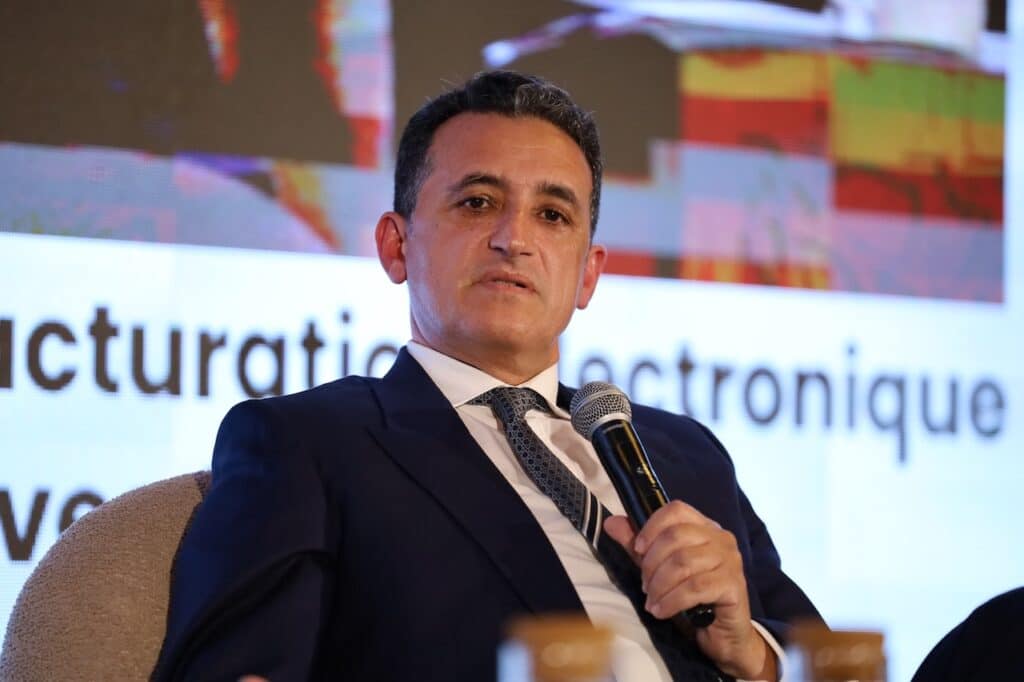
Electronic invoicing is set to be rolled out in Morocco in 2026, according to the Director General of Taxes, Younès Idrissi Kaitouni, who confirmed the timeline during the 4th edition of the “Grands Rendez-vous de Médias24” held on April 16. A draft decree outlining the framework has already been submitted to the General Secretariat of the Government.
The reform is expected to mark a significant shift toward greater transparency in commercial transactions, with far-reaching implications for the country’s tax system. For the government, it represents a powerful tool to combat fraud. For businesses, it will fundamentally reshape day-to-day operations — posing a particular challenge for smaller firms.
Here’s what you need to know.
- What is electronic invoicing?
Electronic invoicing goes far beyond simply sending scanned invoices by email. It fundamentally changes the nature of the invoice itself.
In practice, invoices will no longer exist as paper documents. Instead, they will take the form of structured electronic files, based on a standardized format (UBL, an international standard), and secured with a qualified electronic signature. This ensures authenticity, verifies the identity of the parties involved, and guarantees non-repudiation — meaning neither party can deny issuing or receiving the invoice.
Kaitouni emphasized a point often misunderstood: electronic invoices are more secure than paper ones.
“If you add a single comma to an electronic document, the system rejects it as altered. With a paper invoice, you could add a zero, and if it’s done carefully, no one would notice,” he said.
- When will it take effect?
The rollout is scheduled for 2026. The technical platform has already been developed, tested and validated. What remains is the publication of a decree, currently under review by the General Secretariat of the Government, which will define the timeline and operational details.
Once adopted, the rollout is expected to accelerate. However, authorities have stressed that implementation will be gradual — not a sudden “switch on/switch off.” Instead, it will be phased by company size, sector and type of transaction, similar to previous reforms such as e-filing and payment deadline regulations.
- Who will be affected?
In its initial phase, electronic invoicing will apply exclusively to B2B transactions. The rollout will be gradual, starting with large companies before extending to SMEs, which have been identified as a priority segment.
B2C transactions — invoices issued to individuals in sectors such as retail, hospitality or services — are not included at this stage.
“That doesn’t mean we are not considering it,” Kaitouni said.
Authorities indicated that B2C integration may come at a later stage, once the B2B system is fully operational, and would likely require targeted incentives for consumers.
- How will the system work?
The system is built around real-time invoice validation.
While certified service providers (CSPs) will eventually handle part of the process, the tax administration will initially act as both platform operator and intermediary.
In simplified terms, the process is as follows:
Supplier issues an electronic invoice → in structured format and electronically signed → transmitted via the DGI platform or a certified provider → validated (format, signature and required data checks) → delivered to the client → receipt is automatically acknowledged.
Clients will not be able to refuse receipt in order to delay payment.
The DGI effectively acts as a secure intermediary, ensuring traceability, timestamping and the automatic triggering of both payment deadlines and VAT obligations.
Once the invoice is received, the clock starts ticking — for both payment terms and tax liabilities.
- What tools will be available?
Two systems will be available from launch:
- For SMEs: a free online portal accessible via the DGI website, allowing businesses to issue invoices directly without requiring dedicated software. The platform will be available at fatourati.gov.ma.
- For large companies: an EDI (Electronic Data Interchange) interface enabling ERP systems to automatically transmit invoicing data to the tax administration.
- Who are the certified providers?
The Moroccan model relies on Certified Service Providers (CSPs), third-party entities accredited by the tax administration.
These providers will handle real-time invoice clearance between suppliers and clients, reducing the operational burden on the DGI.
At launch, however, the DGI will perform this role itself. Private CSPs will be gradually accredited under a regulatory framework supervised by authorities responsible for cybersecurity and data protection.
Unlike traditional public procurement processes, the DGI will not issue tenders. Instead, it will publish technical specifications, leaving companies free to choose their service providers.
- What is the objective?
The goal, according to Kaitouni, is clear: transparency.
This includes stronger fraud prevention, improved tax fairness, increased public revenues and real-time visibility over economic activity.
“This is not a coercive measure. It is a preventive measure against tax fraud,” he said.
The reform builds on a series of measures introduced since 2021, including VAT withholding at source, tax compliance certificates and stricter payment deadlines — all designed to prepare the ground for this shift.
- What are the expected benefits?
Authorities highlighted several key benefits:
- elimination of paper archives
- faster VAT refunds, due to pre-validated invoice data
- full traceability of B2B transactions
- stronger enforcement of payment deadlines
- improved access to financing, as invoices become reliable, financeable assets
A representative from CMI confirmed that the system could facilitate short-term financing based on invoices.
In addition, the reform will provide real-time economic visibility. The DGI indicated that aggregated data could be shared with institutions such as Bank Al-Maghrib, the HCP and the CNSS.
- What changes for accountants?
The role of accountants will not disappear, but it will evolve.
Access to structured, reliable data is expected to simplify their work. However, the reform also comes with increased accountability.
“We will not audit the company — we will audit the expert who validated the declaration,” Kaitouni warned, referring to cases of false reporting on payment deadlines.
Accounting professionals will therefore be held directly accountable for the tax compliance of their clients in this area.

à lire aussi

Article : Coupe du monde 2026. Qualification héroïque du Maroc face aux Pays-Bas (1-1, 3 t.a.b. à 2)
Menés à un quart d’heure du terme, les Lions de l’Atlas ont trouvé les ressources mentales nécessaires pour égaliser grâce à Issa Diop, puis éliminer les Oranjes lors de la séance des tirs au but, dans la nuit du lundi 29 au mardi 30 juin, à Monterrey, au Mexique. Yassine Bounou et Ismaïl Saibari ont propulsé le Maroc en huitièmes de finale face au Canada, samedi 4 juillet à Houston.

Article : Coupe du monde 2026. Centième sélection pour Achraf Hakimi face aux Pays-Bas
Le capitaine des Lions de l’Atlas portera le maillot du Maroc pour la 100e fois de sa carrière, dans la nuit du lundi 29 au mardi 30 juin, face aux Pays-Bas, en seizième de finale de la Coupe du monde 2026. Titularisé par Mohamed Ouahbi, Hakimi n’est plus qu’à 15 sélections pour égaler le record de Noureddine Naybet.

Article : GMT, interdiction du démarchage, IA : la triple peine de l’offshoring marocain
Longtemps porté par les donneurs d’ordre européens et les centres d’appels, le secteur de l’offshoring au Maroc doit désormais composer avec des horaires à réorganiser, des appels commerciaux de plus en plus encadrés en France et des tâches que les logiciels commencent déjà à automatiser. Les grands opérateurs invoquent l’adaptation et la montée en gamme, tandis que les syndicats redoutent moins d’embauches et davantage de postes supprimés.

Article : Maroc-Pays-Bas : les cafés pourront rester ouverts pour diffuser le match
Selon Ahmed Bifergane, coordinateur de la Fédération nationale des propriétaires de cafés et restaurants, aucune interdiction n’a été émise par les autorités pour la nuit du lundi 29 au mardi 30 juin.

Article : Défense : les F-16 marocains concernés par un nouveau contrat américain sur les missiles AMRAAM
Attribuée à Raytheon pour 398,6 millions de dollars, l’enveloppe porte sur des travaux liés au système D4/C9, avec une échéance fixée à décembre 2027. Le Maroc figure parmi les pays partenaires du dispositif FMS, aux côtés notamment des Émirats arabes unis, de l’Arabie saoudite, du Japon, d’Israël et du Royaume-Uni.

Article : My Education lance “MY WAY”, un programme dédié aux compétences du XXIe siècle
Destiné aux jeunes de 9 à 16 ans, le dispositif combine des activités régulières, des bootcamps, des stages immersifs et des interventions en milieu scolaire.