
Can Humanity Grow Up?
OXFORD – The COVID-19 pandemic underscores just how tightly interwoven humanity has become. A single infected animal somewhere in China set in motion a chain reaction with effects that, nearly a year later, are still reverberating in every corner of the planet.
This should not be particularly surprising. The history of pandemics tracks our unification as a species. The Black Death traveled on new trade routes forged between Europe and Asia in the Middle Ages. Smallpox crossed the Atlantic Ocean with the Europeans, devastating the Americas. And the 1918 influenza pandemic reached six continents in just months, owing to technological advances in moving goods and people. Each time humanity takes bold steps toward deeper integration, disease follows.
This has yielded profound benefits. We pool our knowledge, innovation, and technology. We share in the rich traditions of each other’s cultures. We cooperate across vast distances, working together on projects too great for any individual, or country, to complete on their own – such as eradicating smallpox from the face of the Earth.
But our interconnectedness also brings profound costs. We share not only our greatest knowledge and culture, but our greatest risks. We may go decades without seeing it, but our activities have a shadow-cost in risk that eventually comes due. And it is not limited to pandemics. Our newfound ability to share information across the world allows dangerous ideas – misinformation, warped ideologies, and hatred – to spread faster than any disease.
These challenges of an interconnected world require new approaches to ethics – new ways of understanding our plight and coordinating our response. Ethics is normally viewed from the perspective of the individual: what should I do? But sometimes we step back to take in a broader perspective, and think in terms of the obligations borne by societies or countries. And in recent centuries, we have begun to adopt a global perspective, asking how the world ought to respond to a pressing concern.
These new perspectives are demanded by a changing world. Before we had civilization, it would rarely have made sense to think of responsibilities beyond our immediate ties. Only when we became more unified and started encountering truly global problems did we begin to consider our collective obligations to our planet and ourselves.
But now we need to go one step further. Alongside our deepening interconnections, there has also been a profound change in the sheer reach of our actions. With the advent of nuclear weapons, humanity’s ever-increasing power over the world around us finally reached a point where we could destroy ourselves. We entered a world where we could threaten not only everyone alive today, but everyone who could follow, and everything they could achieve; where we could betray not only the trust of everyone alive today, but of the ten thousand generations who preceded us.
As our power continues to grow, so do the risks: from extreme climate change, to the coming biotechnologies that will allow for engineered pandemics with a lethality and transmissibility beyond what nature has produced. Such threats to our entire future, whether via our extinction or an irrevocable collapse of civilization, are known as existential risks. How we address them will determine the fate of our species.
Meeting this challenge will require a radical reorientation in our thinking – seeing our generation as a small part of a much greater whole; a story that spans the eons. We will thus need to adopt not merely a global perspective, of everyone alive today, but the perspective of humanity itself – the hundred billion people who came before us, the nearly eight billion alive today, and the countless generations yet to be born. By adopting this ethical lens, we will have a better view of our crucial role in the larger story of our species.
Thinking in these terms can sometimes feel unnatural, because humanity is not a coherent agent. We have deep disagreements about what we ought to do, and we are constantly competing with one another. We struggle to act in concert even when it is obvious that we must. But this is true of all collective agents, and it doesn’t stop us from referring to a company’s interests or a country’s priorities. The point is not to deny the differences and sources of friction between human agents; it is to ask what we could accomplish if we act together, or what responsibilities we collectively bear.
Consider the whole of humanity in the terms of a single human life. The typical species survives for around one million years, and humanity is just 200,000 years old, putting us in our adolescence. This seems an especially apt comparison, for like the adolescent, we are seeing rapid developments in our strength, and in our ability to get ourselves in trouble. We are almost ready for the world, ready to explore the dizzying potential the future holds. Yet when it comes to risks, we can be impulsive and careless, seizing the short-term benefits but neglecting the long-term costs.
Within individual societies, we resolve these tensions by giving the young enough space to grow and flourish, while at the same time steering them away from dangers that they do not yet understand. Only gradually do we grant them the freedoms of adulthood, hoping that we’ve given them enough time and guidance to make wise and prudent choices – and to recognize that with freedom comes responsibility. Unfortunately, humanity does not have the luxury of a caring guardian. We are alone and will have to grow up fast.
Whether humanity survives this critical period is ultimately up to us. Because the greatest risks are not from nature, but from our own action, we can pull back from the brink if we choose. We can take a more mature attitude to our increasing interconnection and technological progress, setting aside some fraction of the benefits they bring to guard against the associated risks. Occasionally stepping back to adopt the perspective of humanity will let us see our predicament more clearly, providing the vision we need to guide us through.
à lire aussi
Article : Le Nouvel an de l'hégire (1er Moharram) sera célébré ce mercredi 17 juin au Maroc
Le 1er Moharram de la nouvelle année de l’Hégire 1448 correspondra au mercredi 17 juin 2026, a annoncé le ministère des Habous et des affaires islamiques.
Article : Adouls : la Cour constitutionnelle valide l’essentiel de la réforme, mais écarte plusieurs dispositions
Saisie par 93 députés avant la promulgation du texte, la Cour a déclaré non conformes des articles touchant aux incompatibilités professionnelles, aux personnes en situation de handicap, au témoignage collectif dit “lafif” et à l’organisation des instances représentatives. Le texte devra donc être corrigé sur ces points, sans remettre en cause le cœur de la nouvelle loi 16.22.
Article : En commission, les conseillers votent la nationalisation de la Samir et le plafonnement des hydrocarbures
Deux propositions de loi portant sur les hydrocarbures et la Samir ont été récemment adoptées en commission à la Chambre des conseillers. Un vote "surprise" rendu possible par un rapport de forces numérique défavorable à la majorité, lors d’une séance où l’opposition était majoritaire en nombre. Si ces textes ont franchi l’étape de la commission, leurs promoteurs sont conscients qu’ils ont peu de chances d’être adoptés en plénière.
Article : Retail : la guerre silencieuse pour conquérir le panier des Marocains
Pendant longtemps, les courses du quotidien se sont surtout jouées entre l’épicier du quartier, le grossiste et quelques grandes surfaces. Ce modèle commence à se fissurer. Entre fusion capitalistique, rachats d’enseignes, master-franchises, centrales d’achat, logistique commune et formats de proximité, les grands opérateurs installent peu à peu des réseaux capables d’accompagner le consommateur du café du matin aux achats du week-end. Non sans bousculer les équilibres.
Article : Crédit du Maroc : ce que cache l’augmentation de capital à 699 MDH
Depuis son passage sous le contrôle de Holmarcom, Crédit du Maroc a changé de rythme. La banque affiche des bénéfices en hausse, prépare son plan CDM Boost 2028, et propose désormais à ses actionnaires de suivre le mouvement via une opération ouverte du 26 juin au 16 juillet. Derrière le prix fixé à 938 DH par action, le marché devra surtout juger si cette nouvelle étape confirme une trajectoire ou ouvre un pari plus large. Décryptage.
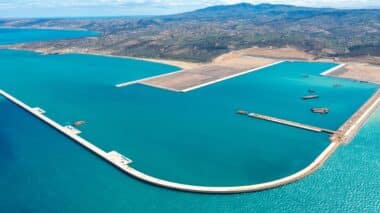
Article : Nador West Med : derrière le port, le pari industriel de l’Oriental
ROUND UP. Prévu pour entrer en service fin 2026, Nador West Med se construit déjà au-delà de ses quais : routes dédoublées, future autoroute vers Guercif, projets chinois dans l’éolien, les pneus et les alliages, ambition énergétique autour du GNL et de l’hydrogène vert. L’enjeu est désormais de transformer cette infrastructure en véritable moteur économique régional.