
Kick‑off of the World Cup on June 11. Morocco’s goal: staying among the elite
The World Cup kicks off this Thursday evening. In 2022, Morocco was the surprising outsider. In 2026, it is the nation under scrutiny. The Qatar semi‑final changed its status — and the pressure. The real challenge is no longer to shine once, but to prove it was no fluke. The history of world football offers instructive trajectories.
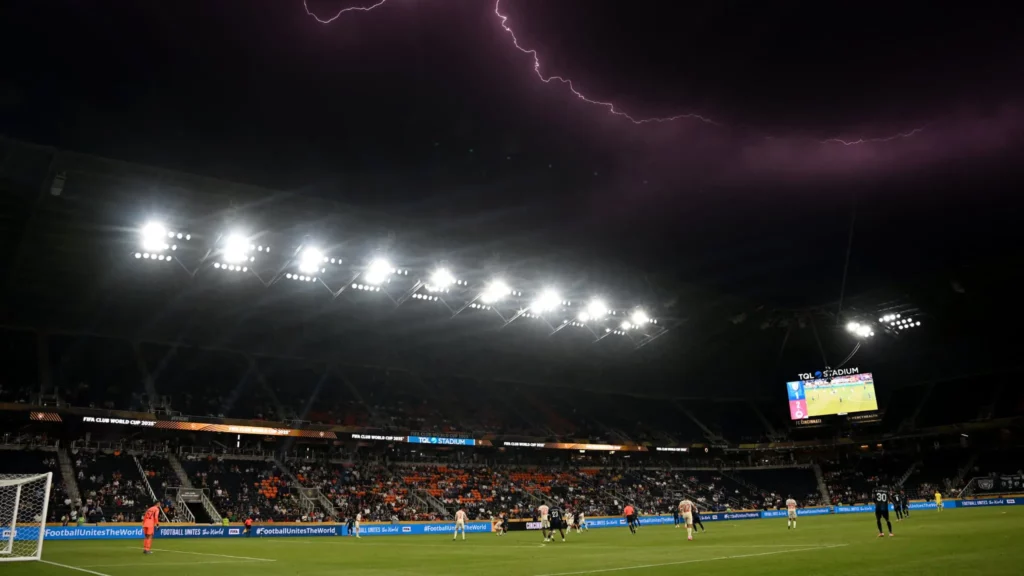
Four years ago, Morocco arrived in Qatar as a friendly outsider. The semi‑final changed everything. This Thursday evening, when the kickoff sounds, Morocco will enter this World Cup ranked seventh worldwide — its best‑ever FIFA position, with 1,756.94 points, ahead of the Netherlands. First nation in Africa. First nation in the Arab world.
The status has changed. So has the question. Does the national team staff set goals like reaching the quarterfinals or the semifinals? In fact, no. The goal is to go "as far as possible," we are told by an authoritative source. The formula is cautious. Behind it lies a much more demanding challenge — not to join the long list of nations that shone once and then disappeared. The president of the Royal Moroccan Football Federation (FRMF), Fouzi Lekjaa, puts it his way: "Qualifying for the World Cup was an achievement yesterday; it is no longer today. For Moroccans, it is a given. Being champions, staying in the world elite, is to trivialize victory."
Trivializing achievements. This is precisely what France managed to do after 1998. This is precisely what Turkey, Bulgaria, and Cameroon failed to do. The history of world football offers multiple trajectories — none of them automatic.
The curse of the isolated feat
The history of football is filled with teams that had their moment of glory and never reached that level again. In 1990, Cameroon defeated Maradona’s Argentina in the opening match, reached the quarterfinals, and even led 2‑0 against England before falling 3‑2. No African team would match this performance for twenty years. The Cameroonian engine was Roger Milla, brought out of retirement by President Paul Biya — 38 years old, double African Ballon d’Or winner. Four years later, in 1994, Cameroon conceded six goals against Russia and three against Brazil, and were eliminated in the group stage.
Bulgaria with Hristo Stoichkov, Ballon d'Or 1994, eliminated the reigning world champions Germany in the quarterfinals, finishing fourth. Bulgaria had never won a single match in five World Cup participations before. After this feat, Euro 1996 and World Cup 1998, then the collapse. Their only major participation after was Euro 2004, where they earned no points.
In 2002, Senegal defeated the reigning world champions France in the opening match and reached the quarterfinals. Then came sixteen years of absence before their return in 2018, eliminated in the group stage on fair‑play points. In 2022, they reached the round of 16, beaten 3‑0 by England.
The most extreme case remains Turkey — third in 2002, their best performance ever, with players like Hakan Şükür and Rüştü Reçber named in the tournament’s best team. Since then, no World Cup qualifications — twenty‑four years of complete absence. The coach Şenol Güneş, architect of their success, was dismissed immediately after failing to qualify for Euro 2004.
What these teams had in common was the presence of a superstar player whose individual talent masked systemic weaknesses — fragile training infrastructure and, above all, a lack of institutional pipeline. These nations produced players despite their system, not because of it.
France, the model of confirmation
France illustrates the ideal trajectory. Crowned in 1998 on home soil, they topped the FIFA rankings at the start of the 2002 World Cup. The group‑stage exit in Korea‑Japan was an accident: the team played without Zinédine Zidane, injured, and failed to score a single goal. It was not a structural regression. In 2018, after their second title in Russia, they jumped six places to reclaim the top spot worldwide. In April 2026, France still holds the number‑one position in the FIFA rankings.
What explains France’s sustainability is Clairefontaine — a continuous talent pool and a federation capable of renewing generations seamlessly. France industrialized player development where others stagnated. Zidane not only won the 1998 World Cup; he structured an entire decade of French football. His retirement after 2006 led to a period of uncertainty, then the machine produced the generation of Franck Ribéry, Karim Benzema, Samir Nasri, and later Kylian Mbappé.
The lesson for Morocco: the 2022 semi‑final can serve as a foundation only if the training structure continues to produce the next generation. This is exactly what Morocco has done — just compare the national teams of 2022 and 2026.
Croatia, intermittent resilience
When Croatia joined FIFA in 1994, they were ranked 125th worldwide. After their first World Cup in 1998, marked by a semi‑final and third‑place finish, they climbed to third in the world — one of the fastest ascents in ranking history. Then came the wilderness years: in 2002 and 2006, they were eliminated in the group stage, and then failed to qualify for 2010.
The resurgence came with the Luka Modrić generation — runners‑up in 2018 after defeating Argentina, Nigeria, and Iceland, then Denmark, Russia, and England in the knockout phase. Ballon d’Or 2018. Third place again in 2022 in Qatar. A country of four million people, considered an outsider throughout the journey.
What Croatia reveals is that they had two superstars twenty years apart: Davor Šuker in 1998 and Modrić from 2018 to the present. Between the two, a void. A country with only four million inhabitants reached two semi‑finals and a World Cup final — and without Modrić, that final would not have existed.
The lesson for Morocco: Croatia shows that a small country can maintain a presence at the top for 25 years thanks to a few exceptional generations, but the gaps between these generations can be severe. This is what Morocco aims to avoid.
Italy, the absolute counter-model
Since winning the 2006 World Cup, Italy’s record at subsequent tournaments reads as follows: group‑stage exits in 2010 and 2014, failure to qualify in 2018 (lost playoff against Sweden), failure again in 2022 (defeat against North Macedonia, one of the most shocking results in football history), and now failure in 2026. Four‑time world champions, absent from a World Cup expanded to 48 nations, where selections like Curaçao, Uzbekistan, or Cape Verde participate.
In 2006, three Italian clubs ranked among the top seven in Deloitte’s richest clubs list. In 2025, the highest‑placed Serie A club, Inter Milan, sits 11th. The last European title for an Italian club dates back to 2010. While the rest of Europe industrialized player development — England gave more minutes to young players, Spain rebuilt its technical identity, and Germany reinvented itself — Italy did not follow suit.
The lesson for Morocco: past titles do not protect. Structure matters infinitely more than the trophy cabinet.
Spain, the most instructive model
Spain is perhaps the richest case in terms of lessons. La Roja won Euro 2008, the 2010 World Cup, and Euro 2012, becoming the first nation to win three consecutive major titles. The foundation: Pep Guardiola’s Barcelona and its tiki‑taka style — Xavi, Andrés Iniesta, Sergio Busquets, all products of the same philosophy.
In 2014, Spain entered the World Cup as world number one and was eliminated in the group stage in Brazil, beaten 5‑1 by the Netherlands. Two consecutive round‑of‑16 exits followed in 2018 and 2022. The decline coincided precisely with Guardiola’s departure from Barcelona in 2012 — a textbook case of a playing system inseparable from a generation that collapses with it.
The resurgence came at Euro 2024: a fourth European title, the most of any nation, by beating England 2‑1 in the final. And there, the superstar emerged spectacularly. Lamine Yamal is 18 at the 2026 World Cup. At 17 years and one day in the Euro 2024 final, he became the youngest player ever to feature in a major final, surpassing Pelé’s record (1958). From La Masia, where Iniesta, Xavi, and Carles Puyol learned their football.
What Spain achieves is extraordinarily rare: replacing a generation of collective genius with an individual genius capable of leading a new collective.
England, the paradox of sterile wealth
England won the 1966 World Cup at Wembley, at home. Since then: two semi‑finals (1990 and 2018), two lost Euro finals (2020 against Italy, 2024 against Spain). Never champions. The Premier League, richest league in the world, attracts the best players on the planet. This economic model long stifled local development, with clubs preferring to buy foreign players trained at lower cost.
The current generation changes the narrative. Jude Bellingham, third in the 2024 Ballon d’Or at 20. Harry Kane, 78 goals for the national team. Bukayo Saka, one of the most complete wingers in the world. Declan Rice, a central midfield cornerstone. The English problem might be having several players almost at global level without one whose individual genius can single‑handedly change games.
The lesson for Morocco: a rich football ecosystem does not guarantee success at national‑team level. What matters is collective coherence and playing identity.
Argentina, the dependence on genius
Argentina illustrates a different case. A nation that has won three World Cup titles — 1978, 1986, and 2022. Their basic infrastructure ensures a solid minimum level, but it is mainly their genius players, Diego Maradona and Lionel Messi, who have led them to their greatest heights.
Eliminated in the group stage in 2002, finalists in 2014, champions in 2022. The dependence on Messi was real: his hat‑trick against Ecuador in the last qualifying match for 2018 saved the country. Since Qatar 2022, Argentina held the world number 1 spot until September 2025.
The post‑Messi question is the real Argentine anxiety today.
Morocco and the super-player question
In every case of sustained elite presence, a super‑player fulfills three simultaneous functions: elevating the collective level, legitimizing the nation in the eyes of European recruiters, and embodying an ideal for the country's youth. Achraf Hakimi, sixth in the 2025 Ballon d’Or — the highest position ever achieved by a Moroccan player — is the best right‑back in the world, 22nd in The Athletic’s ranking of the top 100 players at the 2026 World Cup, the highest‑ranked full‑back in the tournament. But a full‑back, even a world‑class one, does not carry a team like a creative midfielder or a decisive forward. His influence on the game is real but structurally different from a Zidane or a Messi.
The 2026 World Cup might reveal the emergence of a Moroccan genius on the field. And if not, it should eventually happen, given the industrialization of player development.
This World Cup could provide a beginning of an answer. Ayoub Bouaddi and Bilal El Khannouss are among the young talents to follow. If one of them explodes in 2026 as Modrić began to emerge with Croatia at Euro 2008, Morocco will have its answer. The talent pool exists. The question is whether this system can produce a game‑changer, one who shifts a nation from being a "serious contender" to a "legend of world football."
What the pipeline reveals
Morocco presents assets that set it apart from nations with a one-time parenthesis. U20 and U17 titles, a bronze Olympic medal in 2024, performances in the African Nations Championship (CHAN) and the Africa Cup of Nations (CAN) 2025, all show that the pipeline exists at all age levels. The federal governance is professionalized around a long-term project linked notably to the 2030 World Cup.

à lire aussi
Article : Nouvelle baisse du prix du gasoil et de l'essence ce mardi 16 juin
Les prix à la pompe enregistrent un nouveau recul ce mardi 16 juin 2026. Une bouffée d'oxygène pour les consommateurs, alors que le marché tente de stabiliser les contrecoups de la crise régionale en Iran.
Article : IA et désarmement : le Maroc plaide à Genève pour une approche éthique et encadrée
Réunis au Palais des Nations, diplomates, experts onusiens, représentants français et acteurs humanitaires ont débattu du contrôle humain, de la fiabilité des données et des risques liés aux systèmes d’armes autonomes.
Article : Kick-boxing : le Roi Mohammed VI félicite Mohamed Touchassie, sacré champion du monde des mi-lourds
Vainqueur lors du “Glory Collision 9” à Rotterdam, le combattant marocain a été salué pour un exploit présenté comme une nouvelle illustration du rayonnement des sportifs issus de la diaspora dans les disciplines de combat.
Article : Le Nouvel an de l'hégire (1er Moharram) sera célébré ce mercredi 17 juin au Maroc
Le 1er Moharram de la nouvelle année de l’Hégire 1448 correspondra au mercredi 17 juin 2026, a annoncé le ministère des Habous et des affaires islamiques.
Article : Adouls : la Cour constitutionnelle valide l’essentiel de la réforme, mais écarte plusieurs dispositions
Saisie par 93 députés avant la promulgation du texte, la Cour a déclaré non conformes des articles touchant aux incompatibilités professionnelles, aux personnes en situation de handicap, au témoignage collectif dit “lafif” et à l’organisation des instances représentatives. Le texte devra donc être corrigé sur ces points, sans remettre en cause le cœur de la nouvelle loi 16.22.
Article : En commission, les conseillers votent la nationalisation de la Samir et le plafonnement des hydrocarbures
Deux propositions de loi portant sur les hydrocarbures et la Samir ont été récemment adoptées en commission à la Chambre des conseillers. Un vote "surprise" rendu possible par un rapport de forces numérique défavorable à la majorité, lors d’une séance où l’opposition était majoritaire en nombre. Si ces textes ont franchi l’étape de la commission, leurs promoteurs sont conscients qu’ils ont peu de chances d’être adoptés en plénière.