
Médias24 Brief. Is the Trump administration about to force Algeria’s hand on the Sahara?
With less than six months to go before the window opened by Resolution 2797 closes, diplomacy around the Sahara is accelerating. The meeting between the senior adviser to the U.S. president for Arab and African affairs and Algeria’s ambassador in Washington reveals a sharper American resolve to draw Algiers into a framework of compromise, after years of deadlock, delaying tactics and denial.
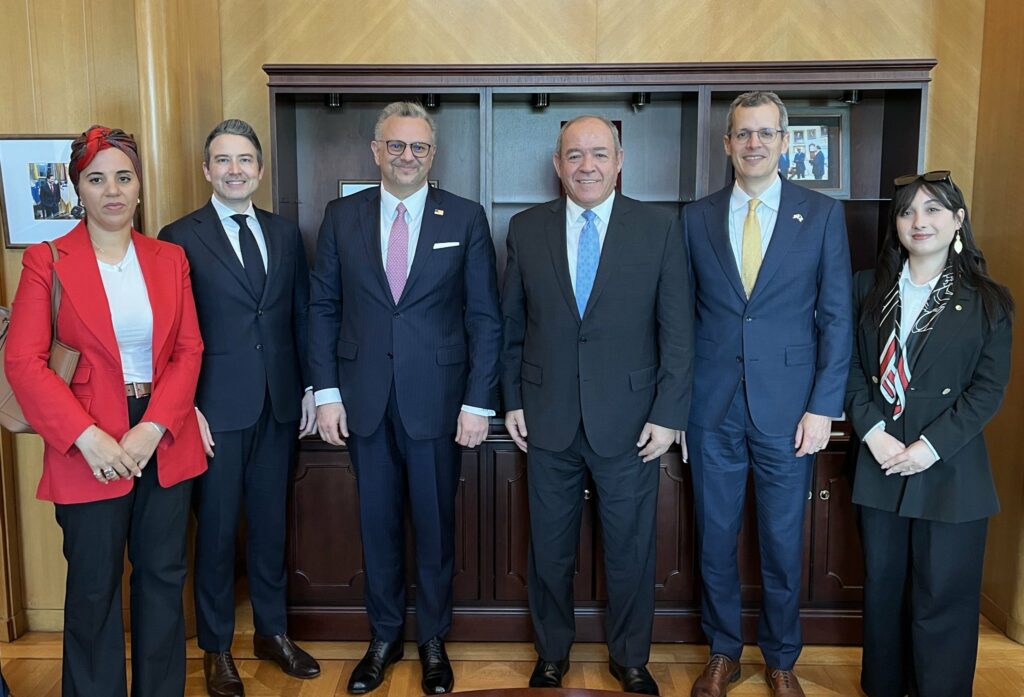
1 - The facts.
On Saturday, May 9, 2026, Massad Boulos, senior adviser to the U.S. president for Arab and African affairs, said on social media that a meeting had been held with Algeria’s ambassador in Washington, Sabri Boukadoum, who was accompanied for the occasion by his team. Also present, according to the same source, was the U.S. chargé d’affaires in Algiers, Mark Schapiro. The exact date of the meeting was not disclosed, but it is reasonable to assume that it took place that same day. As for the venue, everything points to U.S. soil, most likely Washington or its surroundings. But the most important point — and Massad Boulos himself let the cat out of the bag on this — is that the Sahara issue was on the table.
2 - The stakes.
A further attempt by Washington to put pressure on Algeria? That is the least one can say, and it is made abundantly clear by the final sentence of Massad Boulos’s post: “It is time to reach a resolution.” A barely disguised injunction, echoing in tone the statement issued the previous day, Friday, May 8, 2026, by the U.S. Embassy in Algiers in response to the latest attack by the Polisario separatist movement on the city of Smara, in which it tersely stressed that “the status quo serves no one’s interests and cannot continue.” Is this the result of Algeria’s foot-dragging?
Of course, in form, the world’s leading power continues to strike a conciliatory tone. Boulos, to quote him again, said he had “reiterated the United States’ appreciation for Algeria’s vital and ongoing diplomatic efforts to promote peace and security in the region, including its constructive engagement toward achieving a mutually acceptable solution to the Western Sahara dispute, as reflected in UN Security Council Resolution 2797.” He also welcomed the recent visit to Algiers by U.S. Deputy Secretary of State Christopher Landau and Africom Commander General Dagvin Anderson, both of whom were highly complimentary toward the Algerian authorities. Incidentally, President Abdelmadjid Tebboune returned the favor in his televised remarks on May 2, 2026, in which he even said he was “moved” by the visit of the number two in U.S. diplomacy to the country.
The fact is that, as we explained a few weeks ago, Washington does not see its approach to Algeria in adversarial terms. On the contrary, it is clearly seeking to anchor Algiers in a pacified North African order, one in which, above all, antagonistic powers such as Russia and China would be unable to exploit interstate quarrels to advance their own interests. This is, in the final analysis, a cold strategic reading, and one that requires, first and foremost, grasping the present post-Resolution 2797 momentum. Yet that window could close at any moment and lead, once again, to the very “status quo” against which the U.S. Embassy in Algiers has already warned, as mentioned above.
For its part, Morocco is sure of itself, in the image of its King, who, in a Green March speech twelve years ago that has gone down in history, declared that “Morocco will remain in its Sahara, and the Sahara will remain in its Morocco until the end of time,” at a moment when the international context was not nearly as favorable to the national cause. But the Kingdom would, of course, much prefer to spare itself the perpetuation of a dispute that has now lasted for more than half a century.
3 - The blind spot.
In his May 2, 2026 interview, Abdelmadjid Tebboune, for the first time, opened the door to the implementation of Resolution 2797, telling journalists who were hardly encouraged to press him further that “it is making its way.” This was certainly not a move made gladly by the most anti-Moroccan Algerian president since at least Houari Boumédiène (June 1965-December 1978), himself the embodiment of a regime that, in recent years, has gone so far as to close its airspace to Morocco and impose visas on Moroccans, against a broader backdrop of media propaganda often bordering on racism. This official line, it should be recalled, served as a survival strategy in the wake of the Hirak protest movement, which led to the ousting of President Abdelaziz Bouteflika in April 2019 and which, had the Covid-19 pandemic not brought it to a brutal halt, would probably have ended up shaking the foundations of the politico-military system that has held the reins of the state almost since independence. Nor did the United States’ recognition, in December 2020, of Morocco’s sovereignty over its Sahara help temper Algeria’s frenzy — far from it.
But Algeria now finds itself constrained, not to say with its arm being twisted. As is customary for the leaders of the junta when it comes to the Sahara question, they first sought to buy time in the days following the inauguration, in January 2025, of U.S. President Donald Trump, dusting off, barely 48 hours later, a memorandum of understanding on defense with the United States and signing, in the same breath, an agreement with U.S. major Chevron for the exploitation of Algeria’s offshore oil resources. “The sky is the limit,” Sabri Boukadoum would even say in March 2025.
Naturally, the United States is interested — military and economic cooperation was indeed on the agenda of Massad Boulos’s talks with the Algerian ambassador, as the U.S. official himself confirmed — but not to the point of abandoning its Moroccan ally, with which the partnership is of an entirely different strategic depth. This was particularly clear in the weeks preceding the adoption of Resolution 2797, when Algeria, then a member of the Security Council, played its last cards in an attempt to water down the text. In vain. On October 20, 2025, Steve Witkoff, Donald Trump’s personal envoy to the Middle East, said on CBS’s “60 Minutes” that an agreement was in the pipeline between Rabat and Algiers within “60 days.” In hindsight, however, this almost certainly appears to have followed misleading signals from the Algerian capital, again as part of the delaying tactics to which it has become accustomed.
How, then, can an agreement be formalized? Following the meeting held on February 8 and 9, 2026, in Madrid, diplomatic sources consulted by Médias24 at the time assured us that a final text was on track to be adopted in May 2026. That remains possible, except that, as one can imagine, part of the Algerian apparatus will certainly seek to delay the deadline even further, particularly among officers belonging to the faction of the fiercely anti-Moroccan chief of staff, General Saïd Chengriha. To the point, one may suspect, of pushing the Polisario to carry out terrorist attacks in the hope of undermining the process under way. Had Saïd Chengriha not, while serving as commander of Algeria’s third military region, encouraged separatist militias to attack Morocco, as revealed by audio recordings obtained in March 2016 by Medi 1 TV? In any case, believing that Brahim Ghali’s group acted entirely on its own on May 5, 2026, in Smara seems difficult, if not naive.
4 - What comes next...
We are already less than six months away from the end of the period covered by Resolution 2797. Two paths now lie ahead: either the text is given concrete effect and an end is finally brought to a situation that makes absolutely no sense, or Algeria blocks it. Of course, it can still do so, but at the risk of being placed under international opprobrium. That is precisely what ultimately led it, in the first place, to take part in the current negotiations as a stakeholder, after years of refusing to sit at the UN-led round tables relaunched in December 2018.
As illustrated by the very strong speech delivered by King Mohammed VI following the adoption of Resolution 2797, Morocco’s objective is far from being to humiliate Algiers and its leaders. It is simply “to reach a solution that allows all parties to save face, with neither winner nor loser.” As for Algeria’s perennial obsession with securing, at any cost, an ocean outlet, the Sovereign had, one year earlier, in his November 2024 Green March speech, reminded “those” who, “in their covetous desire for access to the Atlantic, instrumentalize the Sahara issue,” that Morocco had no objection in this regard. “Indeed, as everyone knows, Morocco was the architect of an international initiative aimed at facilitating access to the Atlantic Ocean for the Sahel States. Conceived in a spirit of cooperation, partnership and shared progress, this enterprise is intended to benefit all countries of the region,” he said.
The message could not be clearer.

à lire aussi

Article : Moment de grâce avec Dee Dee Bridgewater, une des dernières héritières des grandes voix du jazz
Quelques heures avant de monter sur la scène du Théâtre Royal de Rabat dans le cadre du Festival Mawazine, Dee Bridgewater a accordé une interview à Medias24. De son attachement au Maroc à ses souvenirs de Sonny Rollins, en passant par son amour du scat hérité d'Ella Fitzgerald, et sa conviction que le jazz est une musique éternelle, cette véritable légende américaine revient sur plus d'un demi-siècle d'une carrière jalonnée de rencontres exceptionnelles.
Article : Mondial 2030 : capacités renforcées, toitures, nouveaux aménagements... Ce que prévoit la 2e phase de transformation des stades
Après la réalisation des études techniques nécessaires, l'Agence nationale des équipements publics (ANEP) a lancé les premiers marchés relatifs à l'agrandissement et au réaménagement des stades d'Agadir et de Marrakech, en prévision du Mondial 2030. Celui de Fès ne devrait pas tarder. Round Up.
Article : Le projet d'acquisition de Safettras par TGCC soumis au Conseil de la concurrence
TGCC a notifié au Conseil de la concurrence son projet d'acquisition de 51% du capital de la Société africaine des études et des travaux spéciaux (Safettras), spécialiste des fondations profondes et des travaux géotechniques.
Article : Énergies renouvelables : un projet de décret ouvre la voie à leur intégration en moyenne et basse tension
Encore en consultation publique, un projet de décret entend accélérer l'intégration des énergies renouvelables au réseau électrique de moyenne et basse tension.
Article : Bourse de Casablanca. Le MASI termine en baisse ce 26 juin
La Bourse de Casablanca a clôturé la séance du 26 juin 2026 en légère baisse. Le MASI recule de 0,15% à 18.022,08 points, tandis que Banque Centrale Populaire domine les échanges avec 43,04 MDH.

Article : La météo du samedi 27 juin
Voici les prévisions pour le samedi 27 juin, établies par la Direction générale de la météorologie : - Temps chaud sur l’Oriental, la vallée de […]