

The Future of Global Power
BERLIN – The COVID-19 pandemic is arguably the first truly global crisis of the twenty-first century. The only modern historical parallels to the economic disruption triggered by a microscopic pathogen are to the last century’s world wars.
The start of World War I, in August 1914, not only ended a long period of peace, but also suspended an earlier epoch of economic integration and globalization. As governments around the world pursued new protectionist agendas, economic growth collapsed across the board. A generation later, another world war followed, after which the Cold War began immediately.
The world, and global politics, looked very different at the end of this period of constant conflict and power politics, from 1914 until 1989, than it did at the beginning. Prior to World War I, the British Empire was the dominant economic and military power. After World War II, it was supplanted by the United States, whose hegemonic position was further strengthened following the collapse of the Soviet Union.
The question, then, is how the distribution of global power will change as a result of the COVID-19 crisis. Whether the pandemic’s impact will be comparable to that of either world war remains to be seen. Clearly, a global economic crisis on this scale will bring serious geopolitical shocks. America, the incumbent superpower, may well cling to its position at the top of the global pecking order. But most signs suggest that China, the emerging superpower, will prevail, inaugurating an East Asian century.
The Sino-American rivalry was shaping up to be the twenty-first century’s defining hegemonic conflict long before the COVID-19 crisis. Nonetheless, the pandemic, along with election-year politics in the US, seems to be amplifying and accelerating the confrontation. For US President Donald Trump, everything is at stake in November’s election. Having mismanaged the pandemic and presided over an unprecedented domestic economic crisis, he needs a scapegoat, and China is the obvious choice.
After all, while most of Trump’s policies have, as a general rule, divided American society, his approach to China is a major exception. In going on the offensive against China, he can count on broad bipartisan support. Even deep into liberal Democratic ranks, American attitudes toward China have soured substantially in recent years.
Many US objections are hard to dismiss. The People’s Republic is indeed an authoritarian – even totalitarian – state under the exclusive control of a Leninist party. It has engaged in economic and technological espionage against the US on a grand scale, resorted to unfair trade practices, and violently asserted territorial claims vis-à-vis India, Taiwan, and in the South China Sea. From its persecution of ethnic and religious minorities in Xinjiang and recent move to consolidate control over Hong Kong to its initial mishandling of the COVID-19 outbreak in Wuhan, China’s government has done little to inspire trust.
Nonetheless, the Trump administration persistent efforts to repudiate America’s global leadership role raises a fundamental question about its approach: what does the US under Trump want? To lead without taking responsibility?
That is unlikely to work. While the US remains mired in short-term thinking, China is establishing itself as an alternative source of global leadership and investment, patiently pursuing a long-term strategy to exploit the geopolitical vacuum created by America’s inward turn.
In any case, the blow to America’s international image, especially following the Trump administration’s disastrous failure in the face of COVID-19, will be hard to repair. The pandemic is reinforcing the general impression that the US is a decadent superpower, soon to be supplanted by a strategically deft and economically dynamic China. The age-old story of the rise and fall of great powers is now being written by a virus. We can only hope that this chapter plays out peacefully.
Against the backdrop of the Sino-American confrontation, Europe finds itself caught uncomfortably between two opposing geopolitical forces – and left in the dark about America’s true intentions toward China. Does the US want to pursue containment or all-out confrontation – up to and including military conflict – to block or even reverse China’s ascent? The second strategy, reprising the West’s approach to China during the late nineteenth century, would be extremely dangerous, to say the least.
The alternative for the West is to pursue long-term containment on the basis of strategic rivalry. Europe would be well advised to choose this option. In a Chinese-led world order, Europe, situated at the western end of the Eurasian supercontinent, would be the loser. As a totalitarian one-party state, China can never be a genuine partner to Europe in normative terms. Even after three years of Trump, Europe’s relationship with the US remains much closer than the relationship it could ever expect with China.
But China is already too big, too successful, and too important to ignore. The facts on the ground call for cooperation. The key is to distinguish between strategic engagement with China and submission to it. And maintaining that crucial distinction will require Europe to avoid becoming economically or technologically dependent on the West’s rival.
à lire aussi
Article : Le Nouvel an de l'hégire (1er Moharram) sera célébré ce mercredi 17 juin au Maroc
Le 1er Moharram de la nouvelle année de l’Hégire 1448 correspondra au mercredi 17 juin 2026, a annoncé le ministère des Habous et des affaires islamiques.

Article : Adouls : la Cour constitutionnelle valide l’essentiel de la réforme, mais écarte plusieurs dispositions
Saisie par 93 députés avant la promulgation du texte, la Cour a déclaré non conformes des articles touchant aux incompatibilités professionnelles, aux personnes en situation de handicap, au témoignage collectif dit “lafif” et à l’organisation des instances représentatives. Le texte devra donc être corrigé sur ces points, sans remettre en cause le cœur de la nouvelle loi 16.22.

Article : En commission, les conseillers votent la nationalisation de la Samir et le plafonnement des hydrocarbures
Deux propositions de loi portant sur les hydrocarbures et la Samir ont été récemment adoptées en commission à la Chambre des conseillers. Un vote "surprise" rendu possible par un rapport de forces numérique défavorable à la majorité, lors d’une séance où l’opposition était majoritaire en nombre. Si ces textes ont franchi l’étape de la commission, leurs promoteurs sont conscients qu’ils ont peu de chances d’être adoptés en plénière.

Article : Retail : la guerre silencieuse pour conquérir le panier des Marocains
Pendant longtemps, les courses du quotidien se sont surtout jouées entre l’épicier du quartier, le grossiste et quelques grandes surfaces. Ce modèle commence à se fissurer. Entre fusion capitalistique, rachats d’enseignes, master-franchises, centrales d’achat, logistique commune et formats de proximité, les grands opérateurs installent peu à peu des réseaux capables d’accompagner le consommateur du café du matin aux achats du week-end. Non sans bousculer les équilibres.

Article : Crédit du Maroc : ce que cache l’augmentation de capital à 699 MDH
Depuis son passage sous le contrôle de Holmarcom, Crédit du Maroc a changé de rythme. La banque affiche des bénéfices en hausse, prépare son plan CDM Boost 2028, et propose désormais à ses actionnaires de suivre le mouvement via une opération ouverte du 26 juin au 16 juillet. Derrière le prix fixé à 938 DH par action, le marché devra surtout juger si cette nouvelle étape confirme une trajectoire ou ouvre un pari plus large. Décryptage.
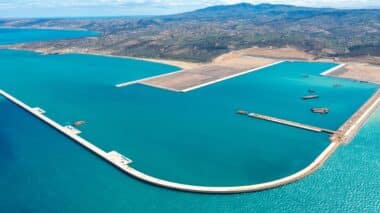
Article : Nador West Med : derrière le port, le pari industriel de l’Oriental
ROUND UP. Prévu pour entrer en service fin 2026, Nador West Med se construit déjà au-delà de ses quais : routes dédoublées, future autoroute vers Guercif, projets chinois dans l’éolien, les pneus et les alliages, ambition énergétique autour du GNL et de l’hydrogène vert. L’enjeu est désormais de transformer cette infrastructure en véritable moteur économique régional.