
Beyond Akhannouch’s record. What Morocco’s labour market indicators reveal
Under the Akhannouch government, employment remains the Moroccan economy’s main weak spot. The problem is not new, but it is worsening over time. Médias24 compares the government’s commitments with its actual record and looks beyond the current term to analyse key labour market indicators over the long run.

As previously reported in a recent article, Médias24 takes a closer look at the record of Aziz Akhannouch’s government. This time, the focus is on employment.
The analysis first examines labour market trends during the term of the National Rally of Independents (RNI), covering the 2022–2025 period. It should be noted, however, that this assessment remains incomplete, as data for 2026 is not yet available.
The second part looks at the evolution of key labour market indicators over the 2007–2025 period.
The government’s record against its commitments
On employment, the 2021–2026 government programme set two main targets:
- Create at least 1 million net jobs over five years;
- Increase the female labour force participation rate to above 30%.
Neither target has been met.
By end-2025, net job creation stands at just 95,000, far below the stated objective. Among women, the participation rate has continued to decline, reaching 19.1%, also well short of the target.
During the presentation of his record before Parliament, Aziz Akhannouch said the economy had generated around 850,000 net jobs excluding agriculture.
Non-agricultural employment has indeed proven more resilient and continued to generate jobs. However, this does not address the core issue. The government’s commitment concerned total net job creation, not just non-agricultural employment.
Even on this point, the figures are debatable. The calculations include 2021, although the current government only took office in October of that year. A consistent assessment should therefore cover 2022 to 2025, and include 2026 once data becomes available. Otherwise, the government would effectively be assessed over six years.
Focusing strictly on the relevant period, net job creation outside agriculture currently amounts to 685,000. After subtracting agricultural losses, which total 590,000 jobs, the net balance falls back to just 95,000 jobs.
It is also worth noting that 2026 is not yet included in this assessment. This year has been marked by exceptionally high rainfall, and the Minister of Agriculture has indicated that cereal production could reach around 90 million quintals.
Agricultural employment remains highly dependent on rainfall and harvest outcomes. Under such conditions, it could return to positive territory in 2026.
Meanwhile, non-agricultural employment remains the most dynamic segment, with 685,000 net job creations, most of them paid. It is also the area where public policy can have the most direct impact.
However, part of these gains reflects the public investment drive in infrastructure, particularly linked to preparations for the 2025 Africa Cup of Nations (CAN) and the 2030 World Cup. The government can claim some credit, but this trend also reflects a broader transformation of the economy beyond its immediate record.
By contrast, agricultural employment remains driven primarily by weather conditions. The government’s short-term impact in this sector is therefore limited. The response lies in longer-term structural change, including the gradual reallocation of labour towards more productive sectors.
Some economists, rural sociologists and agronomists argue, however, that agricultural employment might have been better preserved despite drought conditions if public policies since the late 1990s had not focused so heavily on supply, contributing to groundwater depletion in favour of private interests.
Beyond the record of a single mandate, employment remains a major issue in Morocco. The following sections place recent developments in a longer-term perspective.
Employment in Morocco: a persistent structural challenge
Despite signs of resilience in parts of the economy, employment remains its most visible weak point. This fragility is not new. It reflects deeper imbalances in the labour market, where economic growth, particularly outside agriculture, does not translate quickly enough into job creation, where female participation remains exceptionally low, and where the rural sector continues to transmit its volatility to the broader labour market.
Unstable and insufficient job creation
The first challenge is the instability of job creation. Morocco is not facing a simple temporary shortage of jobs, but rather a volatile trajectory, with years of strong gains followed by periods of destruction or sharp slowdowns. This irregular pattern prevents the labour market from reaching a stable equilibrium.
The major break came in 2020, when the pandemic triggered massive job losses. The rebound observed in 2021 was not enough to restore a sustained trajectory. Job creation remained weak in 2022 and 2023, before picking up again in 2024 and 2025.
This recovery reflects a short-term improvement. The economy is creating jobs again, but not at a pace strong enough to offset the accumulated imbalances.
The labour market does not only suffer from insufficient job creation. It also suffers from an inability to sustain it over time. As long as gains in one year can be wiped out or weakened in the next, the impact on unemployment remains limited.
Agriculture remains the main source of imbalance
The second challenge lies in the decisive role of agriculture in shaping overall employment trends. Data clearly show that non-agricultural sectors now drive most job creation. In both 2024 and 2025, the improvement in the overall balance was largely due to non-agricultural activities.
However, this strength is constantly offset by the weakness of agricultural employment. When agriculture sheds jobs, it absorbs a large share of the gains recorded elsewhere. As a result, the national net balance appears far weaker than non-agricultural figures alone would suggest. Over the 2016–2025 period, agricultural employment lost more than 1.272 million jobs.
This dependence means that Morocco has not yet fully decoupled its labour market from climatic and agricultural shocks.
While the economy is gradually becoming less dependent on agriculture, the transition remains incomplete. The sector’s share of total employment has fallen from 40.2% in 2010 to 25.5% in 2025, but employment dynamics are still heavily influenced by agricultural performance.
In the long run, reducing agricultural employment to around 10% of the total workforce would signal a far more advanced structural transformation and a labour market less exposed to climate-related volatility.
Persistently high unemployment: women remain most exposed
Data from the HCP show that unemployment had already reached elevated levels before the pandemic, crossing a new threshold in Q3 and Q4 2019, at 10.2%.
The situation worsened during Covid, when the unemployment rate approached 12%. Since then, the labour market has not returned to earlier, more moderate levels. Unemployment rose again in 2023, reaching a peak of 13.3% in 2024.
Over the entire 2007–2025 period, the unemployment rate never fell below 9%. While a rate above 13% is particularly high, it also reflects a persistent structural trend. Even when jobs are created, they are often too few or too unstable to significantly reduce unemployment.
Women illustrate these weaknesses particularly clearly. Female unemployment has long been high, but recent data show it rising faster than for the overall labour force. When labour market conditions deteriorate, women are disproportionately affected.
For example, the female unemployment rate increased from 10.9% in 2016 to 20.5% in 2025, a rise of nearly ten percentage points in a decade.
A significant share of employed women work in agriculture. When job creation slows and agriculture sheds large numbers of jobs, women are therefore more directly affected. This helps explain why their unemployment tends to rise faster, and why their participation rate continues to decline.
Moreover, youth unemployment has reached critical levels. By end-2025, the unemployment rate for 15–24 year-olds stands at 48% in urban areas.
This figure must be interpreted carefully. It does not mean that one in two young people is unemployed. Rather, it indicates that 48% of economically active urban youth — those participating in the labour market and actively seeking work — are without a job.
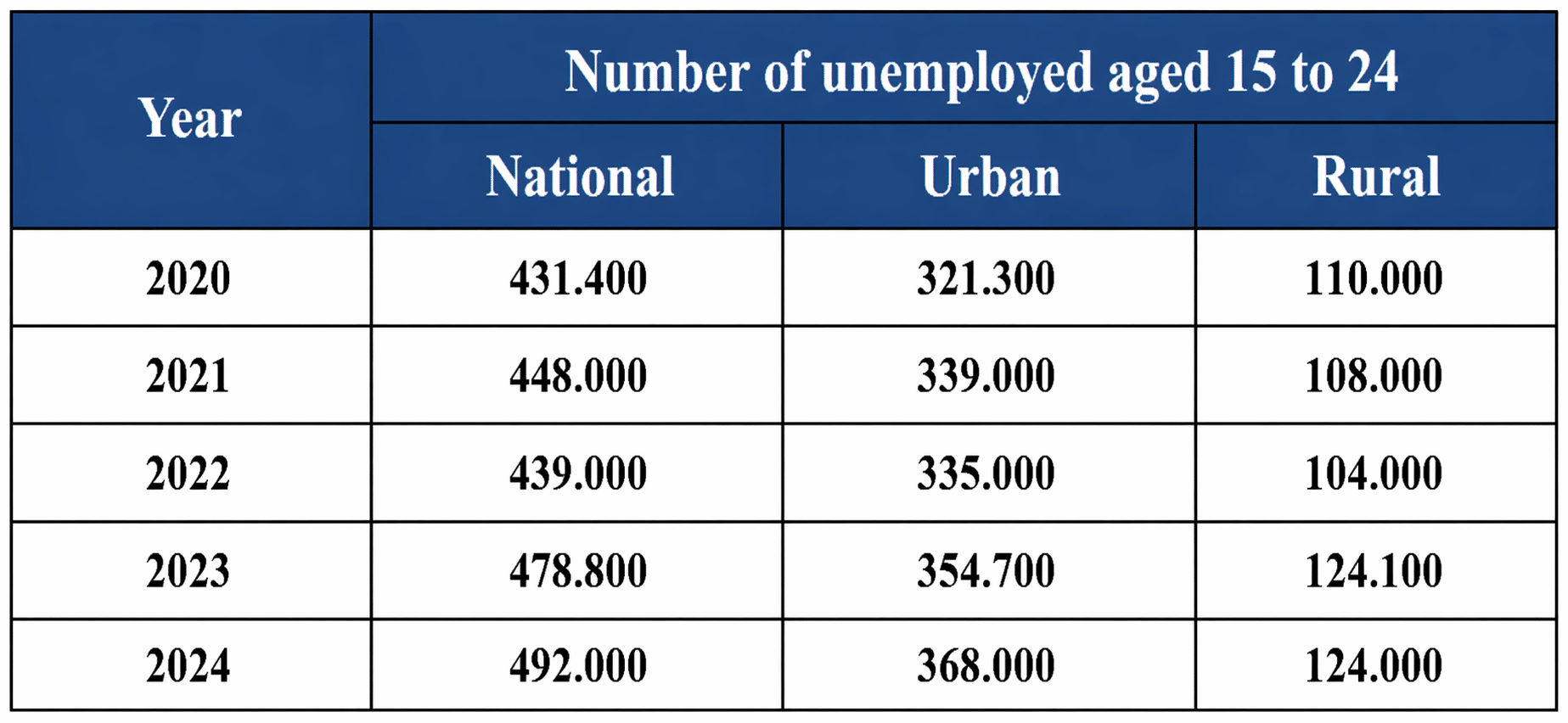
In absolute terms, the number of unemployed people aged 15 to 24 reached nearly 495,700 in 2025, including 366,500 in urban areas and 129,100 in rural areas.
A steady decline in labour force participation
Labour force participation data reveal another key trend, often less discussed but equally important. Over the long term, the share of the working-age population actively engaged in the labour market has been declining — with a sharper drop among women.
This decline means that a growing share of the population is no longer participating in the labour market. For women, particularly in rural areas, drought may partly explain this trend, as much of their activity remains tied to agriculture.
When agricultural activity contracts, job opportunities shrink sharply. Given family responsibilities, mobility constraints and limited alternatives, many women do not actively seek employment. Instead, they exit the labour force and are therefore not counted as unemployed.
This is a worrying signal. Its underlying causes need to be examined more closely. For a country like Morocco, seeking to accelerate its development and move beyond the middle-income trap, a declining labour force represents a structural vulnerability.
A rising share of graduates in employment
Data also point to a significant structural shift: employment among graduates now exceeds that of non-graduates, a transition that became visible in 2023 and has since been confirmed.
Between 2007 and 2024 (with detailed 2025 data not yet available), the share of graduates in total employment rose from roughly one-third to over half.
This trend suggests a more urban and relatively more skilled economy. It reflects a gradual shift in the structure of employment towards sectors requiring higher levels of formal qualifications, and a decline in low-skilled jobs, particularly in agriculture and rural activities.
Paid employment is rising, while unpaid work declines
Another notable change concerns the apparent quality of jobs. The share of paid employment is increasing, while unpaid work is declining.
Between 2007 and 2025, the share of unpaid work in total employment fell from 26.1% to 9.3%. In absolute terms, this corresponds to a decline from around 2.6 million to nearly 1 million jobs.
In Morocco, a large share of unpaid work is linked to rural activity and family farming. Its decline therefore reflects not only an improvement in job quality, but also the contraction of agricultural employment and the gradual disappearance of traditional forms of work in rural areas.

à lire aussi
Article : Mondial 2026 : treize pays, dont le Maroc, recadrent le patron de l'UEFA après ses propos sur les “matchs sans intérêt”
Dans un communiqué conjoint publié par la FRMF, plusieurs sélections qualifiées défendent le passage à 48 équipes, en rappelant que le Cap-Vert, Curaçao et l’Ouzbékistan vivent une première historique, tandis que le Congo et Haïti retrouvent la grande scène après de longues années d’absence.

Article : Karaté : quatre médailles et un podium mondial pour le Maroc à Rabat à la Coupe Mohammed VI
Portée par l’or de Saïd Oubaya en -67 kg, l’argent de Sawsane Benchbab et les bronzes d’Ahmed Haddadi et Mehdi Sriti, la sélection nationale a bouclé la 20e édition derrière le Japon et l’Italie, dans une compétition réunissant 369 athlètes venus de 60 pays.

Article : Le nouvel Opel Mokka débarque au Maroc
Opel fait évoluer son SUV compact phare. Le nouvel Opel Mokka gagne en modernité, en technologies et en clarté de design, tout en conservant son ADN audacieux. Un best-seller qui se renouvelle en douceur, mais avec des évolutions bien ciblées.
Article : Mondial 2026. Comment le Maroc a rivalisé avec le Brésil
ANALYSE. Après une première demi-heure très aboutie, l’équipe nationale a payé le prix de ses ambitions avant de se rendre à la raison face au Brésil, samedi 13 juin, lors de la première journée du groupe C. Si Ayyoub Bouaddi et Achraf Hakimi ont survolé la rencontre, le capitaine de l’EN n’est pas exempt de tout reproche sur le but égalisateur. Mais il n’est pas le seul.
Article : Fouzi Lekjaa : “Le Maroc ne doit son influence qu’à ses résultats”
Rumeurs d’influence, projet sportif marocain, CAF, FIFA, binationaux… Dans un entretien accordé à Al Jazeera, Fouzi Lekjaa défend une vision globale du football national et un modèle structuré, fondé sur la formation, la performance et l’impact social. Il écarte toute idée d’influence occulte ou de “pouvoir caché”.
Article : Made in EU : Renault et Stellantis plaident pour l’Europe, mais gardent une porte ouverte au Maroc
Dans une position commune adressée aux députés européens, Renault, Stellantis et Volkswagen soutiennent le principe d’un contenu européen de 70% pour les véhicules électriques. Les trois groupes demandent que seules les activités réalisées dans l’Union européenne et l’Espace économique européen soient comptabilisées comme européennes. Le Maroc resterait donc en dehors de ce calcul, mais pourrait continuer à jouer un rôle dans les chaînes de production grâce à la marge de 30% prévue pour les pays tiers.