
Ouahbi’s Strategy Against Corruption: A Lockdown That Sparks Debate
Abdellatif Ouahbi continues to defend his vision of how to fight corruption. A stance that raises sharp questions.
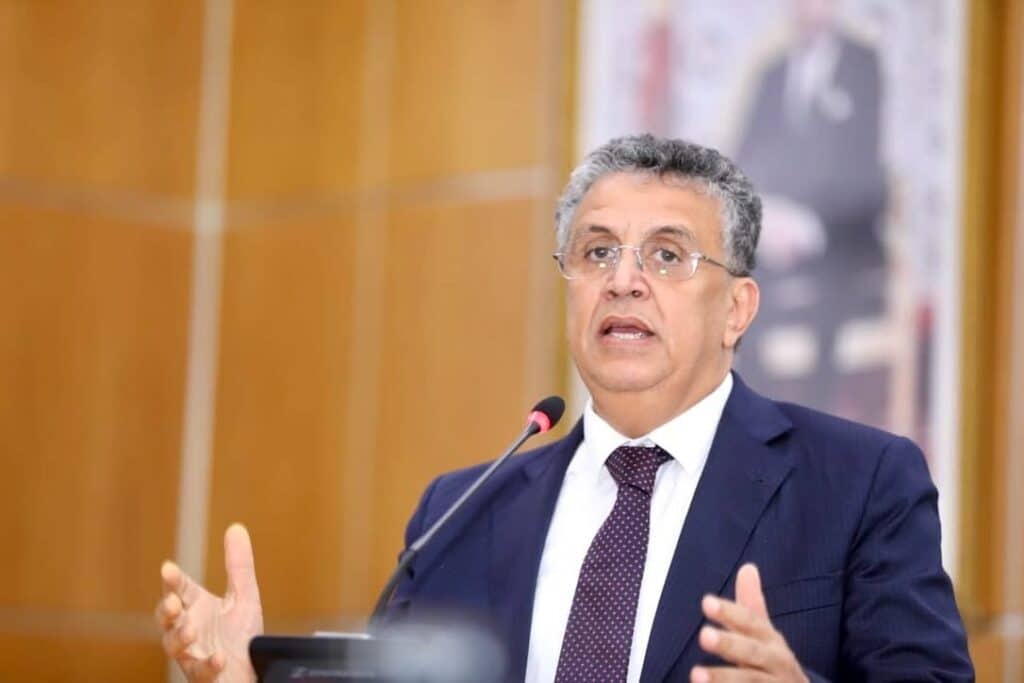
Since 2021, Justice Minister Abdellatif Ouahbi has pursued a course that limits the number of entities authorized to initiate prosecutions in cases of corruption and mismanagement of public funds.
The recent budget debates in Parliament offered him yet another occasion to reaffirm his position, which further narrows the scope for opening judicial investigations against officials.
Starting from 4.00:00
In 2021, the criminalization of illicit enrichment was slated for inclusion in the Penal Code. The measure was ultimately withdrawn by the head of government, following a request from the Minister of Justice.
At the time, this decision was justified as a need for "harmonization" with other texts, notably the Code of Criminal Procedure. Yet, several actors perceived it as the minister's intention to exclude a mechanism that could target political or administrative officials; namely, the criminalization of illicit enrichment.
Since then, Abdellatif Ouahbi has stood firm in his opposition to this criminalization, arguing that it could expose officials to unfounded complaints.
On November 12, during the parliamentary review of his department’s budget, he reiterated his position: in his view, the lack of sufficient safeguards to protect public servants from false accusations poses a major risk. "What guarantees are there for officials? There are none," he declared, invoking the presumption of innocence enshrined in the Constitution.
Unjustifiable Immunity?
This line had already appeared in his earlier interventions. In January 2024, he argued that the Penal Code as a whole already addressed illicit enrichment while safeguarding the presumption of innocence, stressing the need to balance accountability with procedural guarantees. The minister has consistently maintained that corruption exists, but that Moroccan society also comprises "serious" individuals, and the state must protect the innocent.
Yet this argument can also be read from the opposite perspective. Protecting the innocent should not eclipse the problem of genuinely corrupt officials. By drastically curtailing the avenues for justice, the system inevitably opens a space of impunity for those who abuse their positions. The fact that not all officials are corrupt, which is self‑evident, does not justify dismantling a control mechanism that has, over the years, proved a useful tool for uncovering irregularities.
Some observers draw a simple analogy: one cannot ban the purchase of knives simply because some use them to commit crimes. Likewise, the existence of abusive complaints should not justify depriving civil society as a whole of the ability to alert the justice system. Safeguards already exist, or can be reinforced, without resorting to a blanket prohibition.
An Approach Already Adopted
This approach is now reflected in the new Code of Criminal Procedure. The text has removed the right of associations for the protection of public funds to file complaints in cases of financial crime. From now on, only public institutions, such as the Court of Auditors, general inspectorates, or the public prosecutor's office, are authorized to bring cases before the courts.
According to the minister, this refocusing is necessary. He contends that certain associations are being manipulated by actors seeking to interfere in politics. He believes that unfounded complaints risk harming local officials, and that protecting them remains a priority.
Yet this position is far from consensual. Several parliamentarians and civil society actors see it as a setback in the fight against corruption. They stress that many cases uncovered in recent years have originated from complaints filed by associations, which often step in to offset structural shortcomings — institutional workload, investigative constraints, or lack of initiative. Some also recall that specialized public institutions have argued in favor of preserving the ability of associations to take legal action.
A Constitutional Issue
The removal of this right also raises a constitutional concern. Citizens are guaranteed access to justice. Limiting this faculty to certain categories, even in the name of sound administration of justice, calls into question the balance of powers and civil society’s capacity to play a monitoring role.
The minister insists that the fight against corruption must be led by "rigorous state institutions," in his words. He describes corruption as an "invisible" phenomenon, difficult to grasp, and requiring disciplined, regulated structures.
Critics, however, counter that excluding associations weakens a vital monitoring channel. They argue that the fear of abusive complaints does not justify sidelining actors who have helped uncover major cases. They also stress that less radical remedies exist to curb abuses — such as regulating communication around complaints or imposing sanctions for frivolous filings.

à lire aussi

Article : En sept mois de 5G, IAM avance des résultats très probants
Lancée en novembre 2025, la 5G produit ses premiers effets mesurables chez Maroc Telecom. Les résultats semestriels de l'opérateur font état d'une consommation de data mobile en hausse et de nouveaux usages qui s'installent, chez les particuliers comme dans les entreprises.

Article : L'État devient le premier client du secteur bancaire
En quelques années, l'État et sa sphère élargie sont devenus le premier client des banques marocaines, par les bons du Trésor mais aussi par une série d'autres mécanismes de mieux en mieux rodés. Bank Al-Maghrib reconnaît un effet d'éviction, tout en le jugeant modéré. Mais son calcul repose sur un périmètre étroit.

Article : Tournée du RNI dans le Sud : trois meetings en un jour et une riposte au PAM signée Akhannouch
Aziz Akhannouch a clairement repris la main dans la campagne électorale du RNI en prévision des législatives de septembre. À Tan Tan, Laayoune et Dakhla, il défend la présence du parti dans des régions à fort enjeu politique et pas seulement électoral.
Article : Législatives 2026 : lecture de la première annonce des têtes de liste de l’Istiqlal
À moins de deux mois des élections législatives du 23 septembre, le Parti de l'Istiqlal a dévoilé une première vague de ses têtes de liste locales. Cette sélection, qui couvre une grande partie du territoire, traduit un équilibre entre continuité et renouvellement : le parti reconduit plusieurs figures expérimentées tout en faisant émerger de nouveaux profils.

Article : Rapport Banque Mondiale: des fragilités bien réelles sous les bons chiffres
La croissance a atteint 4,9% en 2025 et le pays est passé en catégorie investissement. Le rapport de la Banque mondiale dresse toutefois un tableau plus nuancé : un marché du travail que la refonte statistique du HCP montre bien plus fragile qu'on ne le pensait et une transformation numérique inachevée.
Article : PAM : 90 têtes de liste et une inconnue nommée Lekjaâ (liste)
Réuni le samedi 25 juillet à Salé, le conseil national du PAM a dévoilé ses têtes de liste dans 90 des 92 circonscriptions locales. Mais c'est une case restée vide qui a focalisé l'attention : celle de Berkane, où se présenterait Fouzi Lekjaâ, entré au bureau politique du parti sans que personne ne sache encore quel rôle il compte y jouer. Derrière ce ralliement et celui de Yanja Khattat, une liste qui confirme les ambitions du parti..