
Batteries: Why Does the Moroccan Industrial Model Worry Brussels
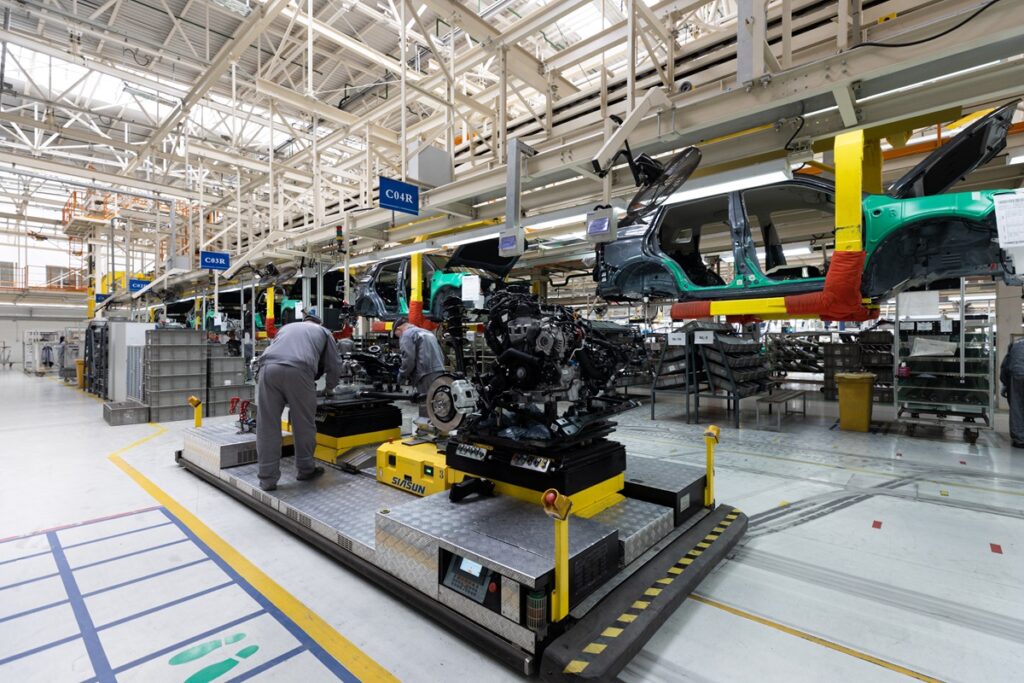
The European Union is toughening its stance toward Chinese investments. With Chinese projects in electric vehicles and batteries, Morocco now finds itself at the center of this new tension. The precedent of aluminum wheels shows that such pressure can already lead to heavy trade duties. The Kingdom intends to defend its interests, with discussions ongoing.
Essential Points:
- The European Union is toughening its stance toward China and is increasingly monitoring Chinese investments in electric vehicles, batteries, and industrial components.
- Morocco is directly affected, with the Financial Times presenting the Kingdom as a potential Chinese industrial base for access to the European market.
- For Rabat, these investments primarily align with a national industrial strategy aimed at advancing the electric mobility transition and building a battery ecosystem.
- The precedent of aluminum rims shows that Europe can impose heavy duties on Moroccan products when it perceives Chinese interests or subsidies as distorting competition.
- Morocco is currently engaged in discussions with the European Union to defend its interests, enforce existing agreements, and explore the recognition of Moroccan-made content as equivalent to European content.
-oOo-
Details:
Over the past few days, the European Union has visibly hardened its stance toward China, particularly in the Anglo-Saxon press. The debate now centers on industrial overcapacity, subsidies, Chinese components, electric vehicles, and what Brussels describes as "risks of trade circumvention."
The message from Brussels extends beyond the European market. As Europe seeks to protect its industry, it has intensified its public messaging through both direct statements and media channels. The Guardian, Reuters and, most recently, the Financial Times have all quoted the European Commission voicing its concerns.
A narrative that seeks to take a hard line against China, yet one in which Morocco finds itself directly concerned — and explicitly mentioned in the Financial Times article. The latter runs under the headline: "EU concerns about China building an industrial base in Morocco." It notes that "investments of several billion dollars have raised concerns about the risk of subsidized products flooding European manufacturers."
Industrial Accelerator Act, Rules of Origin, and Battle for Local Content
To grasp the stakes, one must first consider the broader context. The European Union is approaching a crucial summit at which major decisions could be made, particularly in the industrial sector. This refers to the European Council meeting scheduled for June 18–19, 2026, in Brussels. During the summit, European heads of state and government will discuss key geopolitical and economic priorities, including the legislative proposal for the Industrial Accelerator Act (IAA) under which new restrictions on Chinese imports could potentially be adopted.
Through the IAA, Europe is moving toward a logic of relocation and industrial preference within its own borders. The initiative aims to support low‑carbon technologies manufactured in Europe, accelerate industrial capacity, and introduce requirements related to European content in certain public programs.
Europe aims to reduce its dependence on supply chains dominated by China, particularly in clean technologies, batteries, metals, components, and electric vehicles.
Morocco is directly affected, as the Kingdom is advancing in these very sectors alongside strong Chinese partners. Yet these investments are not new — they have been public, known, and announced for several years. Why, then, does this issue suddenly worry Europe? Several sources consulted by Médias24 shed light on the underlying dynamics.
Morocco, a Collateral Damage of European Strategy?
"Europe is concerned because the Moroccan automotive sector is vertically integrating with Chinese players in the battery ecosystem, while European battery projects are stagnating." Coincidentally, an article published by Le Monde on Tuesday, June 2, perfectly illustrates our sources’ statements and the broader situation in Europe.
The French newspaper explains that French battery gigafactories are seeking alliances. "Stellantis is in talks with the Chinese giant CATL over the future of ACC, the joint venture it created with Mercedes and TotalEnergies, while relations remain strained between Renault and Verkor, deemed too costly and delayed in the eyes of its client and shareholder."
One of our sources adds: "The European battery industry is struggling to take off due to issues of know‑how, quality, and technological mastery. Meanwhile, Morocco’s ecosystem is taking shape, with factories emerging — some already starting production and even exporting to the United States — in a context where Chinese cars are flooding Europe and Europeans are failing to stem this rise."
In essence, Europe is being challenged on its own market. Its solution to halt the Chinese wave is to close all entry points — even if collateral damage occurs.
Morocco and Turkey stand as collateral damage in the industrial strategy Europe seeks to establish.
In this complex context, Chinese investments in Morocco in electric vehicles, batteries, and industrial components take on an increasingly political dimension. For Chinese groups, Morocco represents a credible platform for investment, production, and global export — including to Europe.
For Morocco, these projects are an opportunity to upgrade, strengthen its industrial base, and integrate more deeply into electric‑vehicle value chains.
For Brussels, they serve as a test case for its new industrial policy toward China.
Surcharge on Aluminum Rims, the Harbinger
Moreover, Morocco has already had a foretaste of the new European approach. With the issue of aluminum rims produced in Morocco, there was a precedent. The European Union had already imposed anti-dumping duties on aluminum rims produced in Morocco in 2023. In 2025, it added countervailing duties after determining that certain imports were unfairly subsidized. The heaviest case concerns Dika Morocco Africa, a company with Chinese capital producing in Morocco.
Customs data consulted on June 2, 2026, show that European imports linked to this company are subject to an anti‑dumping duty of 17.5% and a countervailing duty of 31.4%, bringing the total charge to 48.9%.
For Hands 8, a Korean‑owned industrial company, the rate is lower — 8%. The reduced tariff was justified by the company’s transparency with EU investigators.
In essence, Europe accepts preferential trade with Morocco but has created a mechanism to neutralize it whenever it deems the arrangement no longer in its favor.
Morocco contested the decision, defending its position and invoking the framework of the association agreement with the European Union. Nevertheless, the duties remain in force on the ground.
Ongoing Political Discussions to Protect Moroccan Interests
In this battle where European protectionism is now openly embraced, Morocco is standing its ground. Our sources confirm that political discussions on the matter are currently underway.
"Morocco will defend its interests. Moreover, there are free‑trade agreements; any European decision must comply with these agreements, otherwise serious challenges will arise in the future," one source told us.
While tensions over this issue are intensifying in the media — particularly between Europe and China — the Kingdom has not publicly entered the debate.
However, our sources confirm that exchanges are ongoing and that Morocco’s arguments are far from lacking.
Morocco can position itself as a reliable partner for the European Union, enabling the latter to integrate into the Moroccan battery ecosystem and make up for its delay within a win‑win framework.
As for the idea Europe insists on — that China is using Morocco as a Trojan horse or a rear base to access the European market — one source argues: "The Chinese are already established within the EU. They have factories in Hungary, Turkey, and Slovenia, and we would like to assess their level of local integration."
In any case, Morocco intends to advance more diplomatic arguments. Chinese investments in Morocco primarily serve the needs of the Moroccan automotive sector, supporting its electric transition and the development of a battery ecosystem.
Moreover, the main projects involve co-investments with Moroccan capital: COBCO with CNGR and Al Mada, or Gotion Power Morocco with the involvement of CDG.
To address this issue, Morocco is exploring with the European Union the possibility of recognizing, in certain industrial frameworks, Moroccan‑produced content as equivalent to European content, given its association agreement with the EU and its integration into European automotive value chains.
If these discussions lead to a resolution, they could settle the matter and preserve Moroccan exports to the EU while safeguarding Chinese investments in Morocco — and, above all, Moroccan sovereignty over its industrial fabric and strategic orientation.

à lire aussi
Article : Coupe du monde 2026. Le Maroc s’offre une courte mais précieuse victoire sur l’Écosse (1-0)
Malgré quelques frayeurs, l’équipe nationale a quasiment assuré sa qualification pour le second tour du Mondial 2026 après avoir conservé son but d’avance sur la Tartan Army, ce vendredi 19 juin à Boston. Les Lions de l’Atlas occupaient provisoirement la tête du groupe C, à l’issue du match contre l’Ecosse, en attendant la rencontre entre le Brésil et Haïti.

Article : Autorisation des cliniques privées : le secteur dénonce le blocage de dizaines de dossiers par le ministère de tutelle
Les cliniques privées dénoncent le blocage de dizaines de dossiers d'autorisation d'exploitation, "malgré leur passage par l'ensemble des étapes réglementaires". Le ministère n’avait pas encore réagi à ces accusations au moment de la publication de cet article.
Article : La CDG lance un appel d'offres pour confier 15 MMDH d'actifs du RCAR au marché
La Caisse de dépôt et de gestion lance l'appel d'offres destiné à sélectionner les sociétés de gestion qui se partageront une enveloppe de 15 milliards de dirhams d'actifs du Régime collectif d'allocation de retraite. Cette opération concrétise le projet d'ouverture au marché dévoilé fin 2025. Les candidatures sont ouvertes jusqu'au 31 juillet 2026.

Article : Aéroport Mohammed V : 144 MDH pour l’ingénierie du futur terminal
L’Office national des aéroports prévoit de mobiliser près de 144 millions de DH pour une mission d’ingénierie et d’assistance technique liée à la construction de la nouvelle zone terminale de l’aéroport Mohammed V de Casablanca.

Article : Prévisions météorologiques pour le samedi 20 juin
Voici les prévisions pour le samedi 20 juin, établies par la Direction générale de la météorologie : - Temps chaud sur le Sud-est, l’Est et […]

Article : Temps chaud et averses orageuses ce week-end et en début de semaine prochaine
Un temps relativement chaud est attendu dans plusieurs régions du Royaume au cours des prochains jours, notamment sur le Sud-Est, l’Oriental, les plaines intérieures et les provinces du Sud. Des averses orageuses localisées concerneront également certaines zones de l’Atlas et de l’Oriental, tandis que les températures poursuivront leur hausse au début de la semaine prochaine.