
Nigeria-Morocco Gas Pipeline. The project that could reshape Africa’s energy map (Amina Benkhadra)
As global energy markets undergo a profound reshaping, the Atlantic Africa Gas Pipeline is emerging as a pivotal project for both Africa and Europe. Amina Benkhadra, CEO of ONHYM, says the corridor could fundamentally alter the energy balance between the two neighboring continents.
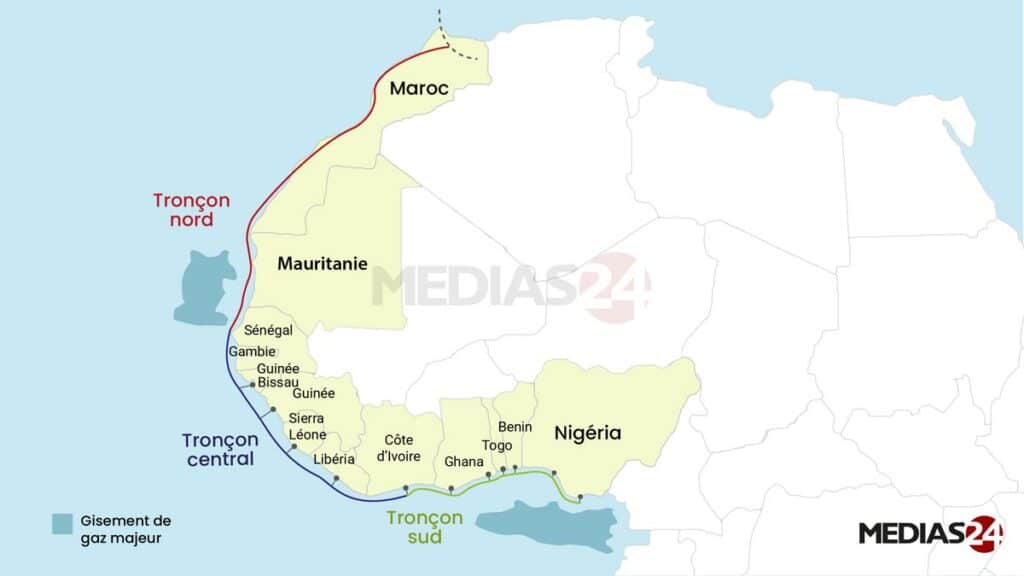
At a time when geopolitical tensions are reshaping global energy flows, the Atlantic Africa Gas Pipeline (AAGP), linking Nigeria to Morocco, stands out as one of the continent’s most ambitious projects. Conceived as a regional initiative, it goes well beyond a conventional export project. In the long term, it is set to become a key piece of infrastructure for economic and energy integration.
A continental project with multiple ambitions
Running along the Atlantic coast, the pipeline will cross thirteen West African countries. By linking Nigeria’s vast gas reserves to Morocco, it is expected to feed an integrated regional network, with potential onward connections to Europe through the Maghreb-Europe gas pipeline.
In comments to Médias24, Amina Benkhadra, CEO of Morocco’s National Office of Hydrocarbons and Mines (ONHYM), said the project should serve as a genuine platform for regional energy integration. In her view, it is not limited to a purely export-driven rationale.
By connecting African and European markets, the Atlantic Africa Gas Pipeline is also expected to create an unprecedented energy corridor across the Atlantic basin, she said.
An economic backbone for West Africa
According to Benkhadra, the pipeline was designed as a multi-purpose infrastructure project. It aims both to monetize Nigeria’s substantial gas reserves and to supply West African economies with reliable energy.
“The pipeline addresses several objectives at once: securing supply, stimulating regional demand and creating an energy bridge to international markets,” Benkhadra said. She added that the project, which is expected to serve 400 million people, would help foster a genuine regional gas market, reduce dependence on imports and strengthen economic integration across the continent.
A phased implementation to secure investment
Since its launch in 2016 under a vision championed by King Mohammed VI and former Nigerian President Muhammadu Buhari, and now carried forward by Bola Ahmed Tinubu, the project has made significant progress. Feasibility studies have been completed, a route has been defined, agreements have been signed with the countries concerned, and an intergovernmental agreement was adopted by the Economic Community of West African States (ECOWAS) at the end of 2024.
Benkhadra also highlighted phased development as one of the project’s main strengths. Initial connections are expected to involve Ghana and Côte d’Ivoire in the south, as well as Morocco, Senegal and Mauritania in the north.
“This phased approach will help generate regional demand from the early stages and reduce financial risks,” she said, adding that the model should strengthen both the project’s bankability and its resilience to market shifts.
A driver of industrialization for the continent
Beyond energy supply, Benkhadra said the pipeline could play a decisive role in West Africa’s industrial development, pointing to the need for reliable gas to support power generation as well as heavy industry and mining.
“The project is a genuine backbone for regional industrialization,” she said. In her view, the emergence of industrial zones and integrated energy markets could, through the AAGP, accelerate the economic transformation of the region as a whole.
A strategic opportunity for Europe
Europe also sees the corridor as a credible alternative. It offers a new route for stable and competitive energy supply between the two continents, at a time when importing markets are seeking to diversify their sources of gas.
“Access to external markets significantly strengthens the project’s economic viability,” Benkhadra said, adding that its dual regional and international dimension is one of its main advantages.
Morocco, a future regional energy hub
À découvrir

à lire aussi
Article : Santé numérique : ce que le projet de loi prévoit de changer dans votre parcours de soins
Le projet de loi 52.26 adopté en Conseil du gouvernement pose les bases de la santé numérique au Maroc. Dossier médical partagé, identifiant sanitaire unique, plateforme nationale et agence dédiée… Il encadre l’accès aux données, fixe les droits des patients et prévoit des sanctions. Détails.
Article : Déficit budgétaire 2026 : le Maroc peut-il tenir les 3% ?
Malgré le choc énergétique, la hausse des dépenses sociales et salariales et l’accélération de l’investissement public, le gouvernement maintient son objectif de ramener le déficit budgétaire à 3% du PIB en 2026. La cible est comptablement atteignable. Reste à savoir si cet ajustement repose sur des bases solides et durables.
Article : Gazoduc Nigeria-Maroc : qui paiera et quand le gaz arrivera
De Casablanca à Abuja, la signature de l’accord intergouvernemental le 19 juillet marque un tournant pour ce projet destiné à acheminer le gaz ouest-africain jusqu’au Maroc et à l’Europe, soutenu par d’immenses réserves gazières au Nigeria, au Sénégal et en Mauritanie. Qui doit le financer, comment il sera construit au Maroc et pourquoi le premier gaz n’est attendu qu’en 2031 : tour d’horizon.

Article : Aviculture : prix toujours bas, jusqu'à 3 DH de pertes par kg pour les éleveurs
Les prix du poulet continuent de reculer au Maroc, creusant les pertes des éleveurs. Le secteur espère toutefois une remontée progressive des prix à partir de septembre, portée par une baisse attendue de l'offre et un léger rebond de la demande. Détails.
Article : Settat : l’ONEE renforce l’alimentation en eau avec un projet de 210 MDH
L’Office national de l’électricité et de l’eau potable a mis en service la première tranche d’un projet de 210 millions de dirhams destiné à renforcer et sécuriser l’alimentation en eau potable de Settat et des localités voisines. Cette première phase permet de doubler le débit d’alimentation de la ville.
Article : La fondation CDG distingue six projets d’innovation sociale digitale
La fondation CDG a clôturé la 2e édition de DIGIT@CTION, un programme dédié à l’innovation sociale digitale. Six projets portés par des associations ont été retenus et bénéficieront d’un financement, ainsi que d’un accompagnement pour soutenir leur déploiement.