
The Brexit Boon to Europe and the US
STANFORD – Most Europeans are happy that Joe Biden will be the next president of the United States. Whether they realize that Biden’s economic policies will put the euro and Europe in a bind is another matter. The new US administration will want the euro to remain strong against the dollar in order to keep the US economy humming.
With the goal of boosting spending on the pandemic response, the environment, and infrastructure, the Biden White House will undoubtedly pressure the US Federal Reserve to keep the value of the dollar low, regardless of how much more fiscal stimulus it can coax out of Congress. And having done so many favors for Donald Trump, the Fed chair, Jay Powell, will be in no position to refuse Biden. In this context, it was a stroke of genius for Biden to appoint Janet Yellen to serve as Secretary of the Treasury. As Powell’s predecessor at the Fed, she still has significant influence there. For good reason, Wall Street is betting heavily against the US dollar for the next year or two.
The expected Biden policy approach will have a dramatic effect on the European economy, which remains heavily reliant on exports. In 2019, exports accounted for 46.9% of Germany’s GDP, 31.8% of France’s, and 31.5% of Italy’s. Europeans cannot afford to sit idly by and watch the euro strengthen to the point that it strangles their exports.
The best solution would be for Germany to deploy a fiscal stimulus, as this would “internalize” a good amount of EU trade, rendering the euro’s appreciation against other currencies irrelevant. Instead of exporting to the US, Italians could export more to Germany and other northern eurozone countries, since the additional stimulus will have provided the means for increased purchases from the south. Europeans have a huge internal market; it is time to use it, even if only to militate against a runaway euro that could otherwise split the European Union.
Just as the US forced quantitative easing on Europe to save its own economy from an overvalued euro in 2014, Biden’s policies are likely to force an expansionary fiscal policy on the Germans for the very same reason. If it happens, the deciding factor this time around will have been Brexit. Had the United Kingdom not left the EU, the chances for German fiscal stimulus and a new model of internalized EU trade would have been close to zero.
As Karl Kaiser, a former director of the German Council on Foreign Relations, tells Roger Cohen of The New York Times, “Brexit made [German Chancellor] Angela Merkel willing to abandon positions that had been sacred.” Merkel was afraid that others would leave the EU if Germany did not change its financial policies. By the same token, the EU’s new €750 billion recovery fund, perhaps Merkel’s greatest achievement, would not have happened had the British stayed in the bloc. As Cohen explains, “The European Union can now borrow as a government does – a step toward sovereign stature and a means to finance the $918 billion pandemic recovery fund that a British presence would probably have blocked.”
It would appear that the British left the EU at just the right moment. The new US president, facing a raft of urgent policy demands at home, will be in a strong position to nudge the Germans in precisely the direction they need to go – toward a new model of greater EU fiscal stimulus and internalized trade.
Since this shift, which could prove a strong antidote to European populism, would help to harmonize US-EU relations and benefit both the US and European economies, no one in Washington, DC, or Brussels should shed any tears for Britain’s departure. The Germans may not be eager to embrace an internalized trade model, but they should recognize that Brexit, in this case, is good for Europe. It has introduced the possibility of a mixed fiscal- and monetary-policy model that would be far more effective than the strictly monetary-based approach that has dominated EU policymaking since the 2008 financial crisis.
Yes, the European Central Bank has performed wonders with its expansionary monetary policy of the past dozen years. ECB President Christine Lagarde and her predecessor, Mario Draghi, deserve great credit for their bold policy decisions. With the sovereign-bond-yield spread between northern and southern eurozone countries having narrowed dramatically, the ECB has managed to integrate the two regions financially for the first time ever. Moreover, the yields on higher-risk periphery assets are now at or close to all-time lows.
These financial developments have been great for European unity and solidarity. But history shows that monetary policy alone cannot finish the job of delivering strong economic growth. Though the euro keeps reaching new heights, the European economy is in a slump, and the ECB is still consistently undershooting its inflation target of “below, but close to, 2%.” In seven of the last eight years, inflation has been closer to 1% than 2%, and the market expects this to continue for the next decade.
This is unacceptable. Fortunately, by allowing fiscal policy to be brought into the EU policy mix, Brexit is precisely what Europe needs to pursue a more effective macro-economic stabilization policy, and to deal with a “beggar-thy-neighbor” currency policy on the part of the Fed.
à lire aussi

Article : Adouls : la Cour constitutionnelle valide l’essentiel de la réforme, mais écarte plusieurs dispositions
Saisie par 93 députés avant la promulgation du texte, la Cour a déclaré non conformes des articles touchant aux incompatibilités professionnelles, aux personnes en situation de handicap, au témoignage collectif dit “lafif” et à l’organisation des instances représentatives. Le texte devra donc être corrigé sur ces points, sans remettre en cause le cœur de la nouvelle loi 16.22.

Article : Parlement : deux textes sensibles sur la Samir et les carburants passent en commission
Deux propositions de loi portant sur les hydrocarbures et la Samir ont été récemment adoptées en commission à la Chambre des conseillers. Un vote "surprise" rendu possible par un rapport de forces numérique défavorable à la majorité, lors d’une séance où l’opposition était majoritaire en nombre. Si ces textes ont franchi l’étape de la commission, leurs promoteurs sont conscients qu’ils ont peu de chances d’être adoptés en plénière.

Article : Retail : la guerre silencieuse pour conquérir le panier des Marocains
Pendant longtemps, les courses du quotidien se sont surtout jouées entre l’épicier du quartier, le grossiste et quelques grandes surfaces. Ce modèle commence à se fissurer. Entre fusion capitalistique, rachats d’enseignes, master-franchises, centrales d’achat, logistique commune et formats de proximité, les grands opérateurs installent peu à peu des réseaux capables d’accompagner le consommateur du café du matin aux achats du week-end. Non sans bousculer les équilibres.

Article : Crédit du Maroc : ce que cache l’augmentation de capital à 699 MDH
Depuis son passage sous le contrôle de Holmarcom, Crédit du Maroc a changé de rythme. La banque affiche des bénéfices en hausse, prépare son plan CDM Boost 2028, et propose désormais à ses actionnaires de suivre le mouvement via une opération ouverte du 26 juin au 16 juillet. Derrière le prix fixé à 938 DH par action, le marché devra surtout juger si cette nouvelle étape confirme une trajectoire ou ouvre un pari plus large. Décryptage.
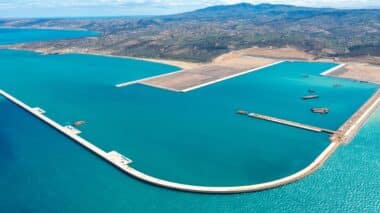
Article : Nador West Med : derrière le port, le pari industriel de l’Oriental
ROUND UP. Prévu pour entrer en service fin 2026, Nador West Med se construit déjà au-delà de ses quais : routes dédoublées, future autoroute vers Guercif, projets chinois dans l’éolien, les pneus et les alliages, ambition énergétique autour du GNL et de l’hydrogène vert. L’enjeu est désormais de transformer cette infrastructure en véritable moteur économique régional.

Article : Pour près de 395 MDH, ce sera Urbagec/Separator qui construira la future gare LGV de l’aéroport de Casablanca
Le marché porte sur le lot 4 du projet, dédié à la construction de la gare ferroviaire de l’aéroport Mohammed V. Cinq candidats étaient en lice, dont SGTM, Sogea Maroc et Construction Management Services, pour une estimation initiale fixée à 380 millions de DH hors taxes.