
From Casablanca to Boston: Inside the Global Excitement of Morocco–Scotland
Before becoming a victory, Morocco–Scotland was, for Médias24, above all a journey. A short night in Casablanca, an almost full plane, the Atlantic to cross, Boston to reach — then a slow ascent toward Foxborough, where jerseys, songs, flags, and accents weave another geography of football. In the end, the Atlas Lions won. But around them, what the World Cup still promises to make more vivid came into view: the journey, the crowd, a rivalry without hatred, and a celebration greater than the score. Boarding.
On Thursday, June 18, 2026, just before 3 a.m., not a soul can be seen in the terminal of Mohammed V Airport in Casablanca. Yet there is a feline presence — the lion, the Atlas lion — its face proudly displayed alongside the national red and green colors.
Even if you're not a football fan, it's hard to miss that the World Cup is underway — especially with Morocco in the mix. Travelers gradually arriving at Mohammed V Airport are well aware of it, many wearing the national team jersey. They are crossing the Atlantic to support Mohamed Ouahbi’s squad in their second match of the North American World Cup against Scotland in Foxborough, southwest of Boston, after a 1–1 draw with Brazil five days earlier.
"I couldn’t make it to Russia in 2018 or to Qatar in 2022, so this feels like the perfect chance to make up for it,"one traveler says while waiting in line at the Royal Air Maroc check-in counters on the second floor of Terminal 2.
The flight to Boston is scheduled for 7:30 a.m. and is expected to last seven and a half hours, with arrival at 10 a.m. Eastern Time in the United States. Normally, Royal Air Maroc serves only three American cities — New York, Washington, and Miami — with Los Angeles recently added. But for the World Cup, the airline led by Hamid Addou has arranged thirty-two special flights for about 8,800 fans attending Morocco’s three group-stage matches.
A round-trip economy ticket costs around 10,000 dirhams, tax included. Once purchased, it gives fans the option to buy a stadium ticket from the Royal Moroccan Football Federation for the symbolic price of 550 dirhams. Overall, it’s within reach for many Moroccans. In any case, the Boeing 787-9 Dreamliner we boarded was nearly full at takeoff.
A Sleepless Night to Boston
Seven and a half hours later, as planned, we land at Boston’s Logan International Airport, named after a U.S. Army general known for his role in the Spanish-American War and World War I. Approaching Boston Harbor, where the city’s skyline begins to emerge under the plane’s wing, passengers finally wake from their transatlantic daze, some joining in to sing the national anthem.
Exhausted after a sleepless night in Casablanca, most passengers spent the crossing in a state of intermittent drowsiness, broken only by the movements of the cabin crew. Perhaps they were also saving their energy for the intense forty-eight hours ahead.
This is when conversations begin to unfold. Standing in the aisle, retrieving their luggage from the overhead compartments, a father explains how he wanted to give his two teenage sons, seated beside him during the flight, the experience of attending the most iconic football competition on the planet.
Their adventure in Uncle Sam’s land doesn’t end in Boston. After Scotland, the trio plans to continue on to Atlanta, where Morocco will face Haiti on June 24. All three are devoted Raja supporters. When a Wydad fan in a red cap joins the conversation in jest, the father instinctively tightens the green-and-white scarf around his neck.
Logan Airport is a 10- to 20-minute drive from downtown Boston, depending on traffic. By bus, you can take the Silver Line SL1, which takes a bit longer. That’s the option we choose after a short stop at a hotel near the terminals.
Boston under Scottish Colors
For those unfamiliar with the city, Boston defies the spectacular image often associated abroad with the United States — endless avenues, skyscrapers, and grandeur. It is a more compact, older city, almost European in places, where red brick buildings, Victorian facades, steeples, campuses, and quays tell the story of America’s origins and its prestigious universities.
One thinks of the Boston Tea Party, a defining moment in America’s revolt against British rule; of Harvard, across the Charles River; of the Kennedy dynasty; of the Red Sox at Fenway Park, one of baseball’s most iconic stadiums; and of the gritty portraits of the city in films such as Good Will Hunting and The Departed. A city of history, learning, and sport — one that, on that day, Scottish supporters seemed to have joyfully taken over.
Back at Logan to catch the Silver Line, Scottish jerseys emblazoned with lions and blue flags bearing St. Andrew’s white cross stand out in the crowd. Near the Freedom Trail — the route linking Boston’s key Revolutionary sites — one could almost mistake the scene for Hampden Park, Glasgow’s national stadium, given the overwhelming presence of the Tartan Army.
And the first sign of this is… beer: for several days, it has been flowing freely in downtown bars, from counter to counter and even onto the narrow sidewalks, with reports of shortages in some establishments caught off guard by the enthusiastic thirst of these tireless devotees of hops. "No Scotland, No Party"is the chant — a festive anthem that will echo again the next day in Foxborough.
Moroccans, by contrast, are less conspicuous and far less inclined toward pub crawls. Yet they are there too, dressed in red, flags in hand, readily joining the impromptu celebrations. Far from any tension, the encounter takes on a jovial, communal tone. Laughter, banter, and friendly exchanges fill the air.
When a Scottish supporter confidently predicts a 1–0 win for his team, a Moroccan replies with a broad smile: "I don’t like what I hear!"Everyone bursts into laughter. Even before the match, Boston already resembles what a major sporting event like the World Cup promises when it delivers: a moment where allegiances are proudly displayed without conflict, and where rivalry serves mainly as a pretext for camaraderie.
Heading to Foxborough
None of it fades the next day. At 2:40 p.m. on Friday, June 19, in front of our hotel, we board one of the yellow buses chartered by Boston Stadium Express, operated by Yankee Line, linking Boston, Logan, and several points across Greater Boston to Foxborough — home to Gillette Stadium, usually the stage for the New England Patriots in American football and the New England Revolution in soccer, as European football is known across the Atlantic. To comply with FIFA’s commercial rules, the venue has been temporarily renamed Boston Stadium.
On a normal day, the ride from Boston to Foxborough takes less than an hour. But with the World Cup in full swing, it takes twice as long. It’s nearly 4:40 p.m., barely eighty minutes before Uzbek referee Ilgiz Tantashev is due to blow the opening whistle, when our bus finally stops at Lot 55, one of the parking areas surrounding the stadium.
The same impression returns almost instantly: the Scots are everywhere. Amid rows of cars and coolers, many have already settled in, beers in hand, embracing the American tradition of tailgating — eating, drinking, and socializing near the stadium before kickoff. Beyond this pre-match campsite, visitors must walk on gravel, cross the road, and follow the signs, guided by on-site staff under the watchful eyes of Foxborough police and Massachusetts state troopers. For newcomers, the route takes a few minutes to get used to.
In this hustle and bustle, familiar faces emerge. In the distance, a recent guest from "12/13,"a weekly show on Médias24, seems recognizable. Later, social media will confirm that several Moroccan personalities have also made the trip. Presumably, the same is true on the Scottish side. Perhaps the middle‑aged man next to whom we sat during the match had also recently appeared on the Scottish equivalent of "12/13,"and a certain Wissam McBouzdaini, in kilt and sporran, spotted him from afar but refrained from interrupting.
Boston Stadium impresses with its scale. Though the arena retains its distinctly American character — surrounded by a vast asphalt ring built for NFL Sundays and crowds arriving from afar — it operates with remarkable efficiency: towering stands, clear sightlines, giant screens, and smooth crowd flow, giving the feeling of entering a finely tuned sports machine. Yet the natural turf laid for the tournament, the FIFA branding, and the global ceremony transform this structure born of another sporting culture into a genuine World Cup stage.
It’s hard not to think of the new Prince Moulay Abdellah Stadium in Rabat, recently inaugurated. The comparison feels apt: Morocco has built a venue of similar caliber — modern, spectacular, and worthy of major global events. And if next year’s Grand Stade Hassan II in Benslimane continues that ambition on an even grander scale, the Kingdom will have every reason to claim the 2030 World Cup final it co-hosts with Spain and Portugal.
Morocco Triumphs, Scotland Roars On
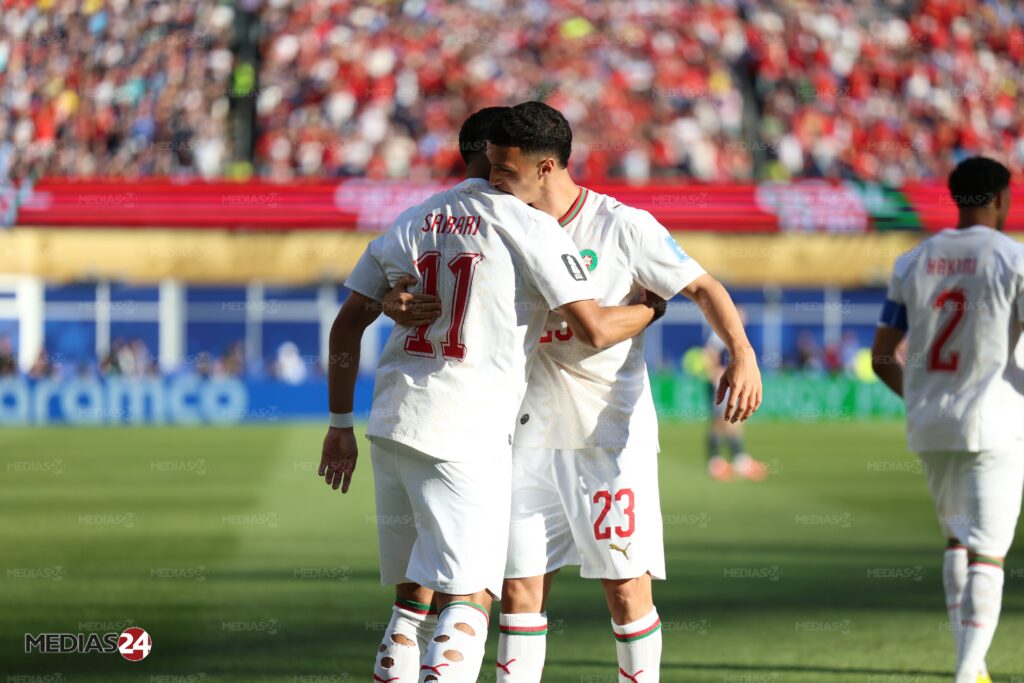
As expected, Morocco–Scotland kicks off promptly at 6 p.m. Ismaïl Saibari quickly finds the net past Angus Gunn, following a perfectly executed pass from Brahim Díaz, deployed as a right-sided playmaker.
There’s no need to recap a match most readers have likely already watched. Yet it’s worth noting that, in reality, Ouahbi’s strategy is even more finely tuned than it appears on television. Every player is dynamic: when one moves out of position to draw a Scottish opponent or respond to tactical demands, another immediately steps in.
The national coach is a known proponent of "juego de posición,"popularized notably by Pep Guardiola during his historic tenure from 2008 to 2012 at FC Barcelona. Yet at times, elements of relational football — a newer school that focuses more on player interactions than fixed positions — can also be seen. Its most prominent representative is former Brazil coach (2023–2024) Fernando Diniz. It is clear that Ouahbi closely follows the latest tactical trends.
"We are dreadful,"summarizes a Scottish supporter in his northern UK accent. But perhaps it's simply that Ouahbi did an excellent job.
In a more realistic scenario, Morocco could have won by a wider margin. In the second half, Díaz, this time, opts for a selfish move and refrains from delivering a second assist to Saibari that could have sealed the match. This urge to be a "superhero"rather than just a "hero,"as former captain Romain Saïss described him a few months ago…
Ayoub Bouaddi, for those wondering, is as impressive in person as he is on screen. A player destined for a bright future, taking charge when needed — he is not even 19 yet, let’s remember — and stepping up when the stakes are high. A high-ranking source at the FRMF had predicted an €80 million transfer after the World Cup, but he is undoubtedly worth much more now.
Another player note: Issa Diop is far from the mediocre footballer some describe him to be. Though less comfortable with the ball at his feet than his central defensive partner Chadi Riad — trained at La Masia, in case anyone needed reminding — he was imperious in the air and repeatedly prevented dangerous situations for the Scots by winning aerial duels. It is certainly a masterstroke by Ouahbi and his staff to have integrated him.
After particularly nerve-wracking final minutes, as Scottish fans fervently chant "Scotland! Scotland!", the Moroccans secure their first World Cup victory and claim second place in Group C behind Brazil on goal difference.
The Scottish supporters, however, keep their jovial spirit. "Chill, man, just enjoy it!", one of them exclaims, breath heavy with alcohol — if that needed clarifying — as though the result were just another chapter in this epic North American journey.
And it is for this reason — their magnificent presence at this World Cup, their loud loyalty, their self-deprecation — that against Brazil we hope they will roar. It would mean at least two lions in the round of 16: Scotland’s rampant lion and Morocco’s Atlas Lion, which we encounter again upon our return to Casablanca Airport on Saturday, June 20. Perhaps more understated than its northern cousin, but equally determined not to leave the American continent too soon.

à lire aussi
Article : Le Maroc pour la première fois aux Young Lions Competitions de Cannes
L’Union des agences conseil en communication (UACC) a conduit la première délégation marocaine aux Young Lions Competitions 2026, organisées dans le cadre du Festival international des Cannes Lions. Le Royaume était représenté dans trois catégories de cette compétition internationale.

Article : Alerte météo : vague de chaleur jusqu’à 46 °C et orages ce mercredi 1er juillet
Les températures les plus élevées concerneront notamment Zagora, Tata, Assa-Zag, Boujdour, Es-Semara, Aousserd et Oued Ed-Dahab. Des averses localement fortes, avec risque de grêle et rafales sous orages, sont attendues dans quatre provinces de 14 h à 23 h.
Article : Sahara : première visite à Laâyoune pour le nouvel ambassadeur de France au Maroc
À peine installé, Philippe Lalliot s’est rendu dans les provinces du Sud, où il a été reçu par la commune de Laâyoune.
Article : Viande : face aux prix qui flambent, le gouvernement envisage de réactiver les exonérations sur les ovins importés
Interrompu en septembre 2025 après le recensement du cheptel, le dispositif revient sur la table alors que l’ovin atteint jusqu’à 140 DH/kg au marché de gros de Casablanca et autour de 180 DH chez les bouchers. Une mesure de court terme, déjà testée sans effet durable, dans une filière toujours minée par les intermédiaires.

Article : Marchés de gros de Casablanca : légère baisse des prix de la viande ovine au 1er juillet 2026
Au 1er juillet 2026, les prix relevés au marché de gros de Casablanca restent globalement stables. La viande ovine recule de 2 DH/kg, s'établissant à 138-140 DH/kg, tandis que la viande bovine enregistre une légère hausse de 1 DH/kg sur son prix minimum, s'affichant désormais entre 85 et 110 DH/kg.

Article : Code de la famille : Ahmed Assid et le cheikh égyptien Mahmoud Amer au cœur d’un vif débat sur l’héritage
Dans un échange tendu, le penseur marocain a plaidé pour une relecture des règles successorales au nom des droits économiques des femmes, tandis que son contradicteur a défendu leur caractère intangible. Une controverse à l’ancienne où il a été question de Constitution, d’ijtihad, de takfir et de la place du religieux dans l’État moderne.