
70 Years of the Royal Armed Forces. From Citizen-Soldier to AI, the King Ushers Morocco’s Army into a New Era
On the occasion of the 70th anniversary of the Royal Armed Forces, King Mohammed VI issued an Order of the Day carrying strategic messages. Between technological modernization, the consolidation of the defense industry and the strengthening of the social dimension, the Sovereign outlines the contours of a military institution ready to meet the challenges of the 21st century.
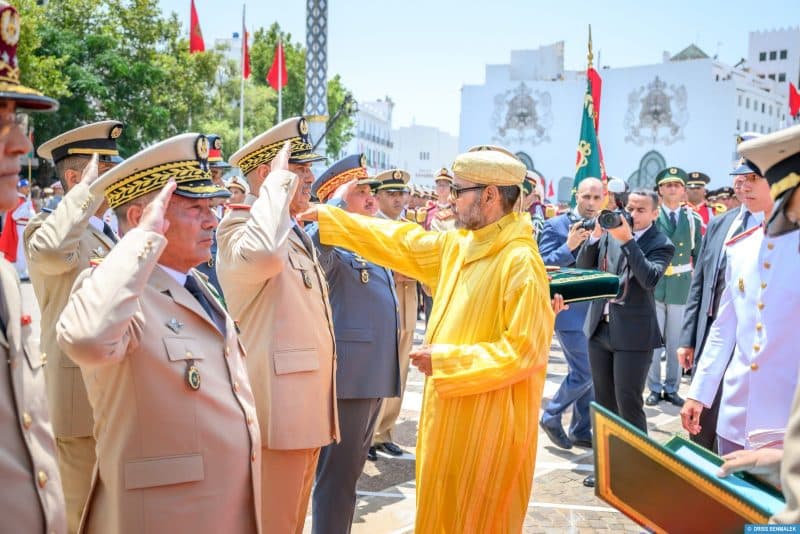
The 70th anniversary of the creation of the Royal Armed Forces (FAR) is more than a simple date in the Kingdom’s institutional calendar. It marks a pivotal moment, a “national epic” linking the legacy of independence to the ambitions of the future. Addressing officers, non-commissioned officers and enlisted personnel this Thursday, May 14, King Mohammed VI, Supreme Commander and Chief of General Staff of the FAR, breathed new momentum into this seventy-year-old institution, a central pillar of Moroccan sovereignty.
In his Order of the Day, the Sovereign invited the military family to a moment of contemplation and reflection on the path travelled since 1956. He expressed his deep appreciation for the evolution of this “solid institution”, paying tribute to the sacrifices made by soldiers so that Morocco may remain a haven of peace and security, while preserving its territorial integrity.
The royal message is that of a leader satisfied with the resilience and professionalism of his troops. The King praised the achievements made over the past period, stressing that the maturity acquired by the FAR now allows them to rank among the most respected armies for their discipline and effectiveness.
For the Supreme Commander, however, this celebration is not an end in itself, but a springboard. While saluting the progress achieved, he insisted on the need to continue working for the constant development of the Armed Forces. The objective is for Morocco’s military institution not only to preserve its fundamentals, but also to adapt with agility to the “profound changes” taking place across the global geopolitical and technological landscape.
As our military consultant Abdelhamid Harifi notes, this Order of the Day is “a message of high satisfaction that defines the new priorities of the national defense apparatus, placing anticipation and modernization at the heart of the Kingdom’s military doctrine.” It is therefore an army proud of its past, yet resolutely focused on innovation and performance, that the Sovereign continues to shape with insight.
An army at the heart of humanitarian action: the citizen-soldier on the front line
While securing land, maritime and air borders remains the backbone of the institution, King Mohammed VI made a point of stressing that the FAR’s vocation extends far beyond the strictly military sphere. Over the decades, the Moroccan army has established itself as a key player in emergency relief, embodying a true “humanitarian epic” in direct service to citizens.
The Sovereign particularly praised the responsiveness of units during the recent floods that hit the north and west of the Kingdom. The interventions in Ksar El Kébir and in the Gharb plain were cited as examples. The army did not merely ensure a security presence; it handled the emergency evacuation of populations trapped by the waters, their emergency accommodation, as well as the distribution of essential food supplies and medical care.
The humanitarian commitment of the FAR is also reflected in their relentless fight against isolation. On royal instructions, medical and paramedical teams, as well as logistics units, were deployed to the most remote mountain areas in the provinces of Azilal, Al Haouz and Midelt. Faced with harsh weather conditions and snowstorms, these military field hospitals served as a last line of support for thousands of households, providing vital assistance where geography makes access difficult.
For Abdelhamid Harifi, this dimension is one of the strong messages of this 70th anniversary. He notes that the Sovereign insisted on “careful planning and coordination” between the various forces.
“What we see on the ground is a fusion of efforts. King Mohammed VI highlighted the FAR’s ability to work hand in hand with the Royal Gendarmerie, National Security, the Auxiliary Forces and Civil Protection. This synergy between the military and civilian spheres under a central authority allows for maximum efficiency during crises. It is a model of emergency management that reassures citizens and strengthens the sense of national security.”
This versatility, which sees the soldier move from surveillance duties to local medical assistance, reflects the transformation of the FAR into a community-based institution, capable of responding to climate and social challenges with the same rigor as it does to conventional threats.
Technological sovereignty: toward a “made in Morocco” defense industrial ecosystem
One of the most strategic pillars of the royal Order of the Day lies in the desire to propel the Royal Armed Forces into the era of high technology. For King Mohammed VI, the modernization of the defense apparatus is no longer merely an option, but a “major priority” to guarantee the performance and interoperability of troops in the face of contemporary hybrid threats.
The Sovereign laid out a clear technological roadmap, ordering the acceleration of cutting-edge scientific programs. The focus is on a “qualitative transformation” based on artificial intelligence (AI), the broad digitalization of command systems and the strengthening of cybersecurity.
This shift aims to equip the FAR with a proactive response capability, able to process massive amounts of data in real time and protect the Kingdom’s critical infrastructure against new forms of conflict.
The royal vision goes beyond the mere acquisition of foreign equipment. It aims to build genuine industrial autonomy. As analyst Abdelhamid Harifi explains, Morocco is in the process of structuring a “core” national defense industrial ecosystem. “The objective is twofold: to gain industrial independence and reduce dependence on technological imports. By promoting the development of “homegrown Moroccan” solutions through applied scientific research, the country is no longer merely learning from the experience of global conflicts; it is creating its own tools, tailored to its terrain and specific needs.”
Yet this technology would be meaningless without highly qualified human resources. The royal message insists on upgrading military academies and schools so that they meet the standards of the world’s best armies. The training curriculum for officers and non-commissioned officers is now geared toward innovation, with stronger partnerships with public institutions to integrate new technical specializations.
By combining scientific research, local industry and high-level training, the Sovereign is preparing the FAR to “meet all challenges with insight and professionalism.” This technological rise gives Morocco a position of regional leadership, enabling it to protect its territorial integrity while remaining a credible partner, technologically compatible with the world’s major powers.
Military service: a school of citizenship and a bridge to employment
Beyond its defense mission, King Mohammed VI reiterated his vision of military service as a true lever for human development. Far from being a mere obligation, it is now elevated into a “strategic gateway” toward the socio-professional integration of Moroccan youth.
The Sovereign insisted on the adoption of an integrated approach, breaking with traditional models to embrace modernity. Thanks to strengthened partnerships between the FAR and public institutions, conscripts now benefit from updated teaching and supervision methods.
The aim is to equip young people with advanced technical skills in new specializations that respond directly to the current needs of the national economy and the expectations of the labor market.
For the Supreme Commander, military service is above all a school of life. It is about instilling in young people the cardinal values of “solidarity, discipline and responsibility.”
“The royal message is clear: military service plays a major role in strengthening the sense of belonging to the Homeland. It is not only about learning the profession of arms, but about cultivating active citizenship that will serve the country in all fields, civilian and military,” Abdelhamid Harifi stresses.
At 70, the Royal Armed Forces assert themselves more than ever as Morocco’s unwavering bulwark. By combining constant loyalty to the Nation’s immutable principles with exemplary agility in the face of future technological and climate-related challenges, they continue to uphold the eternal motto: God, Homeland, King.

à lire aussi
Article : Bourse de Casablanca : les minières sauvent un semestre marqué par la correction du marché (bilan)
Après un semestre marqué par une correction du marché, quelles valeurs ont résisté ? Quels secteurs ont tiré leur épingle du jeu ? Et où les investisseurs ont-ils concentré leurs échanges ? Voici le bilan des six premiers mois de 2026 à la Bourse de Casablanca à travers les principales performances de la cote.

Article : Textile : le déficit de main-d’œuvre dans la confection pèse sur les exportations
Les exportations textiles reculent de 9,1% à fin mai 2026, une baisse que les perturbations logistiques du premier trimestre ne suffisent plus à expliquer. L’aggravation de la baisse en avril et mai montre que le problème dépasse désormais le seul facteur logistique. La cause principale est aujourd’hui le déficit de main-d’œuvre, qui pèse directement sur la production, les délais de livraison et la capacité des entreprises à honorer leurs commandes.
Article : Traitement de l'eau. Le britannique Hydro Industries s'implante au Maroc avec Hydro Services Morocco
Le britannique Hydro Industries Limited s’implante au Maroc avec la création de Hydro Services Morocco, une SAS au capital de 1 MDH dédiée aux métiers du traitement de l’eau, de l’assainissement et du dessalement.
Article : Le Maroc face au choix du Rafale : les clés d'un arbitrage géopolitique contre le tout-américain
Si la volonté d'éviter une dépendance exclusive envers les États-Unis est réelle, l'équation budgétaire et le défi du nombre face à la flotte d'Alger imposent un examen attentif des réalités du terrain.
Article : Maroc-Chine : en attendant le Sahara, la relation bilatérale économique s'accélère
Dix ans après l'établissement d’un partenariat stratégique entre Rabat et Pékin au cours de la visite royale en Chine en 2016, l’ambassadrice chinoise au Maroc a célébré cet événement en déclarant que les relations économiques bilatérales ont connu une progression exceptionnelle. Si les perspectives industrielles et touristiques apparaissent plus que prometteuses, la question d'une éventuelle reconnaissance chinoise de la marocanité du Sahara au Conseil de sécurité de l'ONU demeure toujours entourée de précautions diplomatiques. Explications.

Article : IDE : le flux net progresse de 41,8% à fin mai 2026
Les investissements directs étrangers (IDE) au Maroc poursuivent leur progression à fin mai 2026. Porté par une hausse des recettes et un recul des dépenses, leur flux net atteint 23.319 MDH, en hausse de 41,8% par rapport à la même période de 2025. Dans le même temps, les investissements directs marocains à l’étranger (IDME) enregistrent également une nette progression.