
Football: Moroccan Refereeing Under the Spotlight
Integration of technologies, performance‑analysis platforms, VAR operations, and the internal organization of the refereeing body — the modernization of Moroccan refereeing took center stage at a meeting held on Thursday, May 7, in Salé by the National Arbitration Directorate.
The Essentials:
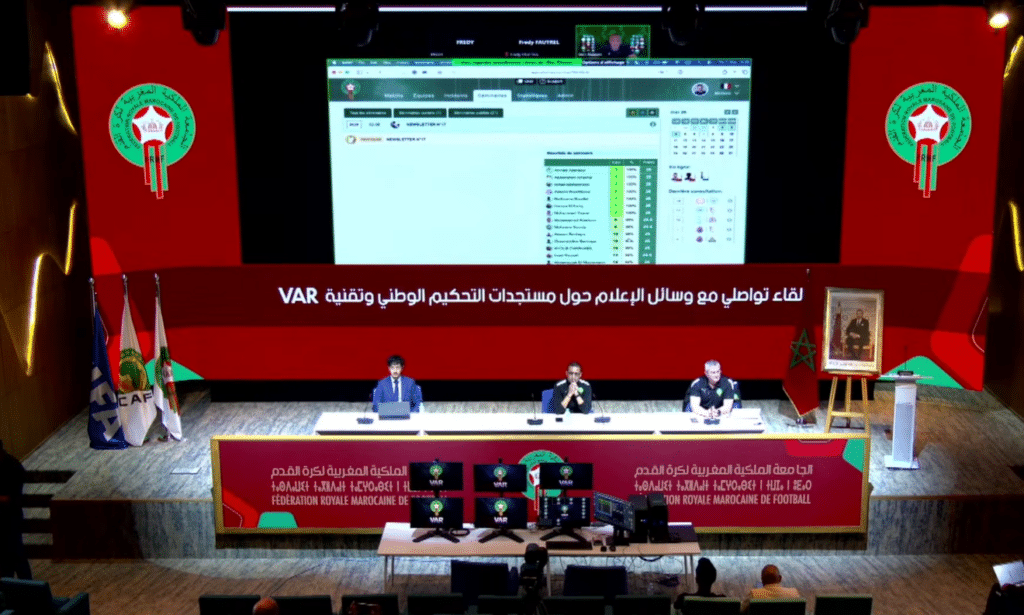
The National Arbitration Directorate made an unprecedented appearance before the media during a conference held on Thursday, May 7, at the Mohammed VI Football Complex in Salé.
Long-awaited, the event offered a wealth of insights and revelations. Its purpose was to deepen public understanding of how Moroccan refereeing operates — its technological tools, evaluation methods, and overall structure.
Showcasing the RefBal platform, performance statistics and the complexity of decisions assisted by VAR were presented. Successive interventions by several international experts highlighted steady progress in a system that is clearly evolving.
Furthermore, the National Arbitration Directorate announced the automation of several game situations through an artificial‑intelligence tool to be implemented from next season onward.
In the meantime, the Casablanca derby between Raja and Wydad, scheduled for Saturday, May 9, will serve as the first test for body cameras, allowing spectators to experience the match from the referee’s unique perspective.
Key Points:
- Improved decision accuracy announced, reaching nearly 90% after VAR review.
- Referee remuneration in Botola Pro 1 estimated at around 1,000 DH per match, plus travel and accommodation allowances.
- First body‑cam trial to take place during the upcoming Casablanca derby.
- Semi‑automated offside technology (SAOT) to be introduced starting next season.
Details:
It was an anticipated meeting that left observers wanting more. On Thursday, May 7, the National Arbitration Directorate outlined its internal operations during a session open to the media, held in the amphitheater of the Mohammed VI Football Complex in Salé.
This initiative comes at a time when almost every match reignites debates over refereeing decisions — discussions that show no sign of fading.
Yet, it is clear that some criticisms are not necessarily justified. For instance, regarding referee appointments, it turns out that selections are actually made through a specialized digital platform.
MyreFRMF integrates a comprehensive organizational framework — from the automatic appointment of referees to the management of grades and certifications, competition scheduling, and allowance tracking.
A comprehensive digital architecture designed to centralize the entire refereeing operation within a single system.
Undoubtedly, Redouane Jayed, the National Director of Arbitration, was inspired to present the structure of Morocco’s refereeing ecosystem.
While not all questions were answered, the event shed new light on a sector in full transformation. The ongoing digitalization of appointments, evaluations, and training programs is clearly driving this evolution.
A Gloomy Economic Reality
Beyond the technological aspect — which will be explained in more detail shortly — it is also necessary to revisit the remuneration of referees, still far from matching the pressure and expectations placed on their shoulders.
Although not the central focus of the speakers, a slide briefly shown and then removed revealed figures related to refereeing in Botola Pro 1.
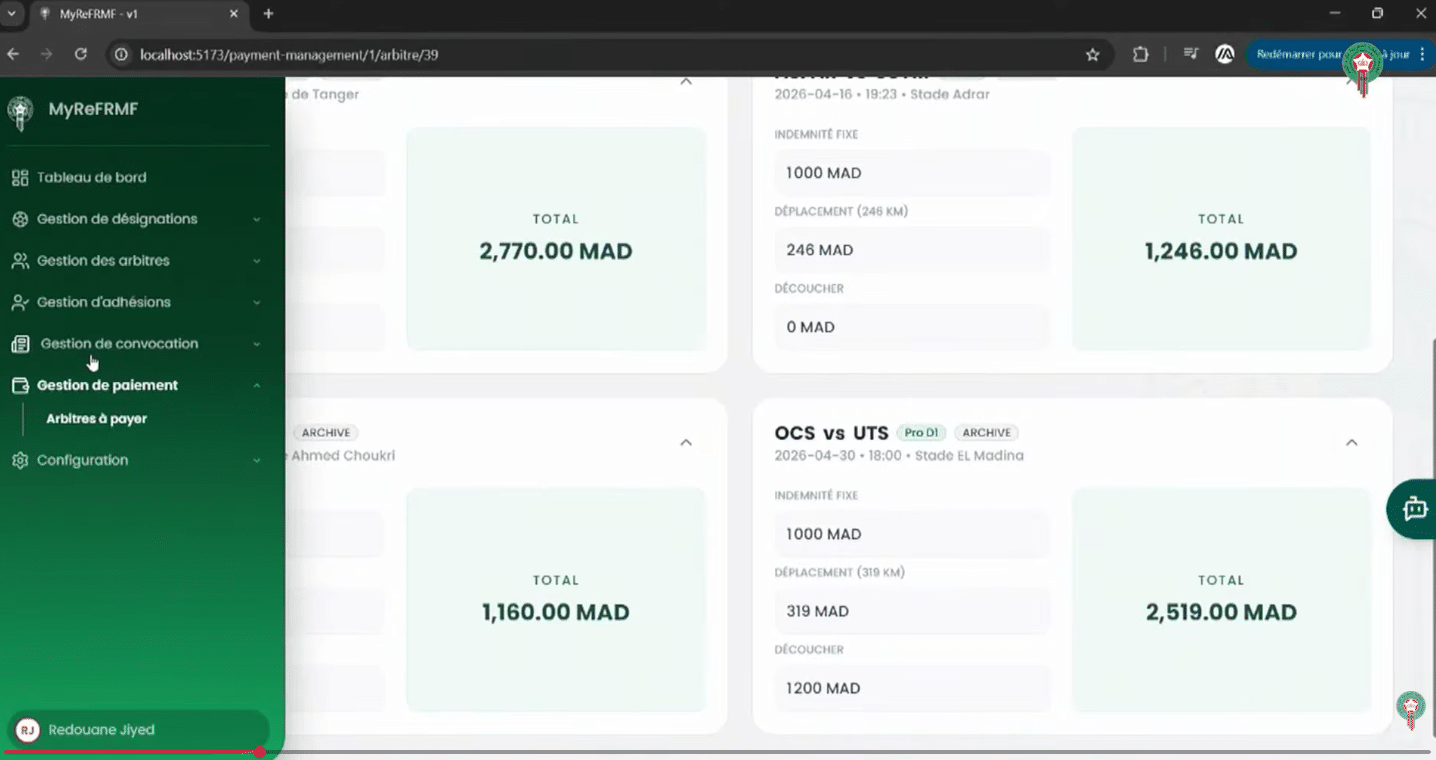
A referee receives approximately 1,000 dirhams per match as a fixed fee. In addition, there are variable expenses covering travel and an accommodation allowance.
For instance, the referee of the match between OC Safi and Union Touarga received a total of around 2,519 dirhams, distributed as follows: 1,000 DH fixed, 319 DH for travel, and 1,200 DH for accommodation.
This is light‑years away from the amounts allocated to referees in other leagues, especially in Europe. For comparison, a referee in France’s Ligue 1 earns at least ten times more.
On average, remuneration reaches around €3,543 per match, in addition to daily allowances of up to €600 for away games, plus transportation and accommodation expenses.
This comparison puts into perspective the workload, pressure, and limited economic recognition of Morocco’s refereeing body.
RefBal Platform: a Pillar of Modernization
Despite receiving remuneration that hardly reflects their level of commitment, national referees are nevertheless supported by technological innovations designed to enhance their performance through an evaluation process where precision is essential.
The RefBal platform has indeed been presented as one of the pillars of this modernization. It centralizes all data related to referees and structures a detailed evaluation process after each match.
In practice, referees can review their decisions, analyze edited video sequences, and compare their judgments with those of a specialized department.
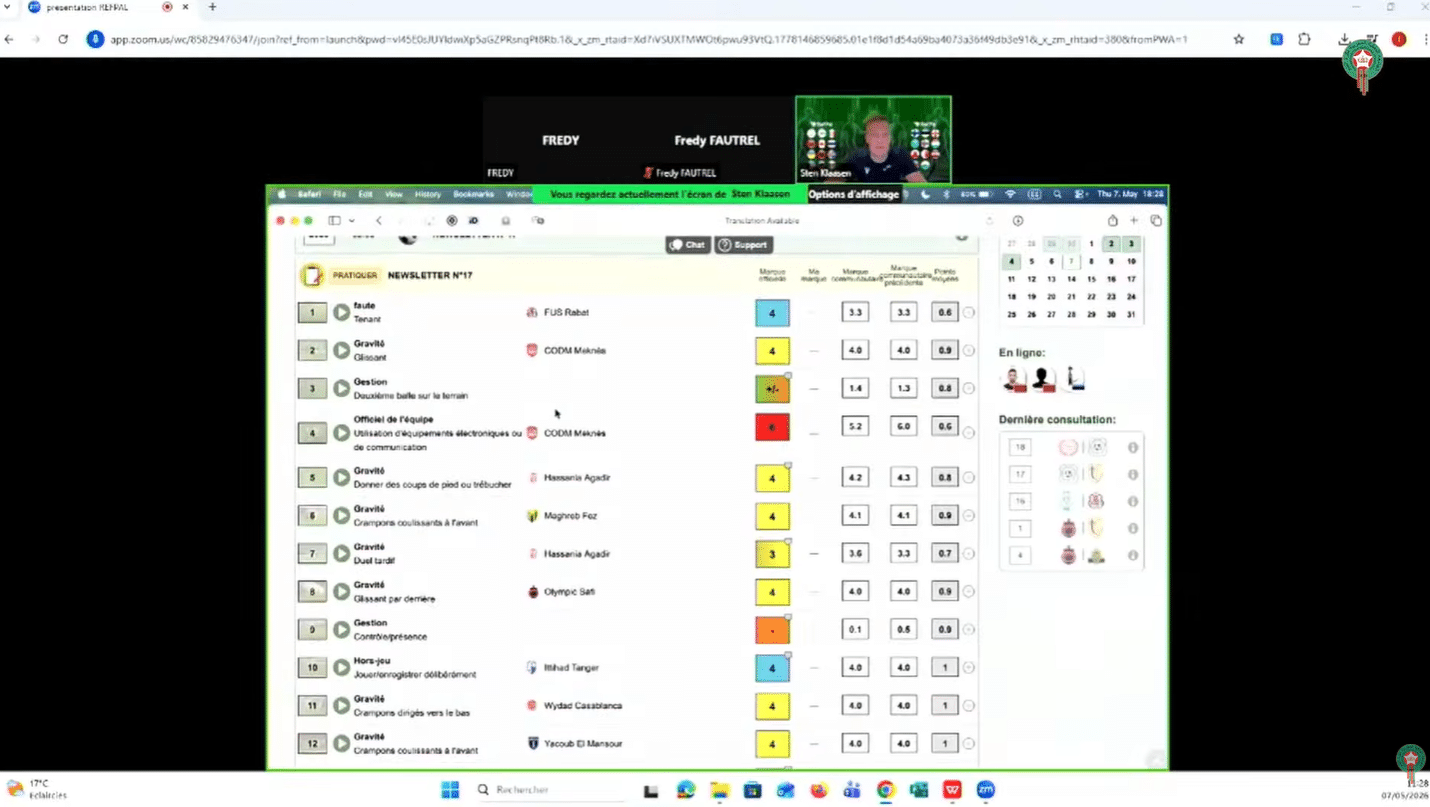
This system ensures continuous training, harmonizes decisions, and maintains independence in performance assessments. As Redouane Jayed emphasized, "the platform operates independently and therefore not directly or indirectly linked to the technical direction of arbitration".
According to the data disclosed, Moroccan refereeing shows significant improvement, particularly in the use of VAR. The rate of correct decisions after VAR intervention now approaches 90%, compared to about 44% in the previous season.
This progress is most evident in penalty situations, red‑card decisions, and the reduction of undetected errors — clear indicators of a system in steady evolution.
VAR: Precision, Protocol, and Constraints
Indeed, VAR has rarely faced as much criticism as in recent months. Frédéric Fautrel, former French international referee, oversees the smooth functioning of Morocco’s refereeing plan.
First, it is worth recalling the limited scope of this system — namely:
- goals;
- penalties;
- red cards;
- cases of mistaken identity.
In these specific situations, the referee retains the final say on the field, except in cases of a clear and obvious error identified through video assistance.
Yet, the operational reality proves more complex. Each action may require several minutes of analysis — time to synchronize cameras, compare angles, and validate points of contact. According to Fautrel, this process explains the seemingly endless waiting periods perceived from the stands or in front of screens.
Another crucial point was raised: the management of decision time, particularly the delayed flag or whistle. In “borderline” situations — tight offside calls or rapid attacking sequences — assistant referees must let play continue to allow for potential VAR intervention. The aim is to avoid prematurely halting a promising move that could later be corrected by video review.
One example cited was the disallowed goal for Raja in the Classico against ASFAR. Fautrel conceded that the decision may not have been ideal: "In that sequence, the referee blew the whistle before the end of the play. It may have been a bit too early," he revealed.
Implicitly, it was understood that the goal might have stood after video review. Conversely, in clear-cut situations, "the decision must be made immediately, without delay, to avoid any unnecessary risk or dangerous situation," Fautrel specified, before outlining the various methods used to analyze the ever-contentious offside calls.
Introduction of Semi-Automated Offside Technology
Have the lines been drawn correctly? Was the freeze frame taken at the exact moment of the last contact with the ball? These are the questions that often arise — and rightly so. Offside rulings now rely on three complementary methods.
The first is the 2D method, used when the most advanced body part is on the ground, usually the foot.
The second, known as the “cross” method, comes into play when the determining body part is higher up — such as the shoulder or head — with a projection traced to the ground.
Lastly, triangulation allows referees to reconstruct the player’s position in three dimensions from two synchronized camera angles, offering a spatial view that minimizes interpretation errors.
These tools enable the precise determination of player positions at the moment of first contact with the ball — a key point in the VAR protocol.
Starting next season, the Moroccan league will introduce semi‑automated offside technology (SAOT), already in use in the Champions League and the Premier League.
Operated by Genius Sports, represented by a former English assistant referee, the system relies on high‑frequency player tracking, synchronized 4K capture, and partial automation of offside‑situation processing. The aim is to ensure faster decision‑making and greater consistency in borderline cases.
Meanwhile, a body‑cam will soon be tested in real‑match conditions — beginning this Saturday, May 9, during the Casablanca derby between Raja and Wydad. Still in its experimental phase, this technology could ultimately enhance decision analysis and improve public understanding of contentious situations.
This meeting shed light on a system in full transformation, but it also underscored the element of interpretation. Consequently, the ongoing debates around referee decisions persist — reminding us that referees, despite technological support, remain human, and therefore entitled to make mistakes.

à lire aussi

Article : CGLU Tanger : comment orienter les capitaux internationaux vers les territoires
À Tanger, le débat sur le financement des territoires a rappelé que les grandes transitions se joueront à l’échelle locale. Reste à doter les collectivités des mécanismes nécessaires pour transformer les ambitions territoriales en projets structurés, finançables et durables.
Article : Bourse de Casablanca : le MASI recule de 0,28%, Managem concentre les échanges
La Bourse de Casablanca clôture la séance du 25 juin 2026 en légère baisse. Le MASI recule de 0,28% à 18.049,47 points. Managem domine les échanges avec plus de 108 MDH de volumes.

Article : BlaBlaCar lance sa plateforme de covoiturage au Maroc
La plateforme de covoiturage BlaBlaCar annonce son lancement au Maroc, marquant son entrée en Afrique du Nord. Avec cette implantation, l’entreprise est désormais présente dans 41 pays, notamment en France, en Espagne, au Brésil, en Inde et au Mexique.

Article : Ébola : la RDC impose 21 jours d’attente avant tout déplacement depuis les zones affectées
Dans le cadre du renforcement de la riposte contre la maladie à virus Ébola, la République démocratique du Congo a décidé d’imposer une période de 21 jours à toute personne en provenance des zones affectées avant tout déplacement national ou international. Cette mesure vise à limiter les risques de propagation et à assurer un suivi rigoureux des personnes potentiellement exposées.

Article : En 2025, le PIB nominal marocain a frôlé les 190 milliards de dollars
Un même PIB, plusieurs lectures. En dirhams, l’économie marocaine a atteint 1.720,2 MMDH en 2025. Convertie au taux de change moyen, elle vaut environ 184 milliards de dollars. Ajustée à l’évolution du dollar durant l’année, elle approche les 190 milliards. En parité de pouvoir d’achat, elle dépasse 438 milliards de dollars internationaux. Détails.

Article : Après la détection de substances toxiques, le goudron interdit dans les poteries alimentaires
Des analyses de laboratoire ont révélé la présence de substances toxiques dans des poteries alimentaires décorées au goudron. Les autorités appellent les artisans à abandonner cette pratique afin de protéger la santé des consommateurs.