
EXCLUSIVE: AFCON 2025 Final — Why CAF Sanctioned Senegal
Médias24 reveals the reasoning behind the decision on the appeal concerning the 2025 AFCON final between Morocco and Senegal. Withdrawal from the field, referee authority, right to protest: the CAF Appeals Board clarifies key rules and validates the interpretation put forward by Morocco’s defense.
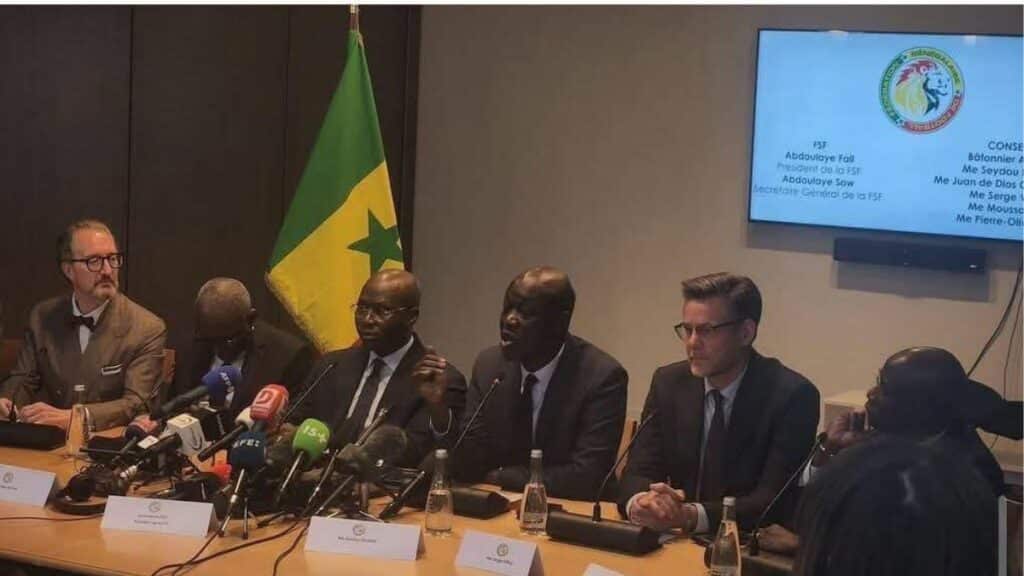
The Court of Arbitration for Sport (CAS) is set to begin examining an appeal filed by Senegal against the decision awarding Morocco the 2025 Africa Cup of Nations (AFCON) final on a technicality.
At the centre of the case is a key document: the Confederation of African Football (CAF) Appeals Board ruling. The public statement was limited to the outcome, without disclosing the reasoning behind it. The parties have since been notified of the full decision, which will serve as the basis for the debate before CAS.
Even a temporary withdrawal from the field is sufficient to constitute an offence
If there is a difference in interpretation, the facts themselves are not disputed. They are established from the official match reports — the contents of which were revealed by Médias24 on March 24, 2026 — and underpin the Board’s reasoning.
In the 97th minute, after the penalty decision in favor of Morocco, "the Senegalese players and their technical staff headed towards the locker rooms on the instructions of the head coach," the Board notes, citing referee Jean-Jacques Ndala's report. The match was interrupted, only to resume a few minutes later.
It is this sequence that lies at the heart of the decision. The first point of contention concerns the nature of the withdrawal.
In the initial ruling, the Disciplinary Committee had held that Article 82 could apply only in cases of definitive abandonment. The Senegalese Football Federation (FSF) maintains the same interpretation, referring to a temporary interruption of the match.
The Appeals Board takes the opposite view. "The text of Article 82 does not require definitiveness," it states.
It adds that the article covers situations in which a team refuses to play or leaves the field before the end of the match without the referee’s permission. "It does not provide that a later return to the field would have the effect of regularising or erasing the offence once committed." The withdrawal, even if temporary, is sufficient to constitute an offence and trigger sanctions.
Arbitral decision and subsequent review
The FSF also argued that the referee’s decision to resume the match should preclude any subsequent sanctions. The Board draws a clear distinction. "The issue at hand is not a challenge to a factual decision within the field, but the legal consequence arising from that conduct."
The Board adds that while the referee makes decisions during the match, "the competence of disciplinary bodies remains," and that they "can sanction events occurring during the match." The resumption of play does not erase the legal consequences.
Morocco continued the match without waiving its rights
Regarding Morocco’s conduct, the Board also dismisses the FSF’s argument. "The right to protest is the mechanism provided to challenge the legal consequences of conduct during the match."
It adds: "Playing the match until the final whistle does not imply a waiver of the applicable rules."
The Board then turns to a more technical point in response to arguments based on precedent. The Senegalese Federation and the initial ruling had cited two decisions as comparable: CAS 2015/A/3874 Albania v Serbia, concerning a match interrupted amid unrest, and a CAF internal ruling in the Al Ahly v Zamalek DC23172 case.
Following that reasoning, the conclusion is clear. The Board considers that the established facts fall within the scope of Article 82 of the AFCON regulations and that the sanction provided for in Article 84 must be applied. "The provisions must be applied according to their ordinary meaning," it states.
With the score at 0-0 at the time of the interruption, the regulations provide for a forfeit. The match is therefore awarded to Morocco by a score of 3-0.
That decision — adopted by a majority — will now be examined by CAS. Senegal is expected to argue for a broader interpretation of the text, based on the course of the match and the referee’s role. Morocco, for its part, will rely on a literal interpretation already upheld by CAF.
The debate will unfold on that basis.
Finale CAN 2025 : voici notre analyse exclusive de la décision en appel
à lire aussi

Article : Tennis U16 : le Maroc champion d’Afrique et qualifié pour les Championnats du monde
Les jeunes tennismen marocains ont remporté le Championnat d’Afrique par équipes à Polokwane, validant leur qualification pour les Championnats du monde U16. Les filles ont également signé une belle performance en terminant vice-championnes d’Afrique.

Article : Lundi 27 juillet : le dirham s'apprécie face au dollar
Ce lundi 27 juillet 2026 vers 8h30, la première cotation centrale USD/MAD de la journée, telle que publiée par Bank Al-Maghrib (BAM), fait ressortir la […]
Article : CAN féminine 2026. Le Maroc surclasse le Kenya (4-0) pour son entrée en lice
En l’absence de Ghizlane Chebbak, l’équipe nationale féminine a dominé le Kenya et lancé idéalement sa compétition, ce dimanche 26 juillet à Rabat. Les Lionnes de l’Atlas tenteront d’arracher leur qualification au second tour lors du choc du groupe A, jeudi 30 juillet face à l’Algérie.
Article : En sept mois de 5G, IAM avance des résultats très probants
Lancée en novembre 2025, la 5G produit ses premiers effets mesurables chez Maroc Telecom. Les résultats semestriels de l'opérateur font état d'une consommation de data mobile en hausse et de nouveaux usages qui s'installent, chez les particuliers comme dans les entreprises.

Article : L'État devient le premier client du secteur bancaire
En quelques années, l'État et sa sphère élargie sont devenus le premier client des banques marocaines, par les bons du Trésor mais aussi par une série d'autres mécanismes de mieux en mieux rodés. Bank Al-Maghrib reconnaît un effet d'éviction, tout en le jugeant modéré. Mais son calcul repose sur un périmètre étroit.
Article : Tournée du RNI dans le Sud : trois meetings en un jour et une riposte au PAM signée Akhannouch
Aziz Akhannouch a clairement repris la main dans la campagne électorale du RNI en prévision des législatives de septembre. À Tan Tan, Laayoune et Dakhla, il défend la présence du parti dans des régions à fort enjeu politique et pas seulement électoral.