
The Fork Is Mightier than the Wall
NEW ORLEANS – The word “migration” conjures images of war, natural disaster, and severe economic distress. All are important reasons why people seek refuge far from home. But the single most powerful driver of migration may well be food – or, rather, the lack of it.
As of 2017, some 821 million people worldwide – about one in every nine – faced chronic food deprivation. While some progress has been made to reduce extreme hunger, the overall number of chronically hungry people continues to rise.
The link with migration is clear. When people in Africa, the Middle East, and Latin America cannot feed themselves and their families, they often leave home. According to a study by the United Nations World Food Programme (WFP), each percentage-point increase in food insecurity increases refugee outflows by 1.9%.
Those facing food insecurity often demand better conditions at home. In the Arab world, “bread riots” have erupted regularly since the mid-1980s. Increases in food prices, particularly for wheat, triggered the Arab Spring protests that began in Tunisia in 2010.
If initial food shortages were not enough to motivate a person to migrate, the ensuing social unrest and conflict often are, not least because they further strain food supplies. As the WFP reports, food insecurity is “a significant determinant of the incidence and intensity of armed conflict.” For each additional year of conflict, refugee outflows increase by 0.4%.
According to the Observatory on Food and Migration, many migrants are single men, who leave their female relatives behind to run their depleted farms. In North Africa, women now account for 43% of all farmers, according to the World Bank – up from about 30% in 1980.
These women operate at a significant disadvantage. For example, the World Bank reports that, in Latin America, “when women take on primary responsibility for the family farm, they face certain gender-specific difficulties, including difficulties hiring and supervising labor and acquiring technical knowledge about farming.”
Similarly, though female farmers represent 70% of Senegal’s workforce, the Observatory on Food and Migration reports that only men are allowed to make decisions about agricultural production or farm operations. This makes it extremely difficult to achieve strong farm output, exacerbating food shortages.
Those migrants who make it to Europe or the United States often form the backbone of their new countries’ agricultural sectors. According to a study by the MacroGeo think tank and the Barilla Center for Food and Nutrition (BCFN), more than half of all farmworkers in southern Italy are migrants, and more than three million migrants work on American farms. The US government estimates that about half of all farmworkers are undocumented immigrants.
Many of these workers live in conditions resembling slavery, toiling in harsh conditions for very low wages. In Southern Italy, for example, migrant farmworkers often have been recruited through the so-called caporalato system, in which criminal gangs – led by “caporali” – organize groups of migrant laborers, provide them with food and housing, and transport them (for exorbitant fees) from their homes to the fields.
The laborers’ workdays can last 16 hours, and when they return home, miniscule wages in hand, they face appalling living conditions. In one reported case, 800 workers were found living with only five showers.
Because the caporali’s fee is deducted from workers’ wages, farmers embrace this system, which also enables them to avoid payroll taxes. And those farmers – not just in Italy, but across Europe and in the US (where undocumented agricultural workers are similarly exploited) – often already benefit from generous subsidies, which encourage them to produce too much food.
The surplus food may be exported at such low prices that farmers and food producers in developing countries cannot compete. Or it may be wasted: according to the UN’s Food and Agriculture Organization, one-third of all food produced globally is either lost or discarded, in what amounts to a gross misuse of the resources – from labor to water – used to produce it.
The worst offenders are the most technologically advanced countries, according to the Food Sustainability Index, produced by the BCFN and the Economist Intelligence Unit. In agricultural sustainability rankings – which includes food waste – the US and the United Kingdom rank 45th and 49th, respectively, out of 67 countries.
In contrast, less developed countries show some surprising successes. Latin America, East Asia, and the Pacific perform well on food loss and waste, with four countries from each region ranking in the top 20. Ethiopia, Kenya, and India are also among the countries with strong strategies for minimizing food loss.
A challenge as complex as migration cannot be addressed simply through stricter immigration laws, let alone a border wall like the one US President Donald Trump seeks to build on his country’s southern frontier with Mexico. Instead, policymakers must tackle migration’s underlying causes – beginning with a broken global food system.
For developed-country governments, that means rethinking agricultural subsidies and implementing targeted policies to reduce food loss and waste. Developing-country governments, for their part, must take steps to mitigate gender inequality.
There is little time – and food – to waste.
à lire aussi

Article : André Azoulay reçoit le prix Boutros Boutros-Ghali de la Paix
Le Forum de Crans Montana salue l’engagement de longue date du conseiller du Roi Mohammed VI en faveur du dialogue interculturel, de la mémoire judéo-marocaine et du rayonnement d’Essaouira.
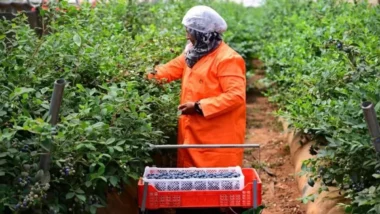
Article : Fruits rouges : l’émirati Elite Agro porte son pari marocain à 1,3 MMDH
Avec une septième ferme de 200 hectares inaugurée à Kénitra, le groupe place le Royaume au cœur de sa production de myrtilles et de framboises.

Article : Maroc-Écosse : l'Ouzbek Tantashev au sifflet, deux ans après la demi-finale olympique mouvementée contre l’Espagne
Désigné par la FIFA pour la rencontre du 19 juin au Boston Stadium, celui qui est arbitre international depuis 2013 avait quitté le terrain dès la 15e minute aux Jeux olympiques de Paris après une collision avec Marc Pubill.

Article : Mr. Bricolage vise 45 magasins au Maroc d'ici 2032 et un plan d'investissement de 700 MDH
Mr. Bricolage Maroc prévoit le déploiement de 45 magasins d’ici 2032, au rythme d’une ouverture toutes les huit semaines, dans le cadre d’un plan porté par un investissement de 700 millions de DH.

Article : Loi 16.22 sur les adouls : l’Ordre réagit à la décision de la Cour constitutionnelle
L’invalidation partielle du texte par la Cour constitutionnelle est accueillie avec soulagement par une partie de la profession, qui y voit la confirmation de réserves exprimées depuis plusieurs mois. Mais pour Maître Driss Trali, membre du bureau exécutif de l’Ordre national, la réforme reste incomplète tant que le dépôt des fonds, l’officialité pleine de l’acte et l’indépendance de l’instance professionnelle ne sont pas consacrés par la loi.

Article : Bourse de Casablanca : le MASI termine encore dans le vert
Au lendemain de sa progression de 4,63%, l'une des plus fortes hausses de son histoire récente, le MASI poursuit son redressement le mardi 16 juin. L'indice a gagné 0,15% à 18.782,58 points, porté notamment par les valeurs immobilières et minières, dans un marché qui conserve une partie de l'élan né du regain d'optimisme sur le front géopolitique.