
Is Benkirane disowning his own vote on the Moudawana?
At a rally in Safi on April 25, 2026, the PJD secretary-general presented his party’s opposition to the Plan for the Integration of Women in Development as an electoral badge of honor. What he failed to mention is that the plan’s withdrawal did not stop history in its tracks: the historic 2004 reform of the Moudawana was passed unanimously by parliamentarians, including PJD MPs. An ambiguity the party has carried with it for twenty-five years.
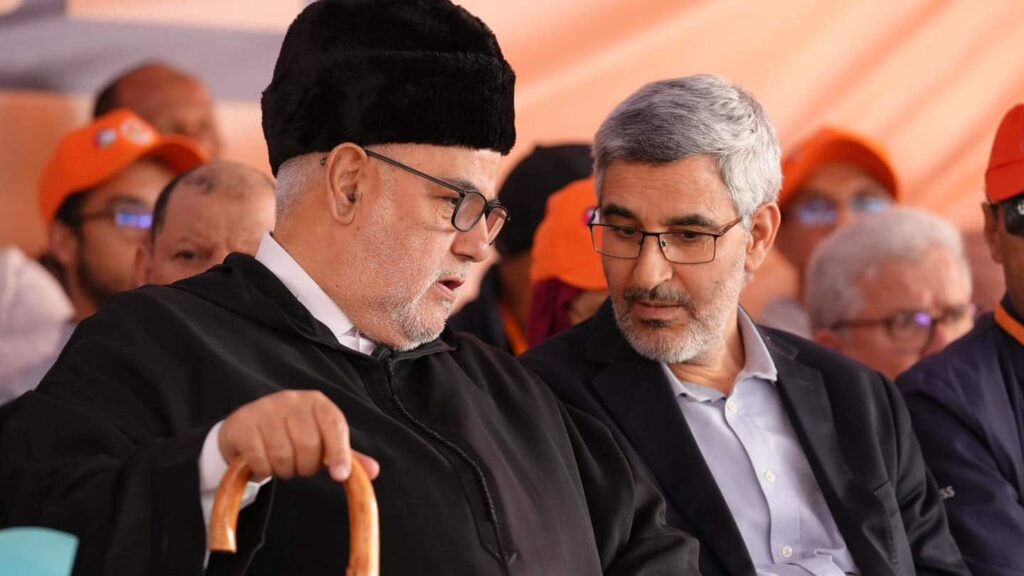
The Justice and Development Party (PJD) has stepped up the pace of its electoral campaign. Campaign rallies have multiplied, even if, as seen in Safi on April 25 and in the days that followed, turnout has remained modest and audience engagement limited.
It was in Safi that Abdelilah Benkirane made remarks that raise questions about his real commitment to the reforms introduced by the Moudawana on women’s status.
The facts:
In Safi, Abdelilah Benkirane delivered a speech (video available through the link, from 1:03:20 to 1:05:00) in which he notably referred to the party’s founding moments and the battles it has fought. Among them, he highlighted the PJD’s opposition to the Plan for the Integration of Women in Development, presented in 1999 by Saïd Saâdi, then a minister from the PPS (Party of Progress and Socialism). That opposition, he said, propelled the party from 14 to 42 seats in Parliament. He described the plan as “contrary to the interests of society” and accused it of being “a national plan whose objective is to alter the Moroccan family”.
In the following parliamentary elections, the PJD thus rose from 14 to 42 MPs. A progression the speaker attributes to the way the party “fought the plan and defended values”.
History has spoken:
The Saâdi plan was indeed withdrawn. But its withdrawal did not amount to a victory for conservatives. In fact, King Mohammed VI set up a royal commission, which worked for two years and whose conclusions led to the 2004 reform of the Moudawana. The King, as Commander of the Faithful, settled the matter. The Moudawana text, submitted to Parliament, was unanimously approved by the members of the legislative institution. Including the PJD.
Why Benkirane’s remarks warrant scrutiny:
The 2004 Moudawana was the result of an arbitration by the Commander of the Faithful. It was therefore natural for the PJD, which likes to invoke Morocco’s Islamic frame of reference, to vote in favor.
But once it did so, is it appropriate to present opposition to the Saâdi plan as a badge of honor? Is the party disavowing a reform it helped adopt?
What this tells us:
This ambiguity is not new. This is not the first time the PJD has struck this chord. In 2015, during a rally in Casablanca, Abdelaziz El Omari, then minister in charge of Relations with Parliament, thought it useful to recall, as a badge of honor, the March 13, 2000 demonstration in Médiouna, which mobilized 500,000 people against the same plan for the integration of women, though far from all of them had answered the PJD’s call. In the context of an electoral campaign, this reminder raised a legitimate question: did Abdelaziz El Omari accept the reformed Moudawana, which he had voted for? And if so, why return triumphantly to an episode that history had precisely made obsolete?
Ideological revisions: how far?
Benkirane himself, during that same 2015 rally, had referred to the “ideological revisions” undertaken by his party on institutions, political violence and the relationship with the state. But on the status of women, he remained silent.
There is a contradiction here that the PJD has never publicly resolved. It deserves to be raised clearly at a time when the party is seeking to rebuild its electoral base and assert a political identity. Voters, and Moroccan women in particular, have the right to know whether the 2004 vote reflected genuine conviction or merely a tactical concession.
There will be a debate this year on the future reform of the Moudawana. The PJD has already taken a position.

à lire aussi

Article : Coupe du monde 2026. Qualification héroïque du Maroc face aux Pays-Bas (1-1, 3 t.a.b. à 2)
Menés à un quart d’heure du terme, les Lions de l’Atlas ont trouvé les ressources mentales nécessaires pour égaliser grâce à Issa Diop, puis éliminer les Oranjes lors de la séance des tirs au but, dans la nuit du lundi 29 au mardi 30 juin, à Monterrey, au Mexique. Yassine Bounou et Ismaïl Saibari ont propulsé le Maroc en huitièmes de finale face au Canada, samedi 4 juillet à Houston.
Article : Coupe du monde 2026. Centième sélection pour Achraf Hakimi face aux Pays-Bas
Le capitaine des Lions de l’Atlas portera le maillot du Maroc pour la 100e fois de sa carrière, dans la nuit du lundi 29 au mardi 30 juin, face aux Pays-Bas, en seizième de finale de la Coupe du monde 2026. Titularisé par Mohamed Ouahbi, Hakimi n’est plus qu’à 15 sélections pour égaler le record de Noureddine Naybet.

Article : GMT, interdiction du démarchage, IA : la triple peine de l’offshoring marocain
Longtemps porté par les donneurs d’ordre européens et les centres d’appels, le secteur de l’offshoring au Maroc doit désormais composer avec des horaires à réorganiser, des appels commerciaux de plus en plus encadrés en France et des tâches que les logiciels commencent déjà à automatiser. Les grands opérateurs invoquent l’adaptation et la montée en gamme, tandis que les syndicats redoutent moins d’embauches et davantage de postes supprimés.
Article : Maroc-Pays-Bas : les cafés pourront rester ouverts pour diffuser le match
Selon Ahmed Bifergane, coordinateur de la Fédération nationale des propriétaires de cafés et restaurants, aucune interdiction n’a été émise par les autorités pour la nuit du lundi 29 au mardi 30 juin.

Article : Défense : les F-16 marocains concernés par un nouveau contrat américain sur les missiles AMRAAM
Attribuée à Raytheon pour 398,6 millions de dollars, l’enveloppe porte sur des travaux liés au système D4/C9, avec une échéance fixée à décembre 2027. Le Maroc figure parmi les pays partenaires du dispositif FMS, aux côtés notamment des Émirats arabes unis, de l’Arabie saoudite, du Japon, d’Israël et du Royaume-Uni.

Article : My Education lance “MY WAY”, un programme dédié aux compétences du XXIe siècle
Destiné aux jeunes de 9 à 16 ans, le dispositif combine des activités régulières, des bootcamps, des stages immersifs et des interventions en milieu scolaire.