
One billion dirhams without a state guarantee: how Casablanca-Settat pulled off its bond issue
The Casablanca-Settat region has just completed its first bond issue, a first for a Moroccan region. The amount raised totals one billion dirhams on the capital markets, including 400 million dirhams provided by the European Bank for Reconstruction and Development (EBRD). Regional president Abdellatif Maazouz discusses the behind-the-scenes of the operation, its financial foundations and the projects it is expected to finance.
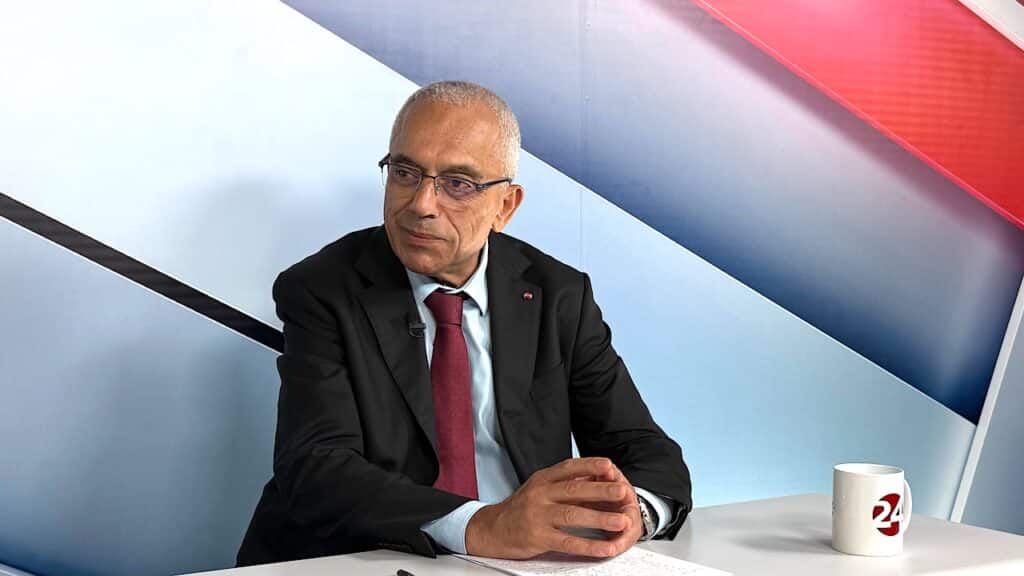
One billion dirhams, ten years, and no state guarantee. In late March 2026, the Casablanca-Settat region finalized the first bond issue ever carried out by a Moroccan region, with the EBRD financing 40% of the amount. According to its president, Abdellatif Maazouz, the pilot operation paves the way for a new model of regional financing.
The operation stems from the Regional Development Program (PDR), whose total cost stands at MAD 47 billion, with the region’s contribution estimated at around MAD 13 billion. “From the outset, debt was accepted and necessary to close the financing plan, given that these are investment projects,” explains Abdellatif Maazouz.
It was in March 2024 that the regional council approved the principle of resorting to a bond issue. Authorization from the Ministries of the Interior and Finance came in December 2025, and the operation was finalized in late March 2026. “Between the moment we insistently expressed this need and the granting of the approval, it took three or four weeks, no more,” he says.
The timing of the fundraising was deliberately chosen. “We did not want to raise funds that would remain idle. We waited until disbursements were ready to begin.” The 50-basis-point cut in the key policy rate since the initial vote was also used to the region’s advantage.
Prior financial clean-up as a key argument
Before entering the market, the region carried out a financial clean-up to reduce its debt ratio. “Between October 2021 and today, we have either cancelled or repaid roughly one billion dirhams of debt.”
The region thus presents itself as the least indebted in the Kingdom. Measured against annual revenues of MAD 1.6 billion, the annual principal repayment — MAD 100 million over ten years — represents one-sixteenth. “That is reassuring. For an investor, there is no comparison,” the president says.
The operation was structured with a consortium of three banks (CDG, Banque Populaire and Attijariwafa bank) and underwent several weeks of due diligence covering the region’s accounts, projects and resources.
40% provided by the EBRD
The EBRD’s participation, amounting to MAD 400 million, or 40% of the total, gives the operation an international dimension. For Maazouz, this reflects three factors of attractiveness: “a very significant economic development dimension, with industrial and logistics activity platforms that will generate wealth, jobs and revenues for the region”; a “human dimension”, with rural development projects and access to drinking water and electricity; and, finally, “sustainability”, through projects linked to the preservation of water resources and sanitation.
There is, however, no state guarantee behind the loan. “The guarantee is the region’s credibility. We did not sign any mortgage. Once you sign a commitment, it becomes a priority before any expenditure.”
Budgetary financing, not financing for a specific project
The billion dirhams raised through this disintermediated borrowing is not earmarked for a single project. “This is budgetary financing, not project-linked financing. We have a portfolio of ongoing projects. The financing will make it possible to meet the cash-flow needs of already programmed expenditure.”
To date, the region has committed MAD 10 billion under its PDR, of which MAD 7 billion has already been disbursed and MAD 3 billion remains available. The billion dirhams raised therefore represents only 10% of the total effort.
“There are still another three billion dirhams that we can raise. We have an agreement with AFD for one billion. The World Bank has proposed another billion,” the regional president says.
Among the projects financed is the Green Region program. Maazouz illustrates its scope with two concrete examples. The first concerns the Médiouna landfill. “What used to be a black spot has become a green hill. We are almost 75% complete.” The treatment model has also evolved, moving from landfilling to a recycling model with incineration producing energy injected into the public grid, for an investment of MAD 16 billion.
The second axis concerns wastewater: two treatment and reuse plants have been opened, making it possible to irrigate green spaces without using drinking water. Other plants are planned in Mohammédia and Berrechid.
Non-polluting mobility is the third pillar, notably through the RER project, with a budget of MAD 16 billion. “The idea is to have a non-polluting public transport model that is financially and practically accessible to citizens.”
Finally, air-quality monitoring stations have been deployed across the region. “Between 2023 and 2025, what we call red spots disappeared.”
A pilot operation for other regions
Casablanca-Settat is the first Moroccan region to access the capital markets. The municipality of Agadir had been a pioneer among local authorities, but under different arrangements.
Maazouz now calls for the approach to be generalized, subject to certain conditions. “Financial maturity is needed, first in terms of competence. Our administration learned through learning by doing. The financial situation must also allow it.”
On the issue of regional autonomy, he downplays the time taken for administrative approvals. “It is a learning process. When we did not need the money immediately, we allowed the process to run its course.” He concludes with a conviction: “Money has never been a problem for well-structured and well-supported projects.”

à lire aussi

Article : Coupe du monde 2026. Qualification héroïque du Maroc face aux Pays-Bas (1-1, 3 t.a.b. à 2)
Menés à un quart d’heure du terme, les Lions de l’Atlas ont trouvé les ressources mentales nécessaires pour égaliser grâce à Issa Diop, puis éliminer les Oranjes lors de la séance des tirs au but, dans la nuit du lundi 29 au mardi 30 juin, à Monterrey, au Mexique. Yassine Bounou et Ismaïl Saibari ont propulsé le Maroc en huitièmes de finale face au Canada, samedi 4 juillet à Houston.
Article : Coupe du monde 2026. Centième sélection pour Achraf Hakimi face aux Pays-Bas
Le capitaine des Lions de l’Atlas portera le maillot du Maroc pour la 100e fois de sa carrière, dans la nuit du lundi 29 au mardi 30 juin, face aux Pays-Bas, en seizième de finale de la Coupe du monde 2026. Titularisé par Mohamed Ouahbi, Hakimi n’est plus qu’à 15 sélections pour égaler le record de Noureddine Naybet.

Article : GMT, interdiction du démarchage, IA : la triple peine de l’offshoring marocain
Longtemps porté par les donneurs d’ordre européens et les centres d’appels, le secteur de l’offshoring au Maroc doit désormais composer avec des horaires à réorganiser, des appels commerciaux de plus en plus encadrés en France et des tâches que les logiciels commencent déjà à automatiser. Les grands opérateurs invoquent l’adaptation et la montée en gamme, tandis que les syndicats redoutent moins d’embauches et davantage de postes supprimés.
Article : Maroc-Pays-Bas : les cafés pourront rester ouverts pour diffuser le match
Selon Ahmed Bifergane, coordinateur de la Fédération nationale des propriétaires de cafés et restaurants, aucune interdiction n’a été émise par les autorités pour la nuit du lundi 29 au mardi 30 juin.
Article : Défense : les F-16 marocains concernés par un nouveau contrat américain sur les missiles AMRAAM
Attribuée à Raytheon pour 398,6 millions de dollars, l’enveloppe porte sur des travaux liés au système D4/C9, avec une échéance fixée à décembre 2027. Le Maroc figure parmi les pays partenaires du dispositif FMS, aux côtés notamment des Émirats arabes unis, de l’Arabie saoudite, du Japon, d’Israël et du Royaume-Uni.
Article : My Education lance “MY WAY”, un programme dédié aux compétences du XXIe siècle
Destiné aux jeunes de 9 à 16 ans, le dispositif combine des activités régulières, des bootcamps, des stages immersifs et des interventions en milieu scolaire.