
Jewish prayers by Marrakech’s ramparts: behind the controversy, a familiar practice
Filmed on April 21 near Bab Doukkala, the viral footage shows members of the Satmar Hasidic movement, from New York, making a brief 24- to 48-hour stop to pray at the tombs of local religious figures. According to Marrakech’s Jewish community, these occasional visits, unrelated to the site itself, are part of regular pilgrimage routes.
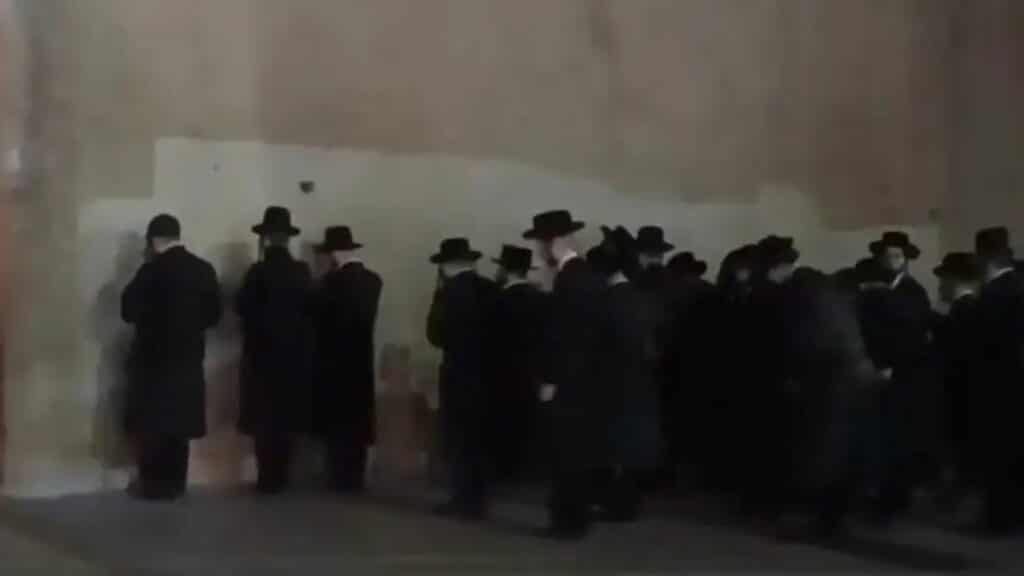
The viral spread, since Tuesday, April 21, 2026, of videos showing Jewish worshippers performing religious rituals outdoors near the historic Bab Doukkala site in Marrakech has sparked a heated debate on social media.
The footage, showing what look like Jewish prayers against the city’s ancient ramparts, has prompted widespread discussion online and among civil society groups, with some questioning the nature and apparent novelty of the scene.
مواطنون مغاربة يستغربون من ظهور مجموعة من اليهود بلباس المتشددين وهم يتبركون من حائط في مدخل منطقة باب دكالة بمراكش 🇲🇦 pic.twitter.com/j3Er3QP9F4
— الرادع المغربي 🇲🇦🔻🇵🇸 (@Rd_fas1) April 21, 2026
For representatives of the local Jewish community, however, the reaction amounts to a "storm in a teacup". Jacky Kadoch, president of the Jewish community in the Marrakech-Safi region, told Médias24 that there is little point in debating an event that is neither new nor provocative.
The identity of these pilgrims is well known. They belong to the Satmar Hasidic community, an Orthodox movement based in New York, particularly in the neighborhoods of Williamsburg and Monsey. Although not of Moroccan origin, these worshippers maintain a deep devotion to the Kingdom’s Tsadikim (saints).
According to Mr. Kadoch, their presence does not follow conventional tourism patterns. They undertake so-called "go and back" pilgrimages — short stays of 24 to 48 hours dedicated exclusively to prayer at the tombs of major Kabbalistic figures such as Rabbi Abraham Azoulay, Rabbi Hanania Ha-Cohen or Rabbi David Hazzan.
As for the choice of the Bab Doukkala wall, the explanation is purely practical. Worshippers are simply looking for a neutral surface for prayer, away from the distractions of the urban environment. "The rampart holds no intrinsic religious significance for them," Mr. Kadoch explained.
Morocco, a "land of peace" for the Hasidim
The attachment of this community to Morocco is longstanding. An anecdote shared by Jacky Kadoch illustrates this connection: about eight years ago, emissaries of the community’s Grand Rabbi requested a feasibility study for a "spiritual village" near the coast. Their spiritual leader described Morocco as "a holy land and a land of peace, protected by an extraordinary King".
Although the project did not materialize following the refusal of local authorities on security grounds, the integration of these worshippers is already a tangible reality. In Touama, 40 kilometers from Marrakech, as well as in certain mountainous areas, members of this community have lived peacefully and in harmony with local populations for many years.
Beyond the reactions sparked online, the episode highlights the singular character of Marrakech, a crossroads city where centuries-old coexistence is inscribed in its stones. By remaining a destination for pilgrims from around the world, Morocco reaffirms its identity as a land of encounter and tolerance.
In the face of the immediacy of viral images, the city answers with the depth of its history, showing that spirituality, when practiced with respect for places and people, remains one of the enduring pillars of Morocco’s unique identity.

à lire aussi

Article : Coupe du monde 2026. Qualification héroïque du Maroc face aux Pays-Bas (1-1, 3 t.a.b. à 2)
Menés à un quart d’heure du terme, les Lions de l’Atlas ont trouvé les ressources mentales nécessaires pour égaliser grâce à Issa Diop, puis éliminer les Oranjes lors de la séance des tirs au but, dans la nuit du lundi 29 au mardi 30 juin, à Monterrey, au Mexique. Yassine Bounou et Ismaïl Saibari ont propulsé le Maroc en huitièmes de finale face au Canada, samedi 4 juillet à Houston.
Article : Coupe du monde 2026. Centième sélection pour Achraf Hakimi face aux Pays-Bas
Le capitaine des Lions de l’Atlas portera le maillot du Maroc pour la 100e fois de sa carrière, dans la nuit du lundi 29 au mardi 30 juin, face aux Pays-Bas, en seizième de finale de la Coupe du monde 2026. Titularisé par Mohamed Ouahbi, Hakimi n’est plus qu’à 15 sélections pour égaler le record de Noureddine Naybet.

Article : GMT, interdiction du démarchage, IA : la triple peine de l’offshoring marocain
Longtemps porté par les donneurs d’ordre européens et les centres d’appels, le secteur de l’offshoring au Maroc doit désormais composer avec des horaires à réorganiser, des appels commerciaux de plus en plus encadrés en France et des tâches que les logiciels commencent déjà à automatiser. Les grands opérateurs invoquent l’adaptation et la montée en gamme, tandis que les syndicats redoutent moins d’embauches et davantage de postes supprimés.
Article : Maroc-Pays-Bas : les cafés pourront rester ouverts pour diffuser le match
Selon Ahmed Bifergane, coordinateur de la Fédération nationale des propriétaires de cafés et restaurants, aucune interdiction n’a été émise par les autorités pour la nuit du lundi 29 au mardi 30 juin.
Article : Défense : les F-16 marocains concernés par un nouveau contrat américain sur les missiles AMRAAM
Attribuée à Raytheon pour 398,6 millions de dollars, l’enveloppe porte sur des travaux liés au système D4/C9, avec une échéance fixée à décembre 2027. Le Maroc figure parmi les pays partenaires du dispositif FMS, aux côtés notamment des Émirats arabes unis, de l’Arabie saoudite, du Japon, d’Israël et du Royaume-Uni.
Article : My Education lance “MY WAY”, un programme dédié aux compétences du XXIe siècle
Destiné aux jeunes de 9 à 16 ans, le dispositif combine des activités régulières, des bootcamps, des stages immersifs et des interventions en milieu scolaire.