
Supply Chain Finance. Morocco launches its national strategy — what you need to know
Morocco launched its national Supply Chain Finance strategy in Casablanca on April 22, 2026, with the aim of structuring value chain financing. The mechanism, designed to optimize companies’ cash flow through their commercial relationships, is set to be rolled out gradually over several years, with the goal of expanding access to financing, particularly for SMEs.
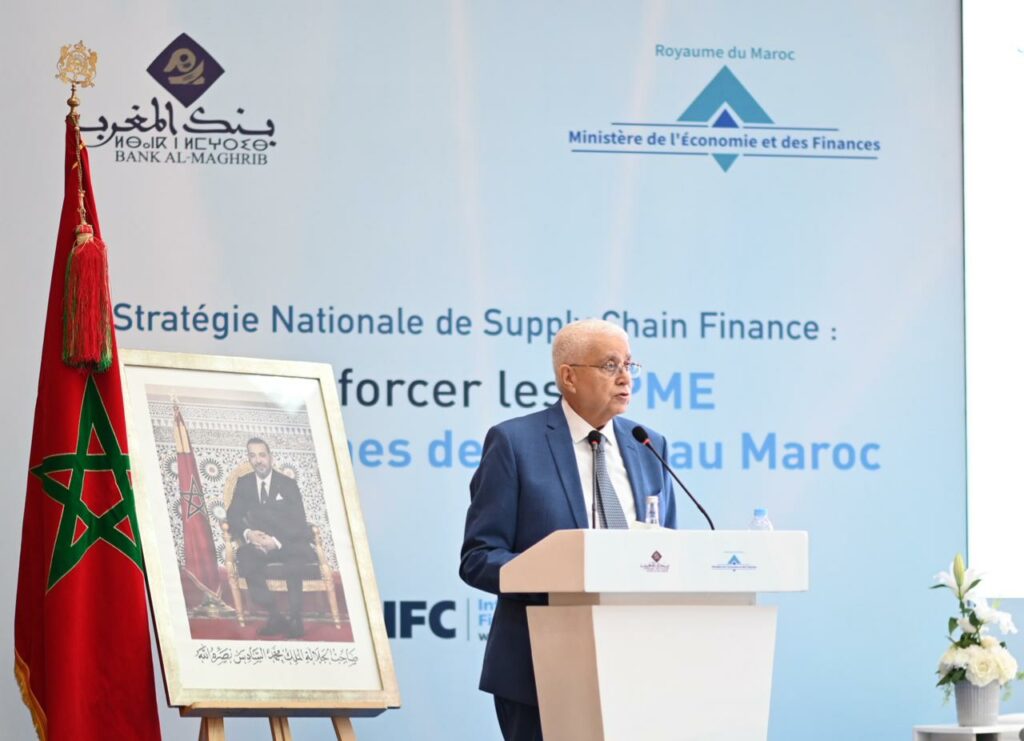
In a context marked by persistent cash flow constraints and still lengthy payment delays, Morocco is entering a new phase in the modernization of its financial system. The Ministry of Economy and Finance and Bank Al-Maghrib, with the support of the International Finance Corporation (IFC), have launched, on April 22 in Casablanca, the National Supply Chain Finance (SCF) strategy, a mechanism aimed at structuring and accelerating value chain financing.
"The Supply Chain Finance project was first discussed at a meeting in January 2025 to present its scope and challenges. Today, we wish to share with you the foundations of the strategy, its levers, its operational mechanisms, and its roadmap," explains Abderrahim Bouazza, CEO of Bank Al-Maghrib.
"One of the first instruments of Supply Chain Finance is factoring. It developed in Morocco in the late 1980s, following the licensing of two specialized credit institutions whose activity initially focused on supporting and financing Moroccan operators’ international transactions, before being extended to the domestic market."
"By adding a new layer to the infrastructure of economic transactions, Supply Chain Finance should contribute to the modernization of the national productive base and enhance its competitiveness, particularly that of SMEs," he adds.
The launch, today, of the Supply Chain Finance strategy marks an important step in its rollout, which will be gradual
The strategy is based on a roadmap covering an estimated period of around four years, with gradual implementation depending on priorities, available resources, and the level of commitment of the various stakeholders.
Mohammed Tarik Bchir, Director of the Treasury and External Finance, explains that payment delays remain a major structural constraint. They weigh on companies’ cash flow, limit their ability to grow, and particularly affect those that need it most. "This is where Supply Chain Finance comes into play, not as just another solution, but as a structural transformation."
"This strategy aims not only to finance companies. It also seeks to restore trust across the value chain between suppliers, lead firms and financial institutions. It further aims to build a digital infrastructure capable of reducing working capital needs at the source."
According to Riadh Naouar, Manager within the Financial Institutions Group (FIG) for Africa, in charge of Upstream and Advisory activities for North, West and Central Africa at the IFC, "this strategy addresses well-known structural challenges: very small, small and medium-sized enterprises, which account for more than 99% of companies in Morocco and 72% of formal employment, contribute only 32% of GDP and 26% of exports. Limited access to working capital financing, excessively long payment delays and cash flow pressures remain among the main obstacles to their development and constrain their competitiveness."
Moreover, Nachid Zakaria, Head of Division at the DTFE, and Hicham Chmanti Houari, Project Manager of the National SCF Strategy at the Banking Supervision Department, detailed the strategy, its objectives, foundations and mechanisms.
What are the objectives of the National Supply Chain Finance strategy
The National Supply Chain Finance strategy is built around several structuring objectives, focusing both on expanding the supply side and improving access to financing for companies, particularly SMEs.
In concrete terms, it aims to expand and diversify available financing instruments in order to better cover needs throughout value chains. The strategy also seeks to improve SMEs’ access to financing by facilitating their integration into these mechanisms, while helping to reduce payment delays, identified as a major constraint on their development.
The strategy also aims to strengthen the resilience of national value chains, accelerate their digitalization and lay the foundations for a more inclusive and efficient ecosystem. In this regard, Supply Chain Finance is conceived as a structuring lever, in line with ongoing financial inclusion initiatives in Morocco.
Three pillars to structure the development of Supply Chain Finance
The National Supply Chain Finance strategy is structured around three complementary pillars, designed to progressively organize the market and expand financing solutions within value chains.
The first pillar focuses on the consolidation and scaling up of existing solutions in the domestic market, particularly factoring and reverse factoring. The objective is to broaden the base of financial institutions offering these products and extend access to a larger number of companies, especially underserved SMEs.
The second pillar aims at a progressive expansion of the offer, through the introduction of new instruments adapted to different stages of the business cycle. This includes purchase order financing, distributor financing, as well as inventory-based solutions. This diversification is intended to better address companies’ specific needs beyond traditional trade receivables.
Finally, the third pillar provides for an expansion into new areas, extending Supply Chain Finance to international transactions and participatory finance. This evolution aims to support the internationalization of Moroccan companies and meet the specific needs of certain market segments, in a context of increasing economic openness.
Five levers to structure a functional ecosystem
Beyond these pillars, the strategy relies on five cross-cutting levers designed to create the conditions necessary for an effective and sustainable deployment of Supply Chain Finance in Morocco.
The first lever concerns awareness and capacity building. It aims to improve understanding of SCF solutions among companies, financial institutions and other stakeholders, while developing the skills required for their implementation. This approach notably seeks to support SMEs and lead firms in adopting these mechanisms.
The second lever focuses on the creation of a supportive legal, regulatory and accounting environment. The objective is to address identified uncertainties, clarify applicable rules and enhance transaction security, thereby facilitating the development of a diversified and accessible offering.
The third lever aims to develop risk-sharing and refinancing mechanisms. Expanding instruments such as credit insurance or public guarantees should reduce risk costs for financial institutions and encourage SME financing.
The fourth lever focuses on technological infrastructure. In particular, the strategy emphasizes the development of dedicated platforms, system interoperability and the use of electronic invoicing to automate exchanges, improve traceability and enhance transaction transparency.
The fifth lever relies on the commitment of major public buyers. These actors are expected to play a leading role by launching Supply Chain Finance programs, expanding access to financing for suppliers—especially SMEs—and creating a ripple effect across the ecosystem.
A monitoring framework to assess the impact on SME financing
Ultimately, the strategy also includes a monitoring and evaluation framework aimed at measuring progress and adjusting actions where necessary. This system will track the implementation of initiatives, assess their economic impact and provide inputs for decision-making.
It is notably intended to assess changes in SMEs’ access to financing through several indicators, including the number of financial institutions offering Supply Chain Finance solutions, the diversification of available instruments, as well as the volume and number of companies financed.

à lire aussi

Article : Législatives 2026 : lecture de la première annonce des têtes de liste de l’Istiqlal
À moins de deux mois des élections législatives du 23 septembre, le Parti de l'Istiqlal a dévoilé une première vague de ses têtes de liste locales. Cette sélection, qui couvre une grande partie du territoire, traduit un équilibre entre continuité et renouvellement : le parti reconduit plusieurs figures expérimentées tout en faisant émerger de nouveaux profils.

Article : Rapport Banque Mondiale: des fragilités bien réelles sous les bons chiffres
La croissance a atteint 4,9% en 2025 et le pays est passé en catégorie investissement. Le rapport de la Banque mondiale dresse toutefois un tableau plus nuancé : un marché du travail que la refonte statistique du HCP montre bien plus fragile qu'on ne le pensait et une transformation numérique inachevée.
Article : PAM : 90 têtes de liste et une inconnue nommée Lekjaâ (liste)
Réuni le samedi 25 juillet à Salé, le conseil national du PAM a dévoilé ses têtes de liste dans 90 des 92 circonscriptions locales. Mais c'est une case restée vide qui a focalisé l'attention : celle de Berkane, où se présenterait Fouzi Lekjaâ, entré au bureau politique du parti sans que personne ne sache encore quel rôle il compte y jouer. Derrière ce ralliement et celui de Yanja Khattat, une liste qui confirme les ambitions du parti..

Article : Littoral nord : la flambée des tarifs hôteliers fait fuir les Marocains et pénalise les commerçants
Selon plusieurs opérateurs, l’explosion des prix des hôtels et des locations meublées en juillet et août, avec des chambres pouvant atteindre près de 5.000 dirhams la nuit, dissuade de nombreux touristes marocains de passer leurs vacances dans le Nord, certains préférant partir en Espagne. Une désaffection estivale surtout visible en semaine, qui frappe les restaurants, les cafés, les commerces et les activités de loisirs.

Article : Législatives : le PAM mise sur la continuité et les ralliements pour améliorer son score
La direction du PAM a dévoilé lors d’une réunion de son Conseil national, une liste de candidats combinant des ministres et élus sortants, deux ralliements de premier ordre qui ont rejoint son bureau politique avant de présenter les grandes orientations de son programme.

Article : TVA intérieure. Pourquoi le taux d’exécution net recule à 38,5% à fin juin
À fin juin 2026, la TVA intérieure affiche un taux d’exécution net de 38,5%, contre environ 45% un an auparavant. Cette baisse ne traduit pas un affaiblissement du recouvrement brut, qui continue de progresser. Elle s’explique essentiellement par l’accélération des remboursements de TVA, dont le montant avait déjà dépassé la prévision inscrite dans la loi de finances.