
Growth, Investment, and Strategic Sectors: Decoding Morocco’s Industry Barometer 2024
Industry barometer, automotive sector, investments... Hanane Belyagou, Director of Statistics at the Ministry of Industry and Trade, reflects on an exceptional year for the Moroccan industry, marked by strong growth and record investments, despite an unstable global context.
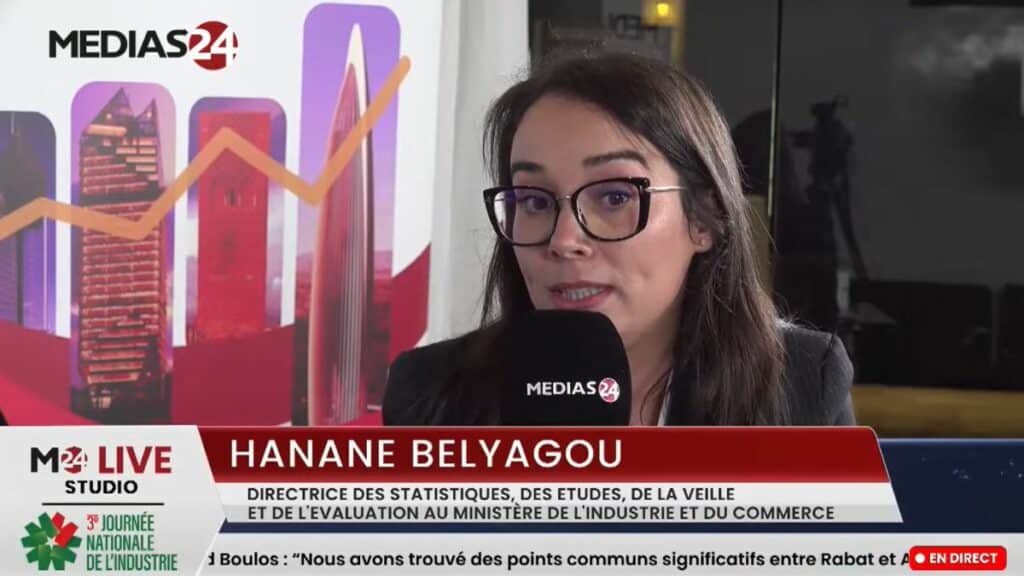
During the 3rd National Industry Day, held on November 3 and 4 in Rabat, Médias24 met with Hanane Belyagou, Director of Statistics, Studies, Monitoring, and Evaluation at the Ministry of Industry and Trade. She presented the findings of the 2024 Industry Barometer, which offers a comprehensive overview of Morocco's industrial sector.
The 2024 Industry Barometer
"The Industry Barometer, in its second edition, is designed as an economic intelligence tool offering a clear analysis of the performance of the industrial sector for both public and private stakeholders," explains Hanane Belyagou.
According to the barometer, industrial turnover nearly reached 900 billion MAD in 2024, up 9% from 2023, with 240 billion MAD of value added and 90 billion MAD of investments, representing a 30% increase.
"These results are notable given the global context marked by geopolitical tensions and shifts in value chains," she points out.
Automotive: a strategic niche, not a dependency
The automotive sector remains Morocco’s industrial driving force, with 196 billion MAD in turnover and 250,000 jobs. However, according to Hanane Belyagou, this does not represent a risky dependency. "It's a strategic choice. The automotive sector fuels related industries such as technical textiles, electronics, and plastics. This reflects strong local integration, both vertical and horizontal."
She notes that Morocco is now the leading exporter of automotive cables to Europe, highlighting higher value added. "In all industrialized economies, strong niches are essential. Morocco has chosen its niche, and it's paying off."
Investments: a historical peak in 2024
The barometer reports record industrial investments of 90 billion MAD, up 30%. "Investment is by nature sporadic, depending on individual decisions by economic actors," Hanane Belyagou explains.
This increase is notably driven by large-scale projects in the chemical industry, linked to decarbonization and the development of natural resources, as well as investments in batteries for electric vehicles. "While some sectors attract larger sums, all are advancing in investment and capacity expansion."
Industrial deconcentration: still weak signals
According to the barometer, 83% of industrial activity is concentrated in three regions: Casablanca, Rabat, and Tangier. "The desire for deconcentration is real, especially through the Investment Charter, which offers incentives for projects outside these hubs," she explains.
Casablanca's share of national turnover has decreased from 70% to 54%, "but it still reflects significant concentration. Deconcentration is happening gradually. For example, the automotive sector is starting to establish itself in Souss-Massa and Oriental, each at 0.2% — weak but telling signals."
Energy transition: an inevitable transformation
The barometer reveals that 74% of industrial energy consumption still relies on "other" energies, a category that includes fossil fuels but also a notable share of renewables. "We know that over 7 TWh already come from renewable sources, but out of caution, we haven't yet separated them in the data," Hanane Belyagou clarifies.
She emphasizes that energy-intensive industries (cement, sugar, chemicals...) are now compelled to adopt decarbonization solutions to maintain access to European markets. "This barometer serves as a baseline. In future editions, we'll be able to measure the shift towards industries that are more electricity-based and less carbon-dependent."
"What we're witnessing today," concludes Hanane Belyagou, "is the realization of a long-term vision. The Moroccan industry is gaining maturity, integration, and economic sovereignty."

à lire aussi

Article : Alerte météo. Temps chaud et averses orageuses dans certaines provinces
Un temps chaud et des averses orageuses sont attendus dans plusieurs provinces, annonce la Direction générale de la météorologie (DGM) dans un bulletin d’alerte de niveau de vigilance orange.

Article : Mondial 2026 : après Maroc-Brésil, Ouahbi fier mais pas euphorique, Ancelotti appelle la Seleção à “s'améliorer”
Face à la presse, le sélectionneur marocain a insisté sur l’ambition nouvelle de son groupe, tandis que le technicien italien a reconnu les limites affichées par l'équipe brésilienne pour son entrée en lice.
Article : Coupe du monde 2026. Le Maroc bouscule le Brésil mais doit se contenter du nul (1-1)
Après une entame énergique et l’ouverture du score par Ismaïl Saibari, l’équipe nationale a concédé l’égalisation face au Brésil, ce samedi 13 juin dans le New Jersey. Les Lions de l’Atlas sont toujours dans la course à la qualification. Ils pourront valider leur billet contre l’Écosse lors de la deuxième journée, vendredi 19 juin.

Article : Mondial 2026 : des fan zones à Casablanca et Rabat pour vivre les matchs
À l’occasion de la Coupe du monde 2026, un réseau de fan zones sera déployé dans plusieurs villes marocaines afin d’accompagner les Lions de l’Atlas et permettre aux supporters de vivre pleinement la compétition.
Article : Le Festival Gnaoua, d’un pari culturel à un modèle de rayonnement pour le Maroc
Trente ans après sa création, le Festival Gnaoua et Musiques du Monde d’Essaouira s’est imposé comme bien plus qu’un événement musical. Invitée de Médias24, sa fondatrice Neila Tazi revient sur les origines de cette aventure née à la fin des années 1990 et devenue, au fil des éditions, un levier de transformation pour la ville d’Essaouira et un outil de rayonnement pour le Maroc.
Article : Numérique et résilience climatique : la Banque mondiale approuve deux programmes de 6 MMDH pour le Maroc
D’un montant total de 650 millions de dollars (plus de 6 milliards de DH), les deux nouveaux programmes sont destinés à accélérer la réalisation des objectifs du Maroc en matière de transformation numérique, tout en renforçant la résilience financière du Royaume face aux risques liés au climat, aux catastrophes et aux cyber-risques.