
Raja SA: Nawal El Aidaoui lays out the roadmap to profitability
Appearing on Médias24’s “12/13” on Thursday, May 14, 2026, Nawal El Aidaoui, CEO of Raja SA, gave a technical update on the club’s transformation. Away from the excitement of match results, the discussion focused on structural issues: asset valuation, debt management and the ramp-up of marketing. A closer look at a business plan designed to clear the past in order to finance the future.
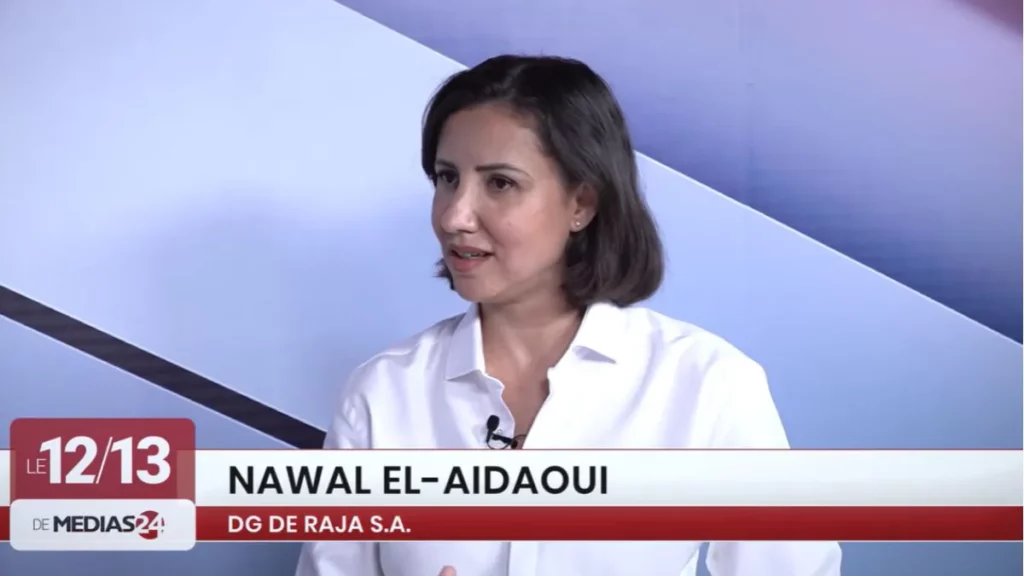
In Moroccan football, the transition to a joint-stock company (SA) has often been seen as a mere administrative formality. At Raja, the process appears to go much deeper. A few months after Ports4Impact effectively entered the club’s capital, Nawal El Aidaoui came to the Médias24 studio to explain that the club has entered a phase of structuring aimed at bringing it closer to corporate management standards, with Ports4Impact as majority shareholder.
Valuation: clearing the books to move forward
The interview was an opportunity to revisit the composition of the 250 million dirham share capital. Often misunderstood, Nawal El Aidaoui clarified the balance of the transaction: while Ports4Impact contributed 150 million dirhams, the association brought in two main assets. These are the Raja brand (150 million dirhams) and the players’ contracts (80 million dirhams).
The historical debt was then deducted. By factoring 130 million dirhams of debt into the structure, the association’s net contribution was reduced to 100 million dirhams. This operation helps explain the constitution of the SA’s capital, although the CEO specified that the real estate assets and the Academy remain the property of the association, as these immovable assets were not transferred to the company.
Asked about the coexistence between the institutional investor and the club’s sporting identity, Nawal El Aidaoui described a segmented governance model. While the board of directors follows the shareholder logic (60/40), sporting management is mainly entrusted to a specific committee in which the expertise of the association’s members prevails.
She recalled that this sporting expertise stems from the association’s 77 years of experience. The administrative and financial side, however, is still being structured. The CEO notably stressed that the club is in the process of structuring itself and completing its teams, with priority given to creating a marketing department capable of turning popular passion into revenue.
Reducing dependence on results
At the heart of the Raja SA project is the diversification of revenue streams in order to reduce exposure to the volatility of sporting results. The strategy outlined rests on several pillars:
- Stadium optimization: without owning its stadium, the club is focusing on the “fan experience” — catering, hospitality boxes and matchday merchandising.
- Cost control: the wage bill has been identified as a central item, whose level will depend on sporting choices. Nawal El Aidaoui cited, as a reference, the case of Real Madrid, which has chosen to keep its wage bill between 60% and 65% of revenue, without presenting this ratio as a target already set for Raja.
- A diversified sporting structure: Raja is no longer limited to the men’s first team. The SA now manages the women’s team, currently in D2, and futsal, which is on the verge of promotion to D1, thus meeting the Federation’s new recommendations.
- Youth development as part of the club’s DNA: Nawal El Aidaoui insisted on the need to revive Raja’s youth development system, intended to feed the first team but also, depending on sporting and financial decisions, to become a source of revenue. She cited the Portuguese model, based on youth development and player sales, while stressing that Raja will have to decide between the players to keep and those to sell.
With the foundations of the SA now in place, full budgetary balance remains the target for the next two seasons. For Raja, the hardest part begins now: proving that the discipline of a joint-stock company can sustainably coexist with the demands of a fan base for whom only trophies truly matter.

à lire aussi
Article : Bourse de Casablanca : les minières sauvent un semestre marqué par la correction du marché (bilan)
Après un semestre marqué par une correction du marché, quelles valeurs ont résisté ? Quels secteurs ont tiré leur épingle du jeu ? Et où les investisseurs ont-ils concentré leurs échanges ? Voici le bilan des six premiers mois de 2026 à la Bourse de Casablanca à travers les principales performances de la cote.

Article : Textile : le déficit de main-d’œuvre dans la confection pèse sur les exportations
Les exportations textiles reculent de 9,1% à fin mai 2026, une baisse que les perturbations logistiques du premier trimestre ne suffisent plus à expliquer. L’aggravation de la baisse en avril et mai montre que le problème dépasse désormais le seul facteur logistique. La cause principale est aujourd’hui le déficit de main-d’œuvre, qui pèse directement sur la production, les délais de livraison et la capacité des entreprises à honorer leurs commandes.
Article : Traitement de l'eau. Le britannique Hydro Industries s'implante au Maroc avec Hydro Services Morocco
Le britannique Hydro Industries Limited s’implante au Maroc avec la création de Hydro Services Morocco, une SAS au capital de 1 MDH dédiée aux métiers du traitement de l’eau, de l’assainissement et du dessalement.
Article : Le Maroc face au choix du Rafale : les clés d'un arbitrage géopolitique contre le tout-américain
Si la volonté d'éviter une dépendance exclusive envers les États-Unis est réelle, l'équation budgétaire et le défi du nombre face à la flotte d'Alger imposent un examen attentif des réalités du terrain.
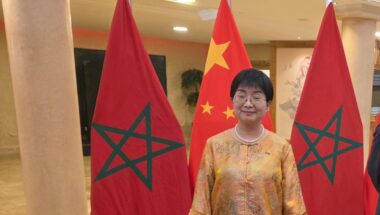
Article : Maroc-Chine : en attendant le Sahara, la relation bilatérale économique s'accélère
Dix ans après l'établissement d’un partenariat stratégique entre Rabat et Pékin au cours de la visite royale en Chine en 2016, l’ambassadrice chinoise au Maroc a célébré cet événement en déclarant que les relations économiques bilatérales ont connu une progression exceptionnelle. Si les perspectives industrielles et touristiques apparaissent plus que prometteuses, la question d'une éventuelle reconnaissance chinoise de la marocanité du Sahara au Conseil de sécurité de l'ONU demeure toujours entourée de précautions diplomatiques. Explications.

Article : IDE : le flux net progresse de 41,8% à fin mai 2026
Les investissements directs étrangers (IDE) au Maroc poursuivent leur progression à fin mai 2026. Porté par une hausse des recettes et un recul des dépenses, leur flux net atteint 23.319 MDH, en hausse de 41,8% par rapport à la même période de 2025. Dans le même temps, les investissements directs marocains à l’étranger (IDME) enregistrent également une nette progression.