
Military cooperation: a new Morocco–US roadmap for 2026–2036, marking unprecedented operational integration
A high-level Moroccan delegation conducted a working visit to Washington from April 14 to 16, 2026. This trip, highlighted by the 14th meeting of the Moroccan-American Defense Advisory Committee, resulted in the signing of a strategic agreement framing bilateral military cooperation for the next decade, with the explicit aim of advancing towards increased operational integration between both armed forces.
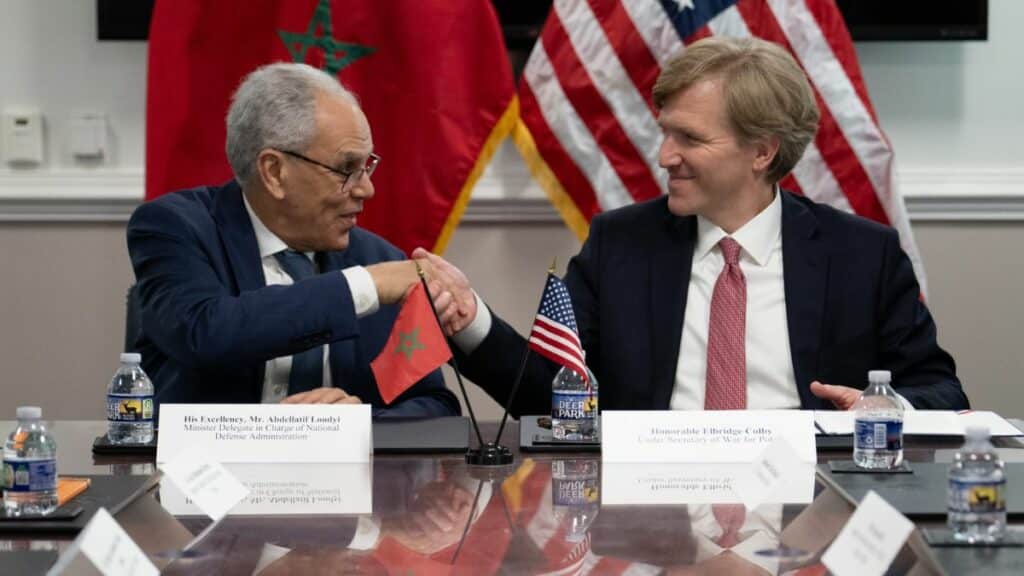
The Moroccan delegation was led by Abdellatif Loudiyi, Delegate Minister in charge of National Defense Administration, and Lieutenant General Mohamed Berrid, Inspector General of the Royal Armed Forces and Commander of the Southern Zone. The officials were received at the Pentagon by Pete Hegseth, U.S. Secretary of Defense, in the presence of the Kingdom's Ambassador to Washington, Youssef Amrani, and his American counterpart in Rabat, Duke Buchan III.
The discussions focused on strengthening bilateral relations, with a particular emphasis on defense, military industry, and cybersecurity, as well as the ability of both countries to conduct joint operations in a coordinated framework. During the talks, the Moroccan side emphasized the importance of American support for the Kingdom's sovereignty over the Sahara.
Morocco's role in regional stability was highlighted, especially through royal initiatives related to the Africa's Atlantic seabord and the Morocco-Nigeria gas pipeline project. The Kingdom's commitment to regional peace, demonstrated by its recent actions in Gaza and active participation in peacekeeping missions in Africa, was also discussed.
The assessment of military cooperation between the two countries was deemed satisfactory by both parties. Key points of this partnership include:
- Training of personnel and exchange of expertise.
- Organization of joint exercises, including the annual large-scale event "African Lion".
- Acquisition of equipment and optimization of military capabilities.
Beyond traditional cooperation, Washington and Rabat expressed their intention to expand their partnership to the defense industry and digital security. These new areas of cooperation aim to address the diversification of contemporary security threats while enhancing the interconnection of systems and operational doctrines.
The highlight of this visit was the official signing of the roadmap for defense cooperation covering the period 2026-2036. This framework document sets strategic objectives for the next ten years, aiming to enhance the efficiency of the Armed Forces in a changing security environment, focusing on interoperability, real-time data sharing, and joint operational planning.
According to our military consultant Abdelhamid Harifi, this new agreement should not be seen as a mere administrative update but as a response to ongoing geopolitical upheavals.
While a strategic roadmap had already been signed just two years ago with a horizon of 2030, the signing of this new document looking to 2036 marks a significant acceleration, with a higher level of integration than envisaged in the previous framework.
"We are witnessing a paradigm shift," explains Abdelhamid Harifi. "Between the proliferation of crisis zones and the potential reconfiguration of American alliances, including a possible NATO withdrawal, Washington is shaping a new security architecture. In this future world order, Morocco is poised to occupy a prominent position within American strategic alliances."
It is precisely in this push for enhanced integration that the evolution of the Link 16 system is situated. Far from being a mere technical detail, this data communication system represents, according to the expert, the barometer of trust between the two armies, as it allows real-time coordination of operations and secure circulation of tactical information.
"Morocco has already mastered Link 16 for years on its F-16s, FREMM frigates, or Abrams tanks, and has tested it in national exercises, but it is the first time the United States has created a shared communication frequency to conduct operations with a non-NATO member country," paving the way for fully integrated operations at both technical and operational levels.
This enhanced cooperation paves the way for an increase in Moroccan autonomy. Beyond equipment procurement, the agreement facilitates access to cutting-edge technologies and positions the Kingdom as a potential industrial partner in future military projects, with a logic of co-development and integration into certain defense value chains.

à lire aussi

Article : Gaza : le Maroc accélère les préparatifs de son déploiement
Des membres du contingent marocain appelé à intégrer la Force internationale de stabilisation ont participé à un débriefing avec leurs homologues kosovars, après une visite à Gaza. Signe que la phase opérationnelle se précise.
Article : Paiements : Mazma Technologies décroche l'agrément de Bank Al-Maghrib
Mazma Technologies franchit une nouvelle étape dans son développement avec l'obtention de l'agrément d'établissement de paiement délivré par Bank Al-Maghrib. Cet agrément vient récompenser les efforts déployés par l'entreprise en matière de développement technologique, de gouvernance, de conformité et de gestion des risques.

Article : Le rappeur Mehdi Black Wind maintenu en détention
Le tribunal correctionnel d’Aïn Sebaâ a rejeté la demande de mise en liberté provisoire de l’artiste et reporté son procès.
Article : Stéréotypes de genre : le nouveau plan de bataille marocain à l'horizon 2035
Le ministère de la Solidarité, avec l’appui du Fonds des Nations unies pour la population (FNUAP), a lancé à Rabat un programme national visant à diffuser la culture de l’égalité et à lutter contre les stéréotypes de genre. Structuré autour de cinq axes stratégiques, ce chantier ambitionne de renforcer la participation des femmes à la vie publique, de promouvoir l’égalité des chances et de consolider les acquis du Royaume en matière de droits des femmes.

Article : Football : l’international marocain Issa Diop rejoint Ipswich
Le défenseur de 29 ans s’est engagé pour quatre saisons avec le promu de Premier League, après quatre saisons à Fulham et huit années passées dans l’élite anglaise.
Article : Croissance à 5,3%, déficit à 3%, dette… les prévisions de clôture 2026 que Fettah a présentées au Parlement
La ministre de l’Économie et des finances a présenté aux parlementaires l’état d’exécution de la loi de finances 2026 et les grandes orientations budgétaires pour 2027-2029. Croissance revue à la hausse, déficit contenu, dette jugée soutenable et poursuite des grands chantiers sociaux : voici les principaux éléments de son exposé.