
Fallen not far from Khémisset, a freshly identified meteorite reveals its first secrets
EXCLUSIVE STORY. In the Khémisset-Tiflet region, a meteorite fell on the morning of February 7, 2026. After nearly two years without a similar event, this fall represents a major interest for science and also sparks economic interest for meteorite hunters. Médias24 accompanied Professor Hasnaa Chennaoui Aoudjehane and Adam Aaronson on the field mission regarding this new discovery. Here is what you need to know.
On the morning of Saturday, February 7, 2026, shortly after 10 a.m., a sound of explosion was heard in several rural areas located between Khémisset and Tiflet. Several local witnesses reported hearing one or more loud noises, without immediately understanding their origin.
These rumblings are linked to the unnoticed fall of a meteorite, whose existence was only recently confirmed, after photos of the found sample were widely shared on social media platforms specializing in meteorite hunting.
This is the 28th observed meteorite fall in Morocco, an event that is already generating significant interest within the international scientific community.
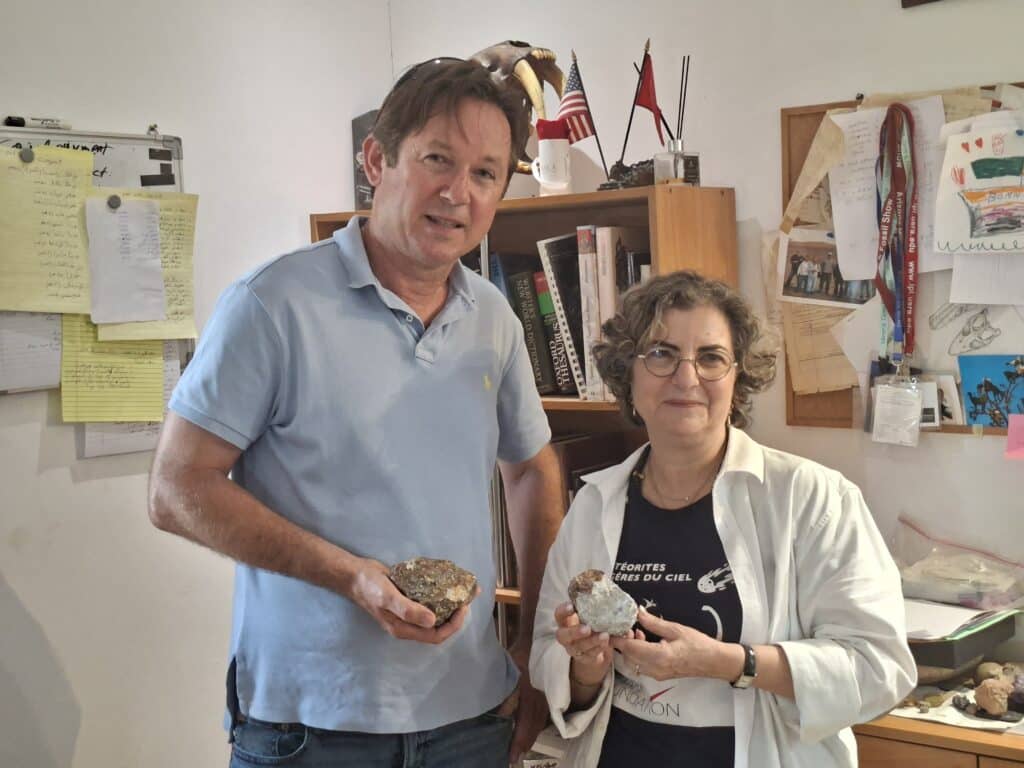
For this occasion, Médias24 went to the field with Prof. Hasnaa Chennaoui Aoudjehane, a planetary scientist, professor at the Hassan II University of Casablanca, resident at the Institute of Advanced Studies (UM6P), and president of the ATTARIK Foundation, along with Adam Aaronson, an international expert in meteorite commerce and research.
The account of the first discoverers of the fall
The first witness, who requested anonymity, is the one who found a part of the meteorite. He was tending a flock of sheep when he heard the sound of an explosion in the sky. According to his statements, the meteorite fell right in the middle of his flock, before they scattered at the sight of the fall.
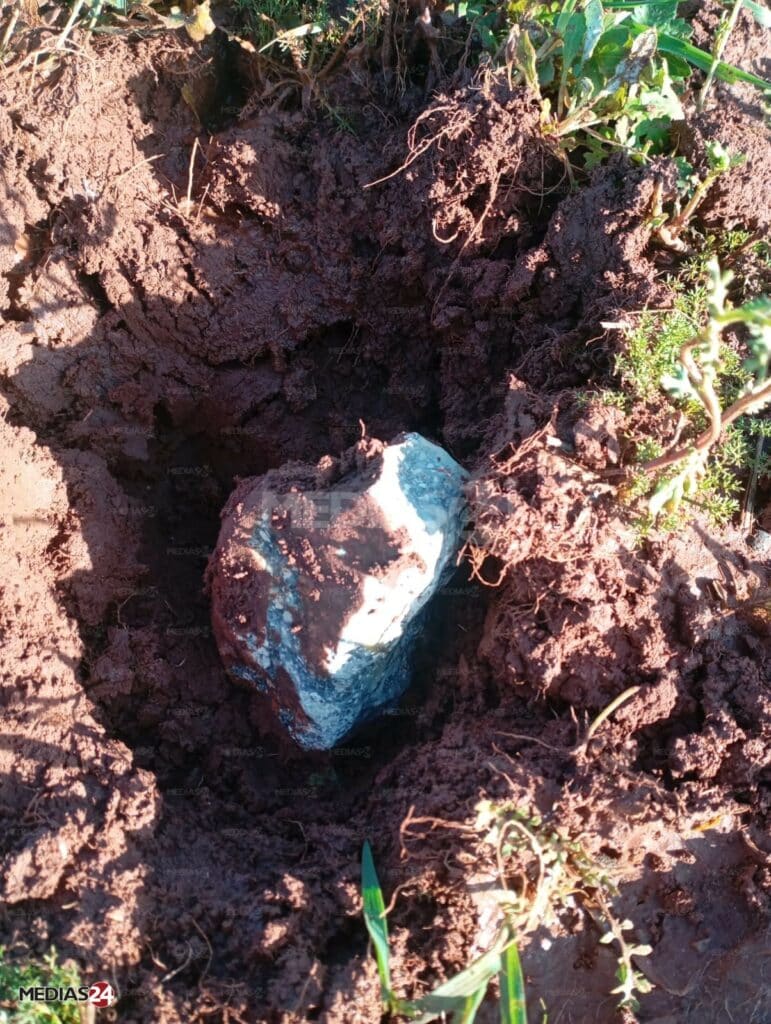
"In all my life, I have never seen anything like this. And you saw that rock, I showed you the photo taken at the moment it fell in front of me... it made a hole," said the witness.
"At that moment, it hadn't even been three minutes since it hit the ground when I photographed it," he added.
"And when I picked it up in my hand, it almost froze it," he pointed out.
On the other hand, a second witness, a shepherd tending a herd of cows only a hundred meters away from the first witness, confirms this testimony, the date, and the location of the incident. He describes the same scenario: the sound of an explosion, then, after a period of time, a fall barely visible to the naked eye.
Other witnesses confirmed hearing a muffled noise, without knowing the origin or location, while others only learned of this event through word of mouth.
For Prof. Chennaoui, the work is just beginning
The first and only Arab expert to have sat on the prestigious Nomenclature Committee of the Meteoritical Society (the body that records all known meteorites), Prof. Hasnaa Chennaoui visited the site of the fall and confirmed the extraterrestrial nature of the find.
"What was reported as a meteorite fall last February has been confirmed: a rock did indeed fall in the Khémisset-Tiflet region. Once this is proven, it becomes essential for me, as an international expert, to go to the field to collect all the information," says Prof. Chennaoui.
This fieldwork is meticulous. "Collecting data, interviewing eyewitnesses, trying to gather as much information and the exact coordinates of the fall... All this information will help us write a report, which is somewhat the family record or birth certificate of this meteorite," she explains.
Now, Prof. Chennaoui is taking charge of studying this new meteorite to classify it and determine its exact origin. However, out of strict scientific rigor, she refrains from publicly confirming the specific type of this celestial object for now.
"As a researcher and expert, I cannot make a statement on that. Yes, I can confirm that it is clearly an achondrite [a meteorite without chondrules, those small mineral spheres typical of primitive meteorites, Editor's note], but I cannot yet say what type it is, even though I have my suspicions," she confides.
This caution is the necessary step before the official announcement of the discovery. "Once we have completed this process, we will make a statement for this observed fall. It will receive a proper description, following the rules of the art, which will give it the recognition it deserves globally, just like all the observed falls that we have had the privilege to classify and declare," concludes Prof. Chennaoui.
Adam Aaronson: an exceptional find, according to initial observations
For his part, Adam Aaronson, an expert and leader of a company specializing in meteorite import-export — authorized by the supervisory ministry —, believes that this is a find of great scientific interest.
"I have indeed acquired a sample, but there is then a rigorous process to follow. First, we need to involve a scientific committee, preferably Moroccan in my case, to assist us in the certification and documentation of the meteorite," explains Mr. Aaronson.
To prove the economic value of the find, Adam first invests in the classification of this meteorite. This process starts with fieldwork involving the collection of testimonies, followed by very detailed geochemical analyses, including oxygen isotope analysis, before being submitted to the Nomenclature Committee of the Meteoritical Society.
Currently, after acquiring the samples and conducting documentation work in the field, geochemical analyses are ongoing.
"In the end, the nomenclature committee decides: either you have covered all the necessary points for classification, or something is still missing. They approve it in a way. And at that point, it is given a name. Generally, it is the name of the nearest village or town where the rock fell. And then it is classified. It is given a name like Tissint, Tirhert, Tarda... these are the names of the nearest village, geographical point. Sometimes it's a hill, a mountain... a side point... it depends," adds our interlocutor.
From the preliminary examination by Adam Aaronson, he also believes it is an achondrite and not an ordinary chondrite, which contain chondrules.
"From what I have observed, it is a very interesting specimen. What I am saying is speculative, but it is speculation based on over twenty years of experience in meteorite commerce," he points out.
"It is undoubtedly an achondrite, I am 100% sure of that. It is not a normal chondrite. Pending the results of the analyses, and based on the visual observation of the samples, I lean towards an Aubrite or an Eucrite. I would say that the probabilities tend 50% towards an Aubrite, 40% towards an Eucrite, and 10% towards an 'ungrouped' meteorite," he explains.
The family of achondrites is as diverse as it is fascinating. The most common are the HED (Howardite, Eucrite, Diogenite), which mostly come from asteroid Vesta. There are also Martian meteorites (like the one fallen in Tissint) or lunar meteorites (none of which have been discovered in Morocco yet).
As for Aubrites, they remain exceptional. To date, the meteorite from Tiglit, fallen in 2020 south of Guelmim, was the only observed fall of this type in Morocco. Interestingly, another meteorite identified as an Aubrite fell very recently in Germany, near Berlin, only a month after the Khémisset-Tiflet event.
Why did it take so long for the Khemisset meteorite to emerge?
Indeed, there is a long delay between the meteorite fall and its discovery by the population. For Adam Aaronson, who discovered the information on March 20, 2026, this delay is entirely normal, due to the absence of people with a connection to meteorites in this region, unlike the southeastern part of Morocco where a large part of the population is constantly engaged in this research activity.
This event highlights the importance of meteorite hunters for Moroccan scientific research and for income-generating economic activities. "Morocco is fortunate to have such an active community; otherwise, many falls would have been ignored and lost forever. We probably have the largest community of meteorite researchers in the world," emphasizes the expert.
In the field, these prospectors collaborate very responsively with researchers. "In the end, it's a win-win situation: from the museum to the collector, through the scientist, everyone benefits. If there wasn't this field community to search for and find the rocks, scientists would have nothing to study," insists Adam Aaronson.
Additionally, what could have also accelerated this discovery is a network of detection cameras. With an investment in a sophisticated camera network, the meteorite would have been found much earlier, allowing for an exact count of how many pieces there could be and in which area to search.
What scientific interest does this observed fall hold?
"Observed falls" refer to meteorites whose passage through the atmosphere was witnessed by eyewitnesses and which are recovered shortly after impact.
This rapid collection is important for scientists. "Working on observed falls is very interesting because it is fresh material, just arrived from space, and has not stayed on Earth to undergo terrestrial alteration," emphasizes Prof. Chennaoui.
The scientific stakes are even higher when dealing with rare specimens. "As was the case with the Tissint meteorite, which is a Martian rock, and only the 5th observed fall of this type in the world. An exceptional discovery, as access to a very fresh rock has provided countless information about the surface of the planet Mars," she recalls.
In Morocco, the first observed fall that benefited from this rigorous approach (fieldwork, classification, and official declaration) is that of the Benguerir meteorite, fallen in broad daylight on November 22, 2004. This event acted as a real catalyst. It not only paved the way for the systematic classification of Moroccan meteorites but also energized a very active local community in the search for these rocks.
Thanks to this synergy between meteorite hunters and scientists, Morocco now stands out as the country that has recorded the largest number of observed falls in the world over the past 25 years.
Recall of Moroccan law on meteorite collection
In Morocco, the collection and commercialization of meteorites are subject to a renewable authorization every five years from the Department of Geology, as specified in Article 116 of Law 33.13 and Decree No. 2-18-968.
Regarding meteorite exportation, it is allowed with a receipt from the Geological Department required by the customs administration (Circular No. 6014/311). In return, the exporter must provide an identification card as well as a sample of the meteorite intended for commercialization or export.
The sample provided to the administration must weigh 20 grams if its total mass is less than 1 kilogram and 40 grams if it is more. Pre-decree consultations concluded that these samples should be given for scientific research purposes to the said Department.
While awaiting the grand project National Museum of Archaeology and Earth Sciences, a large-scale project planned in the capital, Rabat, the observation of all observed falls in Morocco is possible at the expo-museum "Meteorites: Messengers from the Sky, ORIGINS" of the ATTARIK Foundation in Casablanca.

à lire aussi

Article : Coupe du monde 2026. Qualification héroïque du Maroc face aux Pays-Bas (1-1, 3 t.a.b. à 2)
Menés à un quart d’heure du terme, les Lions de l’Atlas ont trouvé les ressources mentales nécessaires pour égaliser grâce à Issa Diop, puis éliminer les Oranjes lors de la séance des tirs au but, dans la nuit du lundi 29 au mardi 30 juin, à Monterrey, au Mexique. Yassine Bounou et Ismaïl Saibari ont propulsé le Maroc en huitièmes de finale face au Canada, samedi 4 juillet à Houston.

Article : Coupe du monde 2026. Centième sélection pour Achraf Hakimi face aux Pays-Bas
Le capitaine des Lions de l’Atlas portera le maillot du Maroc pour la 100e fois de sa carrière, dans la nuit du lundi 29 au mardi 30 juin, face aux Pays-Bas, en seizième de finale de la Coupe du monde 2026. Titularisé par Mohamed Ouahbi, Hakimi n’est plus qu’à 15 sélections d’égaler le record de Noureddine Naybet.

Article : GMT, interdiction du démarchage, IA : la triple peine de l’offshoring marocain
Longtemps porté par les donneurs d’ordre européens et les centres d’appels, le secteur de l’offshoring au Maroc doit désormais composer avec des horaires à réorganiser, des appels commerciaux de plus en plus encadrés en France et des tâches que les logiciels commencent déjà à automatiser. Les grands opérateurs invoquent l’adaptation et la montée en gamme, tandis que les syndicats redoutent moins d’embauches et davantage de postes supprimés.

Article : Maroc-Pays-Bas : les cafés pourront rester ouverts pour diffuser le match
Selon Ahmed Bifergane, coordinateur de la Fédération nationale des propriétaires de cafés et restaurants, aucune interdiction n’a été émise par les autorités pour la nuit du lundi 29 au mardi 30 juin.
Article : Défense : les F-16 marocains concernés par un nouveau contrat américain sur les missiles AMRAAM
Attribuée à Raytheon pour 398,6 millions de dollars, l’enveloppe porte sur des travaux liés au système D4/C9, avec une échéance fixée à décembre 2027. Le Maroc figure parmi les pays partenaires du dispositif FMS, aux côtés notamment des Émirats arabes unis, de l’Arabie saoudite, du Japon, d’Israël et du Royaume-Uni.

Article : My Education lance “MY WAY”, un programme dédié aux compétences du XXIe siècle
Destiné aux jeunes de 9 à 16 ans, le dispositif combine des activités régulières, des bootcamps, des stages immersifs et des interventions en milieu scolaire.