
Floods and heavy rains: damage to farms, gains for water reserves
After rainfall topping 200 mm, floods swept through several farming regions, destroying crops, livestock and blocking access to land. While the downpours replenished water reserves, experts warn of immediate losses and say agriculture remains ill‑prepared for extreme climate shocks.
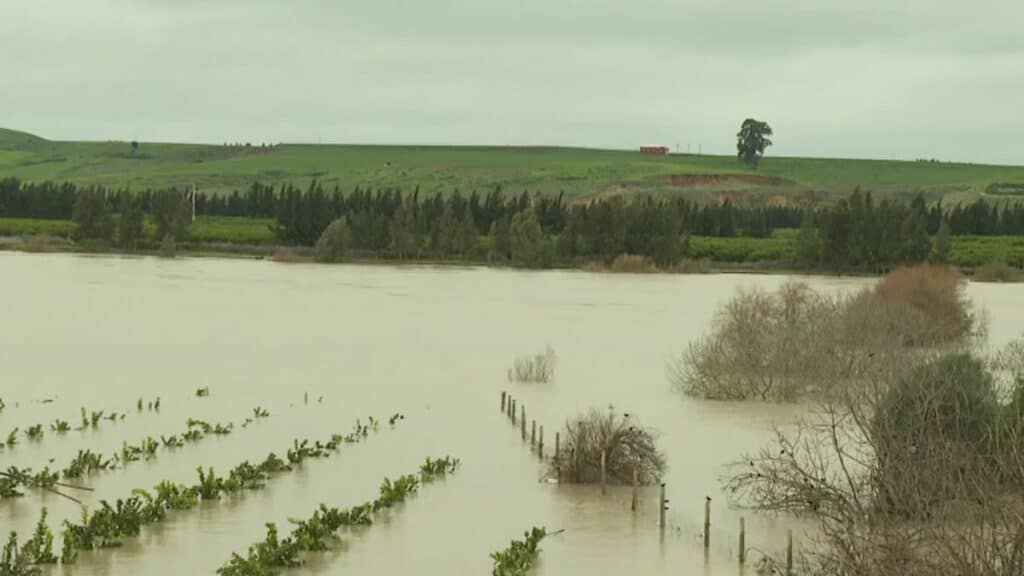
Recent heavy rainfall in parts of Morocco, with accumulations above 200 mm, has caused major damage in agricultural areas, particularly around Sidi Kacem and across the Gharb region.
Floods have submerged farmland, destroyed crops and caused losses in sheep herds. Videos shared on social media show farms under more than a metre of water and fields left devastated.
Agricultural experts warn that flooded rural areas remain difficult to access, complicating emergency response, crop protection treatments and harvesting.
Direct impact on crops and labor
According to agricultural expert Riad Ouhtita, these episodes are part of the climatic reality of a country in a semi‑arid zone, marked by a natural alternation between droughts and heavy rains. While precipitation has clear positive effects on dams and water resources, it can also bring serious consequences for farmland.
Excess water promotes fungal diseases in saturated soils and makes farm access extremely difficult.
In several vegetable‑growing areas, workers cannot enter waterlogged plots to treat or harvest crops such as potatoes, onions and carrots.
This logistical constraint helps explain why consumer prices do not immediately reflect abundant rainfall. Some crops are lost, others remain stuck in the fields, and labour shortages add to the strain.
The expert highlights the growing role of mechanisation and smart farming, including moisture sensors and drones that can treat crops without direct access to fields—an evolution driven by climate variability.
Agricultural losses, water gains
On the other hand, Taher Srairi, a professor at the Hassan II Agronomic and Veterinary Institute, says that despite localized damage, the rains are broadly beneficial for a country emerging from several years of severe drought. They help to:
- restore vegetation cover
- recharge overused aquifers
- bring back pastures for livestock
- support a gradual return to agricultural normality
In the Gharb, however, floods have severely affected high-value export crops such as avocado, strawberry, or raspberry, resulting in significant economic losses.
But the expert notes a capacity for seasonal recovery, with spring crops including sunflower and rice expected to benefit from the current water abundance.
Livestock, floods and the natural cycle of water excess
Floods have also hit livestock in the plains of Gharb and Loukkos. According to Taher Srairi, these episodes of water excess are part of a natural cycle, with major floods recurring every 15 to 20 years under the combined influence of the Rif and Middle Atlas, regions that generate heavy rainfall.
Beyond the immediate assessment, the central issue now is prevention. Key measures include:
- developing watersheds
- reforesting upstream to slow water flow
- preserving vegetation cover to limit the intensity of downstream floods
Deforestation in some mountain areas accelerates water runoff to the plains, amplifying floods.
More broadly, these events highlight the challenge of adapting public policy to climate change. Rising temperatures, longer droughts and extreme rainfall are shocks even advanced economies now face. For Morocco, the question is strategic: do agricultural, forestry and development policies fully account for this new climatic reality?
While the recent floods have caused real and sometimes spectacular agricultural losses, they also underscore a structural reality. In an increasingly volatile climate, the challenge is not only water scarcity but also managing its excess.
Between isolated destruction, medium‑term water gains and the need for adaptation, Moroccan agriculture is entering a phase where climate resilience has become central to its sustainability.
READ ALSO
De la pluviométrie aux intempéries : quand le retour de l’eau expose à de nouveaux risques

à lire aussi
Article : Aïd Al Adha: Le gouvernement réagit enfin à la flambée des prix du mouton
Une réaction tardive mais nécessaire. À une semaine de Aid Al Adha, les marchés sont désormais livrés à la surveillance des autorités locales qui devront veiller au respect des circuits de commercialisation et combattre les pratiques spéculatives.

Article : Bilan de fin de saison. Fortunes diverses, mais dynamique positive pour les internationaux marocains
Alors que la majorité des championnats touchent à leur fin, les internationaux marocains ont pour la plupart signé des saisons de haute volée. Un constat qui s’applique également à ceux qui n’ont rien gagné, mais dont les prestations ont été unanimement saluées. De bon augure en perspective du Mondial 2026.
Article : Criquets pèlerins aux portes du Souss : quel risque pour l'agriculture ?
Ils sont jaunes, parfois rosâtres, et inquiètent les agriculteurs du Souss. Des criquets pèlerins ont été observés à proximité des champs agricoles de Chtouka Aït Baha. Voici ce qu'il faut savoir sur la situation.

Article : En 2025, l’aggravation du déficit extérieur en biens et services retire 3,8 points à la croissance
Au-delà de la sécheresse, la croissance au Maroc est aussi affaiblie par une fuite importante de la demande vers les importations. En 2024, le solde extérieur a retiré 2,5 points à la croissance. En 2025, selon nos calculs, cette perte atteint 3,8 points. Une partie de l’effort d’investissement et de consommation se transforme ainsi en production étrangère, plutôt qu’en valeur ajoutée locale.

Article : Et si on regardait la Bourse de Casablanca hors minières ? Ce que les minières changent dans la lecture du marché
Avec plus de 11% du MASI et une contribution de +656 points de base depuis le début de l’année, les minières prennent une place centrale dans les mouvements de la Bourse de Casablanca.
Article : SkyStriker : le drone “précis, silencieux et mortel” rejoint l’arsenal des FAR
Précis, silencieux et dopé à l'intelligence artificielle, ce nouveau vecteur de frappe à bas coût renforce considérablement la résilience et la réactivité du dispositif de défense marocain.